


In Punjab, there is a well-known and fascinating saying: “The dialect changes every 12 kos.” This is not just a phrase, but a reflection of reality. If one travels from one end of Punjab to the other, they will notice that not just the accent, but also the vocabulary, pronunciation, and style of speaking keep evolving. This very change is what makes Punjabi a living, vibrant, and engaging language.
Punjabi is not just a language; it is deeply connected with people’s emotions, relationships, and everyday life. That is why, wherever people change, the dialect naturally takes on a new shade.
A Rich Legacy of Punjabi Dialects
If we look deeper, Punjabi is not a single uniform language but a vast network of dialects. It is believed that more than 25 dialects exist across Punjab, each spoken in different regions. Every dialect carries its own story, emotion, and identity.
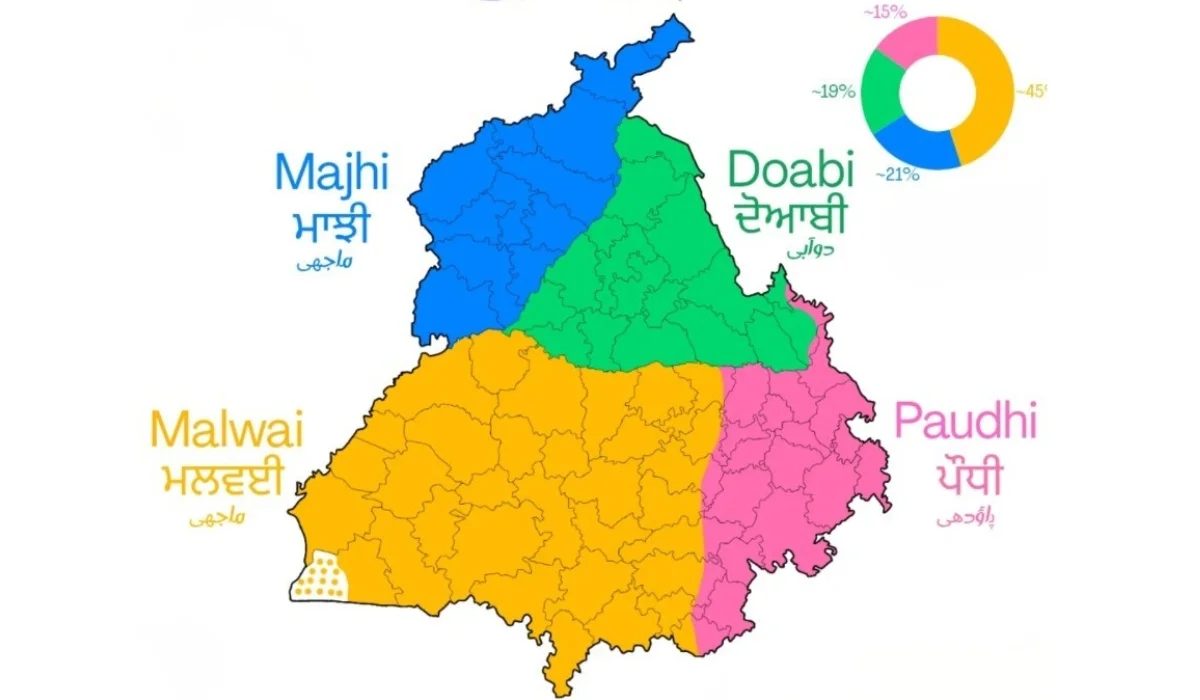
These dialects are not just linguistic variations, they reflect Punjab’s history, culture, and ways of life. In earlier times, people settled around rivers, so dialects also evolved along geographical lines. This is why Punjabi is broadly categorized into four major dialect groups, each maintaining its distinct identity even today.
Majhi Dialect: Clarity and Standard Form
The Majhi dialect is often considered the standard form of Punjabi. It is spoken in the Majha region, including areas like Amritsar, Tarn Taran, and Gurdaspur. The Punjabi we hear on television, news platforms, and in books is largely based on Majhi.
Its key feature is clarity and balance. It is easy to speak and understand, which is why it is often referred to as “pure Punjabi.” There is also a certain seriousness and structure in this dialect that sets it apart.
Doabi Dialect: Sweetness and Softness
The Doabi dialect is spoken in the region between the Beas and Sutlej rivers, known as Doaba. Areas like Jalandhar, Hoshiarpur, and Kapurthala are its core centers.
This dialect carries a distinct sweetness and softness, making it very appealing. Slight variations in pronunciation give it a unique identity. When someone speaks Doabi, there is a gentle rhythm in their speech that reflects warmth, not just in language but also in the nature of the people.
Malwai Dialect: The Largest Spoken Region
Malwai is spoken in the Malwa region, which is the largest geographical part of Punjab.
It is widely used in areas like Ludhiana, Patiala, Bathinda, Moga, and Sangrur. A notable linguistic feature of Malwai is its distinct pronunciation of future tense verbs, which differentiates it from other dialects.
This dialect feels open, direct, and closely connected to everyday life. It is also widely used in Punjabi songs and folk culture, making it highly influential.
Puadhi Dialect: A Blend of Cultures
Puadhi is spoken in the southeastern part of Punjab and extends into Haryana, Himachal Pradesh, and Chandigarh.
It represents an interesting blend, influenced not only by Punjabi but also by neighboring regional languages. Its vocabulary and grammar include elements that make it distinct from other Punjabi dialects.
Puadhi is proof that language never exists in isolation—it constantly evolves through interaction with surrounding cultures.
Dialect and Geography: A Deep Connection
To understand Punjabi dialects, one must understand geography. Rivers, regions, and settlement patterns shaped how different dialects evolved.
Majha, Doaba, and Malwa are not just geographical divisions; they are linguistic identities. Linguistic studies also confirm that Punjabi dialects have developed regionally and have evolved over time.
Changing Forms in Modern Times
Today, with the influence of social media and urban lifestyles, standard Punjabi is becoming more dominant. This helps create a shared understanding among people, which is positive.
However, it is also true that many people are gradually drifting away from their native dialects.
In this changing phase, it becomes important to stay connected to our roots. If we continue speaking our native dialects at home, with elders and children, this heritage will naturally pass on to future generations.
Conclusion: Different Shades, One Identity
In the end, the beauty of Punjabi lies in its diversity. Whether it is Majhi, Doabi, Malwai, or Puadhi, each dialect brings its own color.
Together, they form the complete identity of Punjabi—a language that is not just spoken, but lived.
Leave a Comment