

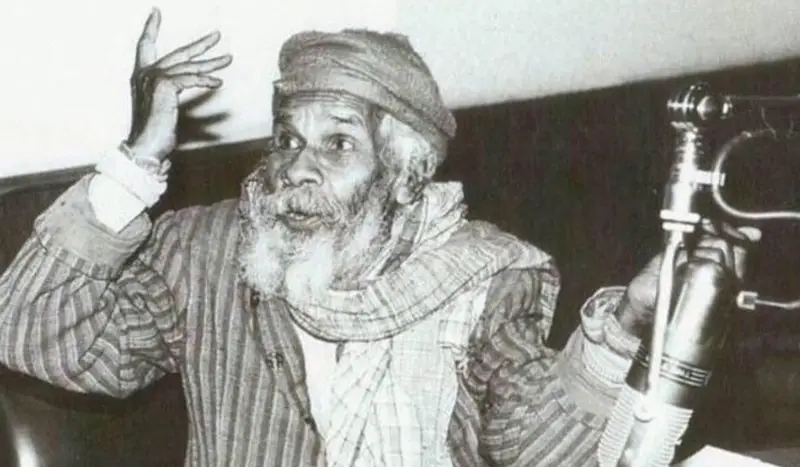

Baba Nagarjuna, considered one of the greatest contemporary writers of the Hindi language, set out on a journey to the Sindh province in the early 1940s. During this long journey, he observed and examined life there closely, and also did menial jobs to earn a living.
Nagarjuna stayed there for 17 months. For a few days, he served as the headmaster of a local Saraswat Brahmin school. Later, he was appointed as the editor of Qaumi Boli, the flagship magazine of the Rashtra Bhasha Prachar Samiti of Sindh there.
He also wrote his memoirs in the form of a magnificent travelogue, which was published in the newspaper Hunkar on December 23 and 30, 1945. In this important prose, Baba has recorded many intimate and important details about Sindh of that era. He writes: “According to the 1941 census, the population of Sindh province is 4.5 million, of whom 1.1 million are Hindus. The religious nature of the population is mainly Sufi and Nanakpanthi. An Arabic text from the 8th century Shahnama shows that, at that time, people of both Buddhist and Brahmin cultures lived there. The Arab invasion of Sindh was led by Muhammad bin Qasim in 692 AD. Since then, the influence of Islamic sentiments has been felt in this land. Fed up with the feudalism of the Miras, Kalahars and Nawabs, the local population migrated to Rajputana, Gujarat and Punjab and vacated the fertile lands of the Indus River for the newcomers. They had to abandon the sword and resort to the scales. This is the reason why the civil life of Sindh has become Hindu-dominated today.”
In Sindh at that time, the teachings of Guru Nanak Dev Ji resonated equally easily with people of other religions besides Sikhs and Hindus. Due to the widespread Sufi tradition in the land of Sindh, most Sindhis had adopted the same liberal mindset advocated by the founders of Sufism.
According to Baba Nagarjuna, if a Sindhi was asked whom he believed most, he would immediately recite a verse of Guru Nanak Dev Ji and then recite two lines of Shah Abdul Latif. Shah Abdul Latif’s fame in Sindh is comparable to that of Goswami Tulsidas in North India.
This travelogue tells how Sindhi Muslims bowed their heads before temples, Varuna Chaityas and gurdwaras, and how Sindhi Hindus bowed their heads with equal reverence at the shrines of saints. In Sindh, religion did not build walls, but opened paths. Baba further recites a couplet by the eighteenth-century Mast Fakir, Sachal Sarmast:
Ah Ruhu Mukhi Jo Arab Jo Ai Khaki Hinduji
Ahmad Milyo Hute Ta Hiti Shyam Milyo Ah
Meaning – My soul is of an Arab and my body is of a Hindu. If Muhammad is found there, then Shyam is found here
Sindh at that time was a region where communal riots did not take the violent form in Sindh as in other Indian states. Baba Nagarjuna often saw Hindu devotees dancing in unison in the fairs held at the religious places of saints. Multan was once under Sindh.
The Sindh saint Udero, also known as Lal, is considered an incarnation of Varuna, and Varuna is as revered in the Asura civilization as Indra is in the Vedic civilization. The remains of the Asura civilization have been found in Mohenjo-Daro in Sindh and Harappa in Punjab. Baba Nagarjuna saw the water-worship tradition of those civilizations prevalent in the nearby Multan areas and after researching, he found that a whole sect of water-worshippers had come into existence in Sindh, which was called Daryapanth.
Interestingly, many Muslims also actively participated in the worship of Varuna. They also had an interesting tradition of addressing the Indus River with the respectful name Daryashah.
Considered by most readers to be a great poet, the travelogues and memoirs of Baba Nagarjuna prove him to be a great traveler and an even greater explorer, within whom we get to read unique accounts of our continent. This article of his written on Sindh is as fascinating and important as his poetic works.

Leave a Comment