

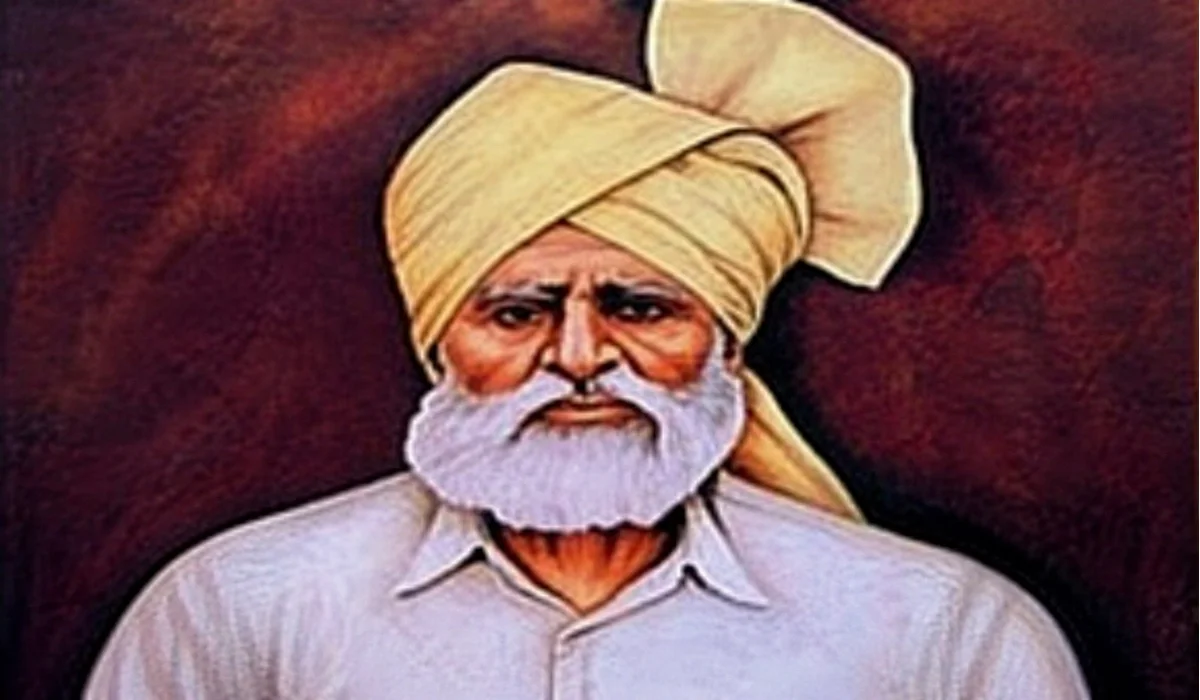

The phrase “Malwa Desh” may sound unfamiliar, but in the history of this region’s unique poetic tradition, elders gave this land the status of a “desh”, a country of its own. The grief of the daughter who cries, “Jangal desh na viaheen meri maa,” and the pain of her brothers and father, have been preserved most beautifully in the folk-poetic tradition of kavishri.
Whenever I learn about Malwa’s kavishri tradition, I feel as if I am watching a rainbow stretch across the sky after a rain shower. Whether it is the kavishri of Bhai Bhagwan Singh of Mehraj, Karnail Singh Paras Ramuwalia, or Babu Rajab Ali’s kavishri that walks parallel to Kishor Chand Baddowalia’s qissa tradition, it has always left me spellbound.
Babu Rajab Ali lived for a long time near the bridge on the way to Akhara village, close to Jagraon. I suggest that the bridge near Akhara should be named “Babu Rajab Ali Bridge.” Nearly two years ago, I had requested Jagraon MLA Sarabjit Kaur Manuke and engineer-poet Sehajpreet Singh Mangat, who was involved in the bridge’s construction, to seek formal approval from the Punjab government. Sarabjit had agreed; perhaps approval has already been taken. After all, Babu Rajab Ali spent his whole life building invisible bridges from one heart to another through poetry.
I first became familiar with Babu Rajab Ali’s poetry in 1973. Through the joint efforts of Ludhiana-based scholar Dr. Atam Hamrahi and Dr. Rulia Singh Sidhu of Kot Kapura, Gurdev Singh Sahoke’s kavishri troupe presented many colours of Babu Rajab Ali’s kavishri at Punjab Agricultural University, Amritsar. During his visit to Pakistan in 1975, Punjab Chief Minister Giani Zail Singh and noted scholar Dr. Attar Singh met Babu Rajab Ali. A few months later, Rajab Ali bid us farewell.
The poet who wrote “Koi desh Punjabon sohna na” considered Malwa Desh to be the boundary of his Punjab, because while working in the canal department, he had come to know every inch of this land. His sharp observations on its social, economic, religious and communal life can be found throughout his work.
The Punjab Language Department has published selected works of Babu Rajab Ali, and Dr. Atam Hamrahi also edited his writings. In recent years, kavishar Sukhwinder Singh Sutantar of Pakka Kalan has taken up the task of editing Babu Rajab Ali’s writings. Through Sangam Publications, Samana, he has so far edited books such as Rangeela Rajab Ali, Babu Rajab Ali De Qisse, Dasmesh Mahima, Ankheela Rajab Ali, Anmol Rajab Ali, Anokha Rajab Ali, Anootha Rajab Ali and Albela Rajab Ali.
Another collection of Rajab Ali’s work has also been prepared by kavishar Sukhwinder Singh Sutantar. It includes Guru Arjan Dev Ji Di Shahadat, Qissa Jang Mahabharat, Bahadari Qissa Bibi Harnam Kaur, Qissa Harphool Singh Soorma and Qissa Kalian Wali Heer.
When Babu Rajab Ali presents these episodes, he never abandons folk tradition. While writing about Guru Arjan Dev Ji’s martyrdom, he uses folk references beautifully to build the atmosphere. Look at his style in the second stanza:
Chandu magar hakoomat te afrevaan dhan da hai.
Gur nu dassda mori aap chubara banda hai.
Chhad ke mang farzand di bahuti kari daleri gaye.
Tapdi tavi te Guru Arjan beh ke mala feri gaye.
Kesi garam bareti geran sikhar dupairian nu.
Dil tharda hikk tapdi lagda sek muchhairian nu.
Balihare hikk kadd ke roki zulm haneri gaye.
Tapdi tavi te Gur Arjan beh mala feri gaye.
While writing this, Babu Rajab Ali forgets that he was born in a Muslim household. In truth, in the times when he stood face to face with history and wrote this qissa, the fever of religious division had not yet risen so sharply. Before Partition, for Hindus, Muslims, Sikhs and Christians, the third enemy was the white colonial ruler. He was the adversary. Babu Rajab Ali’s pen wrote about the martyrdoms of freedom fighters like Shaheed Bhagat Singh who fought against him.
Standing on the ground of the patriotic atmosphere of his own time, when he looks at history, Guru Arjan Dev Ji’s martyrdom inspires him to make it the foundation of his writing. Because of his mastery over different poetic metres, his poetry gains richness, variety and expressive power. This is why even today, in Malwa Desh, there may be more than 200 kavishars who sing Babu Rajab Ali’s work. His songs have been sung by seasoned singers like Mohammad Sadiq and by newer melodious voices like Satinder Sartaaj.
While writing Qissa Jang Mahabharat, Babu Rajab Ali introduces us to every grain of Punjab’s soil. As he opens the old pages of history, he narrates the story as if everything is happening before our eyes, as if he himself were present in the battlefield of Kurukshetra during the Mahabharata war. See these lines:
Kehan lagge maapian nu viah ke dobti.
Pando bali laige jitt ke Daropati.
Bhisham Pitama ne manga ke potian nu.
Meve vande roran ton utha ke totian nu.
Addh raaj vandta Dharitt taaye ji.
Dukh-sukh karde bhra de jaaye ji.
Aje kharhi Pando di nishani theek hai.
Inder Prast Dilli de nazdeek hai.
Kandh naal vajjia tarakk matha ji.
Pakki kandh mathe ’chon chatak latha ji.
Aakhdi Daropati kare ki andha ji.
Kandhin maare takkraan sadaai banda ji.
Babu Rajab Ali had an endless treasure of words. He did not acquire this from books; he learned it from the people’s wisdom. That is why words appear before him like humble petitioners. Even while writing about local heroes such as Bibi Harnam Kaur and Harphool Singh Soorma, he remains rooted in folk knowledge. Listen to the story of Harnam Kaur’s bravery in Babu Rajab Ali’s own voice:
Suneenda Punjab ’chon laraaka Malwa
Ethe maavan lain bachian nu paal vaah
Kaaki Harnami jammi inhan jhaaran di
Marnon darein na vanshaj Bararan di
While describing the bravery of the daughters of this land, he never forgets that he is narrating a tale of courage, not merely the story of a woman. Perhaps that is why he creates an atmosphere of hatred for robbers and respect for the brave daughter. This small glimpse of Malwa’s courage presents the woman as a powerful force. This is the same land where Mai Bhago once challenged her brothers and sons for abandoning Guru Gobind Singh Ji.
While narrating the tale of Harphool Soorma too, he uses folk idiom as if priceless strings of inherited words were waiting for his writing. Different metres change according to the events. The Manohar Bhawani Chhand had never entered my consciousness before. Unless I am mistaken, no one except Babu Rajab Ali used this metre with such fullness:
Peeli haldi ton keeti,
Dukh darji ne seeti, ratt haukian ne peeti,
Sansian ne maarti.
Ghadi-ghadi sau-sau saal di guzaarti.
Dili muddatan ton taanghan, uchi-uchi maare chaanghan, vajjian vairaag saanghan,
Komal sareer de. Tejo galh chimbrhi Dadiaake veer de.
Such pure, restrained and graceful expression of experience is granted to very few poets. Babu Rajab Ali uses words like colours. He brings faces out of different shades. He teaches colours how to speak and move in a living manner. This power comes only to rare creators: that their written words move forward exactly as intended.
We should also examine the possibilities of sociological study within Babu Rajab Ali’s writings. In his work, the land itself speaks, shares its sorrows and joys, and presents the virtues and flaws of its children.

Leave a Comment