


Pride of the Nation – Hari Singh Nalwa
Who was the one who made the Pathana wear salwars?
By scaring whom did the Pathana mothers lull their children to sleep?
That is Hari Singh Nalwa. In fact, Maharaja Ranjit Singh gave the name “Nalwa” to Hari Singh Nalwa. A popular story tells that a small caravan of Maharaja Ranjit Singh was passing through the forest, when a wild beast attacked the caravan, at that time Hari Singh Nalwa put his hand in the tiger’s mouth and tore its jaw with both hands. Impressed by Hari Singh’s courage and strength, Maharaja Ranjit Singh compared Hari Singh to a king of the Mahabharata, Nalla (Nala), who was known for hunting wild beasts and other dangerous animals. It was after this incident that Hari Singh got the name Hari Singh Nalwa (or Nalwa).

The fear of the attacks on Afghans by Hari Singh Nalwa had reached such an extent in Afghans that at that time even Afghan men had started wearing women’s clothing, i.e. salwars, because the Sikh armies did not attack women. Information about these conditions is found in an open letter of Miangul Aurangzeb, in which he believes that his ancestors had adopted the Punjabi women’s clothing (salwar-kameez) to escape the Sikh army.
Similarly, it is said that in those times, Afghan women used to resort to the fear of Hari Singh Nalwa’s name to put their crying child to sleep. In fact, a saying was popular among Afghan mothers at that time, “”Chup Sha, Hari Singh Raghale”, which in Punjab means “Be quiet, Hari Singh is coming”.
The information about these situations is found in an open letter of Miangul Aurangzeb and this incident is also mentioned in Vaneet Nalwa’s book “Hari Singh Nalwa – Champion of Khalsa Ji” and along with this, Dr. S. P. Singh, former Vice-Chancellor, Guru Nanak Dev University, Amritsar, has also confirmed this.
Birth and Early Life
Hari Singh Nalwa was born on 29 April 1791 in Gujranwala, Punjab, on the land of Majha, this area was then part of Sukarchakkia Misl. Hari Singh’s family was already associated with religion and the royal court. It is said that Hari Singh’s grandfather Hardas Singh was also a hero who was martyred in the war against Ahmed Shah Durrani and his forces in 1762. While Hari Singh Nalwa’s father Gurdial Singh Sukarchakia served in the campaigns of Sardar Charat Singh and Mahan Singh. When Hari Singh was about 7 years old, his father Gurdial Singh died in 1798. After his father’s death, Hari Singh started living with his mother Dharam Kaur at his maternal grandmother’s house, where he was taught Punjabi and Persian as well as horse riding, swordsmanship and archery. At the age of 10, Hari Singh was initiated into the Khalsa.
By the age of 12, Hari Singh had started taking on his responsibilities. At first, he began to manage the property. After a gap of about 6 years after his father’s death, when Hari Singh was 13 years old, Mata Dharam Kaur took him back to her in-laws’ house in Gujranwala, where Hari Singh continued his education, horse riding and swordsmanship.
Military service and entry into the royal court
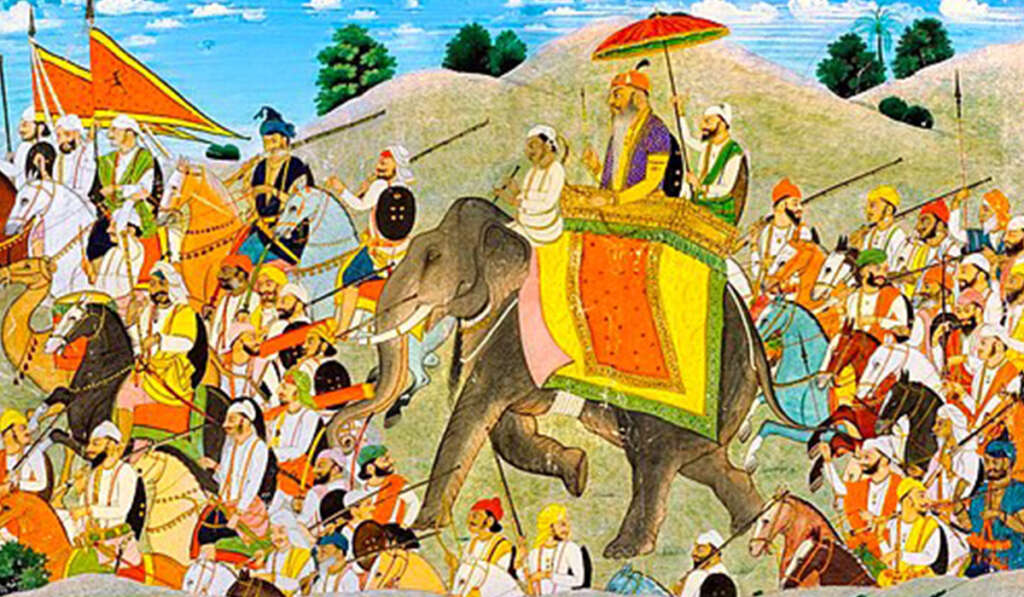
The reason for Hari Singh Nalwa’s immediate presence in the court of Maharaja Ranjit Singh was a property dispute. In 1804, at the age of 14, Hari Singh was sent to the Maharaja’s court by Mata Dharam Kaur for a political hearing. Hari Singh took advantage of this opportunity and presented his case not only on legal grounds but also on the loyalty of his family to the Sukarchakkiya ancestors. He also successfully demonstrated his skills as a good horseman and gunner before the Maharaja. Impressed by Hari Singh’s ability, skill, and background Ranjit Singh ruled in his favor and immediately appointed Hari Singh Nalwa as a personal attendant in the court.
It was only after this that Hari Singh encountered a wild beast during a royal visit to the Maharaja, which he hunted alone, after which Maharaja Ranjit Singh bestowed the title of “Nalwa” on Hari Singh.
(This encounter with the wide beast was confirmed by Hari Singh Nalwa to Baron Hugel, an Austrian nobleman, during one of his visits in 1836)
At that time, Maharaja Ranjit Singh justified the immediate promotion of the young warrior Hari Singh and after this incident, Hari Singh was recognized as a Sardar (leader) and given command of an army of 800 men.
Battle of Kasur and Sialkot
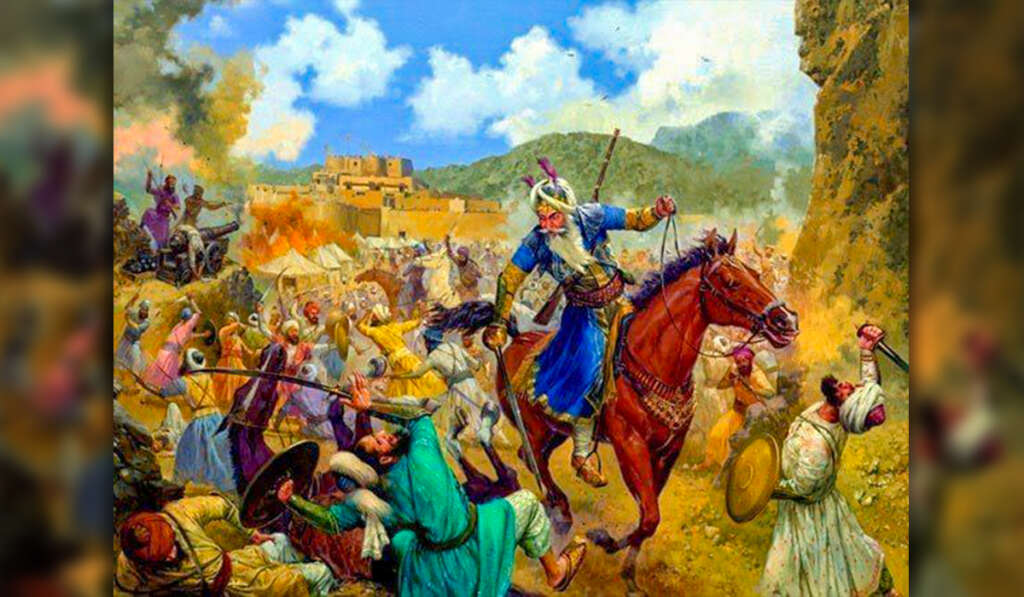
In 1807, at the age of about 16, Hari Singh Nalwa participated in his first important campaign, the Battle of Kasur. Kasur’s proximity to Lahore was a constant threat to the Sikh state, and Kasur was conquered by the Sikhs only in the fourth attempt. At that time, Hari Singh Nalwa laid a three-month siege to defeat the Afghan ruler of Kasur, Qutb-ud-Din Khan. During the siege, Nalwa displayed remarkable bravery and skill. Qutb-ud-Din of Kasur surrendered to Nalwa himself. Seeing this victory and service spirit of Hari Singh Nalwa, the royal court also gave him a jagir (estate) as a reward.
Further confirming the ability of Hari Singh Nalwa, Maharaja Ranjit Singh immediately gave Hari Singh Nalwa the responsibility of conquering Sialkot from the ruler of Sialkot, Jiwan Singh.
In 1807, at the age of just 17, Hari Singh Nalwa first marked the Battle of Sialkot under his command and then, leading the Sikh forces, proudly hoisted the flag of the Khalsa Raj over the Sialkot fort.
Trials of Multan and Attock
Hari Singh Nalwa participated in several campaigns with the aim of conquering Multan, in the year 1810, Hari Singh Nalwa, who was about 20 years old, took the lead in the siege, which was initiated due to the refusal of the Nawab of Multan, Muzaffar Khan, to pay tribute.
It was here that Hari Singh Nalwa, while actively scaling the walls of the Multan fort, was seriously injured by a fiery pot thrown from the fort. Although the Nawab eventually surrendered and paid a large tribute, this serious injury established Nalwa’s reputation as a warrior, who was now fully prepared to endure personal danger and harsh conditions.
About three years after this incident, on 13 July 1813, the Sikh army clashed with the Durrani Empire in the land of Attock, led by Wazir Fateh Khan and Dost Muhammad Khan. Along with Hari Singh Nalwa, generals Diwan Mokham Chand and Sham Singh Attariwala also participated in this battle.
This conflict was significant as the first decisive military victory of the Sikhs over the Durrani, the victory secured the strategically important Attock Fort, the passage across the Indus River, and the adjacent areas of Hazara-i-Karlough and Gandhar. The victory of Attock witnessed the moment when the Sikh Empire had fully transformed into a major power, now aggressively pushing its borders westward and directly challenging the traditional Afghans.

Commander-in-Chief, Architect of the Sikh Empire and Managing the Unstable Frontiers (1818–1834)
After the crucial conquest of Multan in 1818 and the successful conquest of Kashmir in 1819, Hari Singh Nalwa quickly assumed the role of supreme military commander and chief provincial administrator on the most difficult frontiers of the Sikh Empire, the area of his administrative rule being about one-third of the area of the entire Sikh Empire at that time.
Governorship of Kashmir and Economic Reforms (1820–1821)
After a fierce battle in Kashmir on 5 July 1819, which was followed by Diwali-like lights and celebrations in Lahore and Amritsar, Hari Singh Nalwa was appointed the first Khalsa Governor (Subedar) of Kashmir in 1820, he administered the Kashmir region for a little over a year.
Hari Singh Nalwa’s main responsibility was to enforce stability in the territory of the Kashmir state and to consolidate the newly conquered territory. Nalwa established a mint on behalf of the Sikh Empire to streamline the economy and facilitate revenue collection. The silver coins minted during Nalwa’s governorship came to be popularly known as ‘Hari Singhi’. Due to the lasting impact and efficiency of Hari Singh Nalwa’s economic acumen, all Sikh coins minted in Kashmir continued to be popularly known as ‘Hari Singhi’ even after Nalwa’s martyrdom.
Although Hari Singh Nalwa spent little more than a year in Kashmir, it was essential for the Sikh forces to have Hari Singh Nalwa’s leadership and insight to conquer other important fronts.
Securing the Hazara Sikh Frontiers and Urban Planning (1822–1837)
Hari Singh Nalwa was appointed Governor of Greater Hazara in 1822, a role he held until his martyrdom in 1837, during which time he also served as Viceroy of the Western Frontiers.
This tenure was entrusted to Hari Singh Nalwa for the development of major military campaigns and important infrastructure designed to strengthen the Sikh state. During this same period, in 1821, Hari Singh Nalwa achieved a decisive success at the Battle of Mangla, in which he decisively crushed a rebellion led by the Khakha chief Ghulam Ali after crossing the dangerous mountains and the Kishanganga River with 7,000 infantry. At that time, Hari Singh Nalwa’s military strategies were highly praised because Hari Singh Nalwa skillfully combined and implemented both strategies of staying defensive and attacking, even in a challenging and dangerous area.
Significantly, Nalwa attempted to unify the frontier by establishing permanent administrative centres. He planned and built the town of Haripur (near Hazara, now in Pakistan), which still stands as a testament to his visionary vision. The “Harkishangarh Fort”, a testament to the defensive fortifications that surrounded it, became a lasting monument to Hari Singh Nalwa’s might and skill. These structures were instruments of military strategy that helped secure lives, property and communications, ensuring centralized control in a region that was previously prone to chaos and instability.
Consolidation as Commander-in-Chief (1825–1834)
Hari Singh Nalwa was formally appointed Commander-in-Chief on the Afghan frontier in 1825, a position he held until 1837, when he became responsible for extending the Sikh Empire’s frontier beyond the Indus River and to the very mouth of the Khyber Pass.
This phase saw several critical battles fought by Hari Singh Nalwa aimed at maintaining the power of the Sikh state and suppressing tribal rebellions against it, including the Battle of Mankera (1822), the decisive Battle of Nowshera (1823), the Battle of Sirikot (1824), and the Battle of Saidu (1827). Hari Singh Nalwa’s effective command on this turbulent frontier was considered of the utmost importance, reflecting Hari Singh Nalwa’s ability to understand the opposing British forces and to discern potential commercial designs.
Khyber Pass Sentries, Peshawar and Jamrud Resistance (1834–1837)
The northwestern frontier surrounding Peshawar and the Khyber Pass was historically strategically critical as it was the corridor for almost all major invasions into the Indian subcontinent, and Nalwa’s final appointments were specifically made to permanently secure this volatile region.
Governorship of Peshawar (1834–1837)
Hari Singh Nalwa was twice appointed Governor of the Trans-Indus Province of Peshawar (1834–1835 and 1836–1837). Hari Singh Nalwa had already brought Peshawar under Sikh rule in 1818, but in 1834 Nalwa was appointed to raise a separate strong military structure to counter the ever-increasing threats from Afghan and Pashtun armies.
In fact, Hari Singh Nalwa’s administration depended heavily on high-level military supervision. Nalwa not only raised battalions of high-level “Fauj-e-Khas” but also used his own private feudal army to maintain control and order. The control of the Khyber Pass region was considered extremely critical to stabilize the region and prevent external attacks, as the history of the past centuries itself testifies.
Strategic Siege of Jamrud (1836)
The conquest and immediate fortification of Jamrud was the result of Hari Singh Nalwa’s forward offensive policy. In 1836, Hari Singh Nalwa overthrew the Afridi Pashtuns and captured Jamrud Fort. The victory of Jamrud was extremely important as it was located at the very mouth of the Khyber Pass.
Upon taking possession of Jamrud Fort, Nalwa began the construction of a strong permanent fort. This action was seen as a direct threat by the Kabul rulers. Dost Muhammad Khan Barakzai and the Amir of Kabul believed that Nalwa’s advance base at Jamrud was inevitably leading Nalwa to conquer Kabul, which further increased the fear of the Sikh state in Afghanistan. The establishment of Jamrud Fort greatly strengthened the Sikh state’s frontier, which had been the subject of attacks on the region for almost 8 centuries.
The Last Battle of Jamrud and Martyrdom (1837)
In the year 1837, when Maharaja Ranjit Singh was busy celebrating the marriage of his grandson at Amritsar, Afghan forces under the leadership of Dost Muhammad Khan’s son “Akbar” began to mobilize to attack the weakly defended Sikh post at Jamrud. At the same time, Hari Singh Nalwa was waiting for military support from Lahore. It is said that the delay in the arrival of military support was probably due to the court intrigues going on in the Lahore court regarding the successor.
However, Hari Singh Nalwa, seeing the delay in military support, recognized the desperate situation at that time and with the limited army available to him, set out for Jamrud, ten miles away.
A fierce battle was fought on 30 April 1837. The great warrior of the Sikh army, Hari Singh Nalwa, faced the Afghan forces with his limited army and during this battle, Hari Singh Nalwa was seriously injured. From the wounds on his body, Nalwa felt that his time of service was now over. At that time, Hari Singh Nalwa issued a critical and final order to his deputy. The order was that the news of his death should be kept secret until the arrival of the Sikh forces from Lahore.
Hiding the news of Hari Singh Nalwa’s death proved to be strategically crucial. Indeed, for decades, the Afghans had been terrified of Hari Singh Nalwa’s bravery and ability. Hari Singh Nalwa’s prestige among the Afghan tribes was so powerful that even though the Afghans knew that Hari Singh Nalwa was wounded, the Afghan forces were still too afraid to advance without confirming Nalwa’s death. The news of Hari Singh Nalwa’s martyrdom was kept secret for almost a week. This paralyzed the Afghans for more than a week, allowing time for military reinforcements to arrive from Lahore.
Finally, upon the arrival of the Sikh forces from Lahore, the Afghans hastily retreated to Kabul and completely failed to achieve their objective of conquering Jamrud or driving the Sikhs out of Peshawar, thus further strengthening the Sikh state’s frontiers at the Khyber Pass.
Great Legacy and Eternal Inspiration
Although the martyrdom of Hari Singh Nalwa was a profound loss, Hari Singh Nalwa was a warrior who had fought the enemy with the edge of his sword for decades, who had secured several major strategic victories and had greatly strengthened the borders of the Sikh state.
Hari Singh Nalwa’s legacy of military genius, strategic administration, and personal integrity cannot be described in a few words. Hari Singh Nalwa made the impossible possible with his skill, intelligence, and bravery. Nalwa displayed a secular outlook. He provided equal funds for the construction of temples, gurdwaras, and mosques, and also built beautiful gardens in Srinagar and Amritsar. Hari Singh Nalwa also donated a large portion of his personal wealth. After Nalwa’s departure, very little money was found in his personal treasury (Toshakhana). Even his enemies, the Pathan Afghans, respected Nalwa so much that songs were written in celebration of his unparalleled bravery, and his stories are heard even today in the Afghan, Pakistan-India bordering areas.
The high character and bravery of Hari Singh Nalwa will continue to shine in the golden letters of Sikh history for the rest of the world and at the same time, these stories of Nalwa’s passion, selflessness and sacrifice towards his religion and state will continue to be a source of inspiration for the Sikh community in every good and bad time…


Leave a Comment