
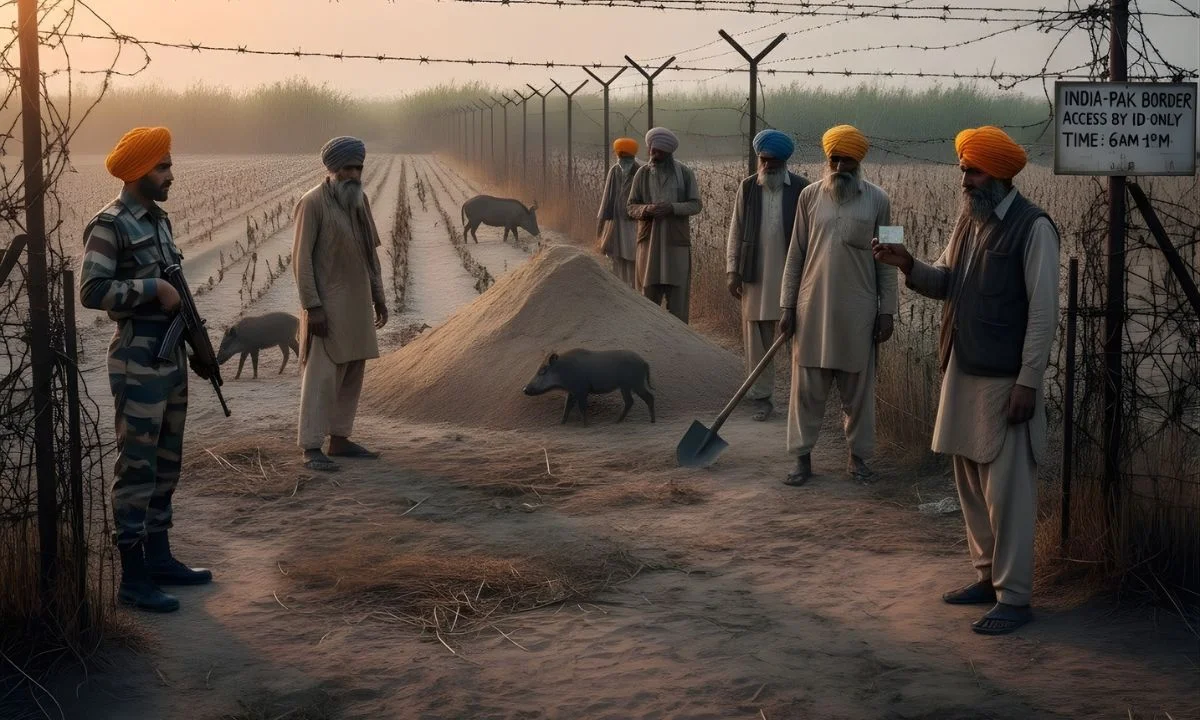

The story of farmers from 6 border districts of Punjab
The barbed wire installed on the Indo-Pak border is certainly saving the people of our country from difficulties, but this barbed wire is a problem for those farmers who go across it every day to farm. The barbed wire passing through 6 districts of Punjab was installed on the border around 1988-90. The governments had given many reasons behind all this. The central and state governments had also decided to give compensation to the farmers per year for farming across the barbed wire.
Of course, the farmers started getting the said compensation after 2000, but the suffering of this barbed wire has been tied to the farmers’ heads forever. Today, the situation is that farmers go beyond the fence to farm, but according to the time fixed by the governments. Farmers are not allowed to do anything beyond the fence as they wish, meaning that farmers can also do farming only as per the instructions of the governments.
Border farmers forced to give up farming
Although the government’s argument is that farmers cannot sow high crops across the barbed wire, now the question of the farmers is that if they are not able to sow high crops there and depend only on wheat and paddy, then it will have a bad effect on their land, as well as they will suffer economically. In the six districts of Punjab (Gurdaspur, Pathankot, Amritsar, Tarn Taran, Ferozepur and Fazilka), which are struggling with problems, the current situation is such that a majority of farmers have been forced to give up farming. Because the expenses of farmers are increasing day by day, while the increase in income is slowing down.
Farming with an identity card
Let us tell you that although the government gave permission to farmers to farm in the lands beyond the barbed wire during the decade of 1988-90, the farmers were told that you can go and farm only by showing your identity card. Apart from this, the identity card was also made by the BSF, which is still made. Even today, those who farm beyond the barbed wire are allowed to set foot in the field only through their identity card and that too according to the time fixed by the government. Farmers can work only 6-7 hours as per government duty beyond the barbed wire, the BSF does not allow farmers to work more than this.
Farming during the day, but at night…
Farming during the day on the lands beyond the barbed wire, but prohibition of guarding at night. In fact, farmers farming on the India-Pakistan border are not only at risk from neighboring Pakistan, but also from wild animals that destroy their crops every day. There are reeds for several kilometers from the Sutlej, Beas and Ravi rivers. Due to the lack of fodder in Pakistan, nilgai, wild boar and other animals enter Indian fields. Farmers work day and night, but their hands are empty during harvest. That is, wild animals destroy the farmer’s crops.
Well, the problem of these farmers does not end here, the farmers who were previously hit by farming alone across the barbed wire were hit more by the terrible floods this time. The damage that these border farmers have suffered this time from floods is the first time since the 80s. Currently, the fields of most farmers have been converted into deserts. Because the fields where farming was once done beyond the barbed wire have now been covered with many feet of sand.
Many questions have arisen that where will the farmers beyond the barbed wire finally remove the sand from their fields and throw it away? The farmers here will dig out the coarse sand from their fields and spread it around, but what will the farmers beyond the barbed wire do? Neither the central government nor the state government is thinking about this.
Let us tell you here that when Punjab Governor Gulab Chand Kataria became the new Governor of Punjab, he visited all the border areas. The farmers had told him about their problems, about which the Governor Sahab had said that you are facing a big problem of farming in the lands beyond the barbed wire on the border, which I understand very well and I will try to solve these problems and make farming easier. To keep an eye on the border, C. T. V. Cameras and anti-drone system will be installed. Talking about compensation for land beyond the barbed wire, Kataria assured that the lands for which compensation is pending will also be released soon after discussing with the central government. He instructed the BSF officials to be present at the gates while crossing the barbed wire and make arrangements to let people pass on time for work.
If farmers are to be believed, crops are being continuously destroyed by wild animals beyond the barbed wire. Apart from this, permission is not being given by the BSF to build electric motors and small sheds. The demands include opening 75% of the gates installed on the barbed wire, allowing water pipes to be laid under the wires, providing timely compensation, increasing the time of the gates, allowing the installation of a three-foot high net along the zero line, and quickly giving farmers permission to install tubewells and borewells across the barbed wire.
If these demands are met, all these problems of these border farmers can be solved. It can be hoped that the promises made by the Governor Sahab to the farmers will be fulfilled as soon as possible and the hands of these farmers will be held soon.


Leave a Comment