

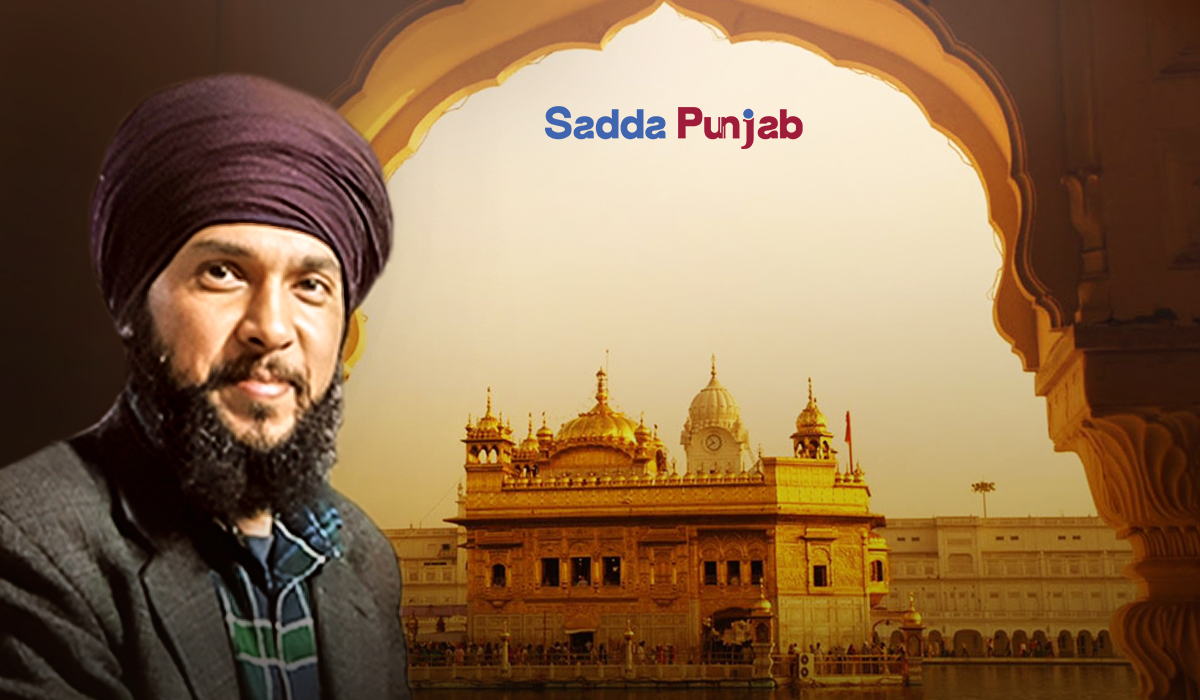

The nearly 200-year-old artistic portrait of Guru Gobind Singh Ji, displayed at Sachkhand Sri Harmandir Sahib, Amritsar, is currently undergoing a careful restoration process. This historic painting was created during the reign of Maharaja Ranjit Singh and holds deep emotional and spiritual significance for the Sikh sangat.
The restoration seva is being carried out by the Guru Nanak Nishkam Sewak Jatha, with active support from the Shiromani Gurdwara Parbandhak Committee (SGPC).
Legacy of the Kangra Style
In the early 19th century, Maharaja Ranjit Singh established contact with Raja Sansar Chand of Kangra. The two rulers already shared cordial relations, and through this connection, Maharaja Ranjit Singh came to know of a portrait of Guru Gobind Singh Ji that had been created during the Guru’s earthly lifetime.
With the intention of installing a similar portrait at Sri Darbar Sahib, Maharaja Ranjit Singh approached the ruler of Kangra. As a result, the grandson of the original artist who had painted the earlier portrait was commissioned to recreate the artwork. That very painting continues to remain on display at Sri Darbar Sahib for the sangat’s darshan.
A remarkable aspect of this legacy is that Balwinder Kumar, who is currently engaged in the restoration seva at Darbar Sahib, is himself a descendant of the same Kangra artistic lineage. Speaking about this heritage, Balwinder Kumar says: “Guru Sahib has given us this opportunity. Everything is happening only by the Guru’s hukam.”
Heritage of Pahari Art
Balwinder Kumar, a native of Kangri village in Kangra district, Himachal Pradesh, holds a PhD in Pahari miniature painting and serves as an Assistant Professor in academia. He regularly travels from Shimla to Amritsar, often on weekends, to continue the restoration work, which began in August 2025.
While speaking to the Sadda Punjab team, Balwinder Kumar explained: “Time is not the primary measure in seva. The work progresses in accordance with the Guru’s hukam.”
According to him, the restoration does not involve modern techniques. Instead, it is being carried out by carefully studying the original methods, including the use of natural pigments and fresco techniques, so that the painting’s authentic form and spiritual radiance (noor) remain intact.
He added: “The restoration follows the exact traditional methods. The Guru Sahib’s noor remains exactly as it was.”
A History of Similar Sacred Service
This is not the first time Balwinder Kumar has been entrusted with such a responsibility connected to Sikh history. In 2021, he also performed the seva of restoring an ancient portrait of Guru Tegh Bahadur Ji at Baba Bakala Sahib.
Reflecting on that experience, he shared: “After completing the seva at Baba Bakala Sahib, when my dumalla was tied, I also stopped trimming my hair.” He clarified that this decision was entirely personal and not made at anyone’s insistence. Balwinder Kumar concluded by saying: “Guru Sahib Himself made us capable and connected us to this seva.”

Leave a Comment