
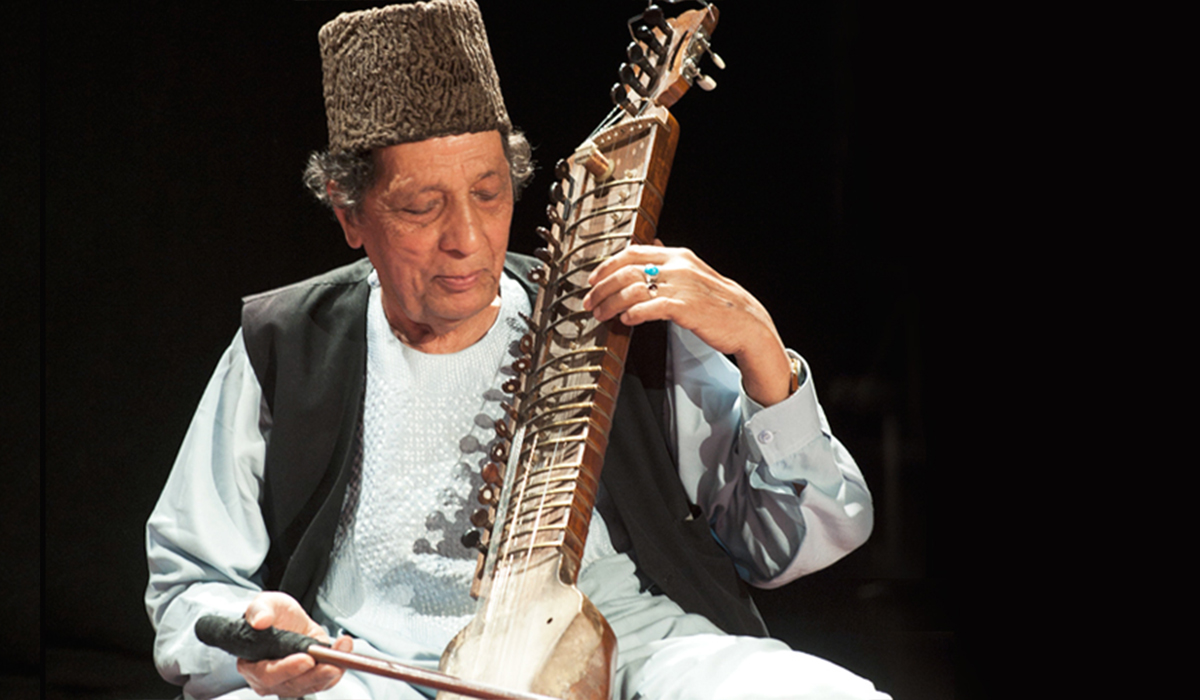

Amaruddin’s father was a musician and owned a shop selling musical instruments in the Afghan city of Mazar-e-Sharif, known for its beautiful Blue Mosque. Noticing his son’s deep interest in music from an early age, he sent Amaruddin to study under Ustad Rahim Bakhsh, one of the country’s most respected ghazal singers. The ustad taught him to play the dilruba.
This instrument, carved from the hard trunk of mulberry trees that grow on mountain heights, traces its roots to Sikh tradition. It is said that three centuries ago Guru Gobind Singh created it, inspired by the mayuri veena. Its design was such that cavalry soldiers in the Guru’s army could carry it easily.
Amaruddin quickly mastered the dilruba and was employed as a staff artist at the national radio station. The Soviet invasion of Afghanistan in 1979 devastated the careers of many traditional musicians, but Amaruddin’s artistry only deepened during this turbulent period. Within fifteen to twenty years, he became the foremost exponent of the dilruba and came to be respectfully addressed as “ustad.”
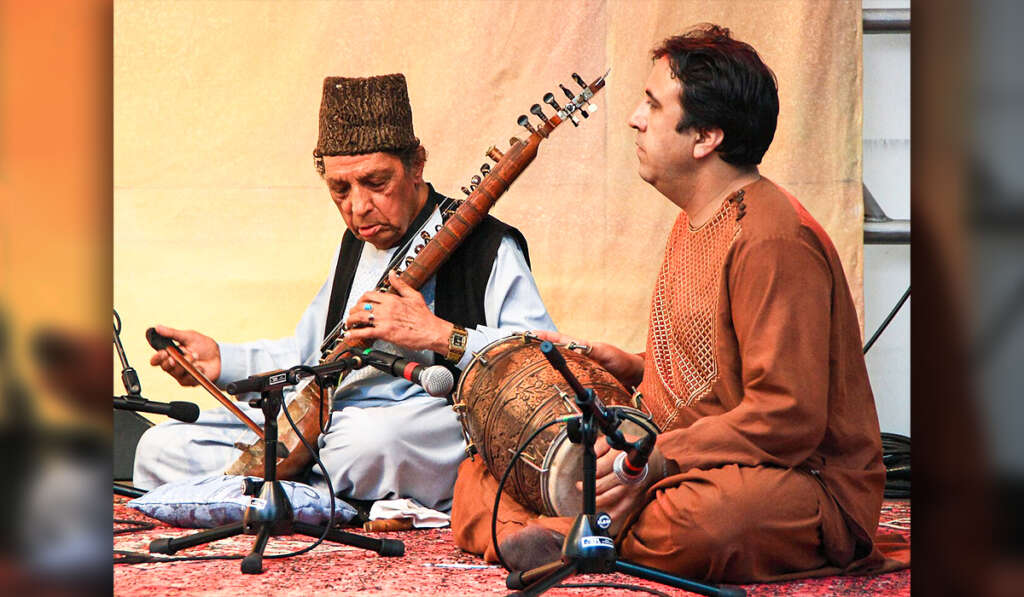
In 1989, when the Mujahideen seized control of the country, severe restrictions were imposed on music. Women were banned from performing, and many musicians were forced to flee. Compelled by circumstance, Ustad Amaruddin was forced to destroy hundreds of rababs, pandurs, dilrubas, and tablas kept in his ancestral shop. Hoping for better days, he buried a few of his favorite instruments underground.
By then he was sixty-six years old. He left Mazar-e-Sharif and moved to northern Afghanistan, believing he might continue his musical practice away from scrutiny. But that proved impossible. To avoid arrest, he had no choice but to leave the country.
He regarded his father as the greatest dilruba player in the world, so he carried that one lone instrument with him into exile. To avoid suspicion at military checkpoints, he removed its strings so it would look like an ordinary piece of wood. For a few days, the journey passed without incident. No one suspected the aging mulberry wood.
But in Herat, a young guard recognized it and hurled it against the car. Before anyone noticed, the ustad slipped a broken fragment of the dilruba into his pocket.
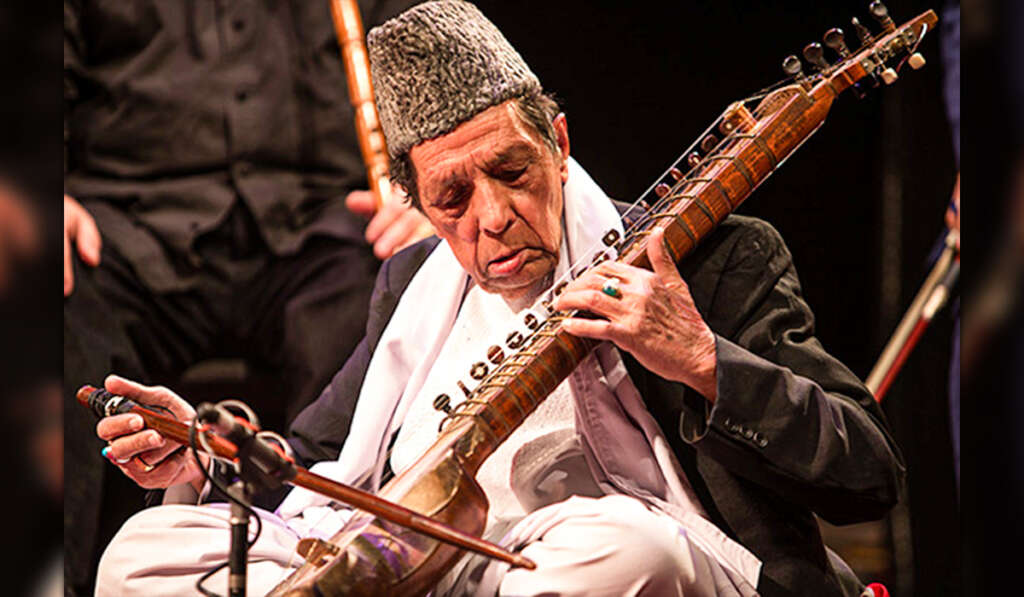
Eventually he reached Peshawar, where thousands of Afghan refugees had already gathered. Months later, he met a young Afghan named Wilayat Khan, whose family had been crafting rababs for centuries. The rabab is believed to have originated in Afghanistan in the seventh century. In the fifteenth century, Guru Nanak’s companion Bhai Mardana incorporated it into Sikh devotional tradition, and those who sang Gurbani with it were known as rababis. (In the film Zanjeer, Pran, playing Sher Khan, is seen playing it in the famous friendship song.)
Wilayat Khan smuggled special mulberry wood from Kharabat in Kabul and crafted a new dilruba for the ustad.
Kharabat was an old Kabul neighborhood where Hindu and Sikh families, along with Afghan musicians, had long lived. At one time, the sounds of musicians practicing all day once floated through the air. Besides Ustad Rahim Bakhsh, it was home to Ustad Mohammad Hussain Sarahang, who integrated the Patiala gharana style into Afghan musical tradition. Sarahang had trained for sixteen years under Ustad Ashiq Ali Khan in Patiala. During the 1990s, bombing between Mujahideen and Taliban forces reduced Kharabat to ruins.
When Amaruddin resumed playing in Peshawar, he was the only surviving master of the dilruba.
In 2001, after the fall of the Taliban, he returned to Afghanistan and began teaching the new generation in his ruined home. Sometimes he even performed small concerts in his courtyard for passersby.
When the Taliban departed, only three instruments remained in Kabul Radio’s studio: a rabab, a sarinda, and a pair of tablas. Among the 125 musicians who returned to Kabul, only one could play the sarinda — a man known as Mashinai.
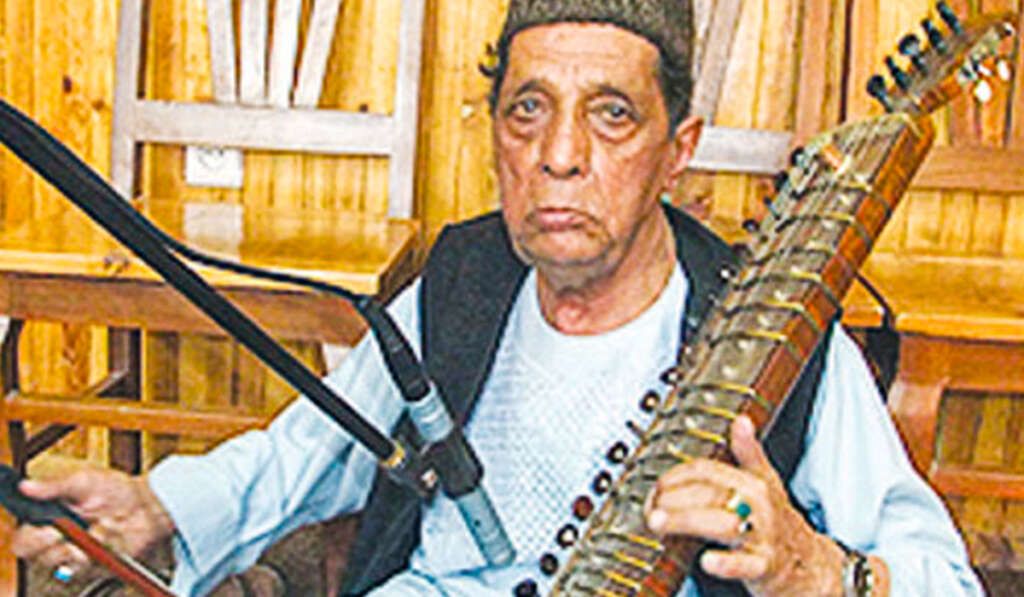
The story behind his name is equally compelling.
Abdul Rashid had learned the sarinda by watching his father play. As a child, he could replicate any melody exactly, like a machine. People began calling him “Mashinai” – the machine.
He did not leave Kabul during Taliban rule. In fighting between Mujahideen factions, his son was killed and his home destroyed. The Taliban smashed all his instruments. For five years, to feed his family, Mashinai worked as a butcher in Kabul’s market.
After the Taliban fell, the lone surviving sarinda at Kabul Radio could only be played by him — because he alone still knew how.
History bears witness: war and hatred always strike first at melody and word.
History also bears witness: melody and word do not die at the hands of power — whether it is Iqbal Bano singing Faiz, or Ustad Amaruddin and Mashinai playing their ragas.
If the ugliness of the world frightens you, keep a dilruba alive within you.
Leave a Comment