
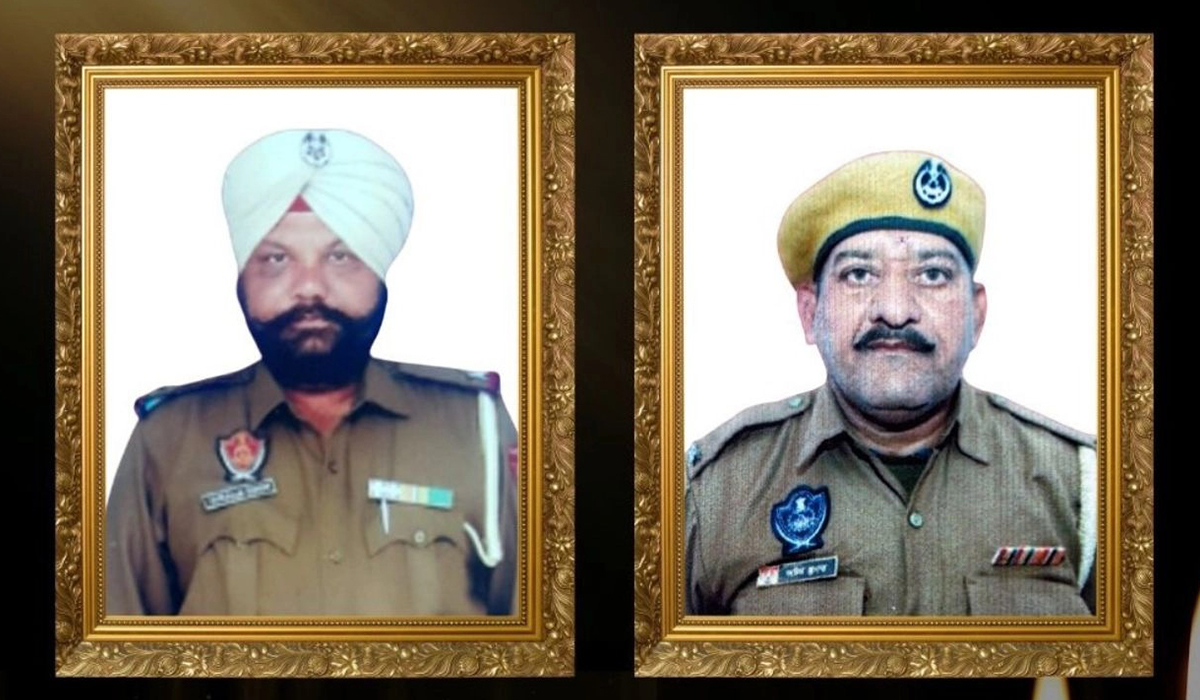

The killing of two police personnel – Assistant Sub-Inspector Gurnam Singh and Home Guard Ashok Kumar – at a border outpost in Punjab’s Gurdaspur district has raised serious concerns about evolving security threats along the India-Pakistan border. The two were found dead with bullet injuries at a police post in Adhian village, barely two kilometres from the international border. The outpost, maintained by the Punjab Police in close coordination with the Border Security Force (BSF), functions as a crucial second line of defence in the sensitive border belt.
Investigations are underway to establish the precise circumstances surrounding the incident. Authorities are also examining claims of responsibility made on social media by a previously unknown outfit, Tehreek-e-Taliban Hindustan (TTH). At this stage, the credibility and origins of the group remain unverified, raising the possibility of either opportunistic propaganda or the emergence of a new proxy front.
The killing of two policemen in such a strategically sensitive location constitutes a grave provocation. It inevitably evokes memories of past cross-border attacks in the region. In April 2025, a BSF personnel was injured in an IED blast along the border. Earlier, on July 27, 2015, Pakistan-based terrorists attacked the Dinanagar police station in Gurdaspur, followed by the assault on the Pathankot Air Force Base on January 1, 2016. These incidents underline the district’s persistent vulnerability to cross-border militancy.
Political reactions have also reflected the seriousness of the episode. Gurdaspur MP Sukhjinder Singh Randhawa has demanded a Home Ministry inquiry, warning that Pakistan-based and Pakistan-oriented extremist organisations were seeking to exploit the incident for propaganda. In a letter to Union Home Minister Amit Shah, he noted that such messaging mirrors recent patterns of cross-border terror propaganda and revivalist separatist narratives targeting security installations in border districts.
Security agencies have long pointed to Pakistan-based state and non-state actors using drones to smuggle drugs, arms, and ammunition into Punjab to fuel instability. At his year-end press conference on December 31, 2025, Punjab Police chief Gaurav Yadav alleged that Pakistan’s intelligence agency, the ISI, was waging a proxy war by pushing weapons through drone networks and encouraging grenade attacks to project Punjab as a “highly disturbed” state. He revealed that around 500 drones were sighted in 2025, of which 263 were intercepted.
Taken together, recent incidents point to a tactical shift in Pakistan’s approach. Instead of high-profile, large-scale terror strikes, there appears to be a growing reliance on low-cost, deniable methods — small drones, local proxies, night-time drops, and criminal intermediaries — to sustain low-intensity instability. These tactics allow sustained disruption while maintaining deniability and avoiding major diplomatic or military escalation.
Central agencies have repeatedly issued alerts about possible attacks involving gangster-terrorist networks operating in border regions. These groups often serve as conduits for arms, narcotics, and extortion money, blurring the line between organised crime and ideological militancy. At the same time, efforts are underway to revive separatist narratives by exploiting sections of the youth made vulnerable by unemployment and drug addiction.
The larger objective, according to security officials, is to keep India preoccupied with internal security challenges, thereby diverting attention and resources. Some experts also believe that Pakistan’s growing proximity to the United States and its enduring strategic partnership with China may be emboldening sections of its security establishment to pursue low-risk destabilisation strategies in Indian border states.
Whether the recent killings were orchestrated directly from across the border or executed by local proxies acting under remote guidance, they fit into a broader pattern of calibrated provocation. The emphasis now appears to be on sustaining a climate of insecurity through small, frequent, and deniable strikes rather than spectacular attacks.
For India, the challenge lies in responding with a comprehensive strategy that combines enhanced border surveillance, deeper intelligence penetration of local networks, disruption of narco-terror financing, and sustained social outreach to prevent radicalisation.

Leave a Comment