
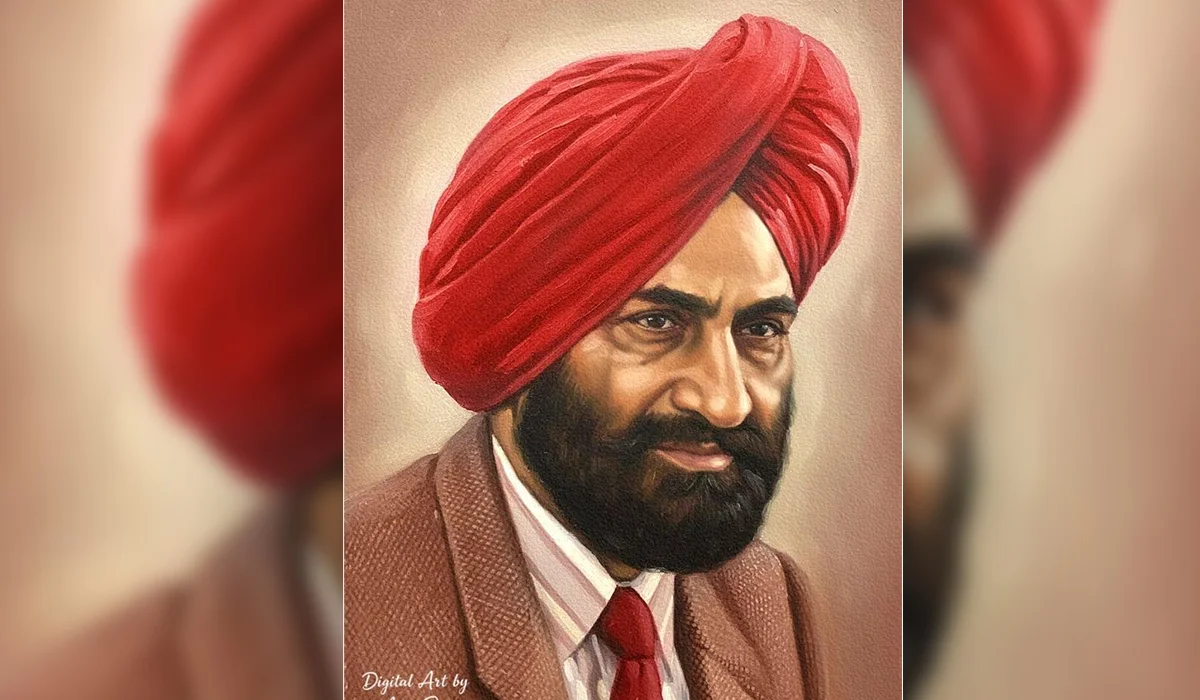

Dr. Jagtar was like the shade of a burning tree—his roots intact, his spread all around, yet inwardly restless every moment. Only a brave person could tie a swing to his branches. I am proud that for many years I kept swinging in affection from Dr. Jagtar’s branches. He was no man of terror, yet in literary circles many were afraid of him. But in the field of literature many people in the literary world kept clear of him. They hesitated to come near him.
“Hath na laayeen kasumbhde, jal jaasi dholaa.”
I chose the safflower, shook down its ripe seeds, and stored them away – white, white safflower seeds. I saw with my own eyes, for the first time, that thorny flowers could also hold such tenderness.
I first heard Dr. Jagtar in 1970 at the Guru Nanak Dev centenary poets’ gathering held at Guru Nanak College, Kala Afghana (Gurdaspur). This grand gathering became possible because of the courage of my teacher and poet Surinder Gill. Major poets such as Prof. Mohan Singh, Sardar Sobha Singh, S.S. Misha, Dr. Jagtar, Satinder Singh Noor, Harbhajan Singh Hundal, Surjit Patar, Kashmir Qadir, and Dr. Harbhajan Singh participated in it.
When Surinder Gill introduced Dr. Jagtar at that gathering, he said that people like us had learned to write by reading mature poets like Dr. Jagtar. Our ears perked up. Dr. Jagtar began his poem:
“Aao purani rasam duhraaiye.”
The point of that poem was this: what is the use of growing in a wall, an abandoned well, or the hollow of a tree? If one must grow, one should grow in the earth. His sharp style appealed to me. With his carefully tied turban and trimmed beard, he looked less like a poet and more like a police officer. His commanding manner set him apart from ordinary poets. Even while being a schoolteacher, he was taught in postgraduate university syllabi.
I also read another of his poems, “The Accused Brought into the Court of Justice,” in the quarterly magazine Sirjana. That poem shook me. It felt like a completely new style, as if he was speaking directly to you.
In 1971, I moved to Ludhiana for my studies. There, at Dr. S.P. Singh’s urging, I read Dr. Jagtar’s poetry collection Dudh Pathri. I also read some of his older songs in literary magazines. One song was:
“Hawaa de vich udddi phire meri tittaran wali phulkari.
Agge agge main turdi, mere turde ne magar shikari.”
I was intoxicated by that song. Around those same days came his book Lahoo de Naksh (Patterns of Blood). That book too shook all of Punjab. There was marvelous flow in his ghazals.
“Har mod te saleeban, har pair te hanhera,
Phir vi assi ruke na, saada vi dekh jera.”
Another ghazal was:
“Khoon lokaan da hai, eh paani nahi,
Isdi surkhi kade jaani nahi.
Tere layi chhanaka ke langhe beriyan,
Tu hi saadi chaal pehchaani nahi.”
Until this time, I had never met Dr. Jagtar in person. But after reading this book, I longed to meet him. By then he had moved to Panjab University. It was Dr. Vishwanath Tiwari’s effort that Dr. Jagtar left school teaching and moved toward university or college teaching. When the Bhai Vir Singh Chair was established, much like the Baba Farid Chair, Dr. Tiwari became its chairman. Dr. Jagtar was then working in that university as a research fellow.
It was during this period that he, along with Dr. Tiwari, edited the valuable collection of Punjabi poetry from Pakistan, Dukh Dariyaon Paar De (Sorrows from Across the River). In truth, it was this book that introduced the poetry being written in Pakistan to the Punjab on this side. The Bhai Vir Singh Reference Lexicon was another important work of his scholarship. Similarly, his work on Sufi poetry, Pichhokar (Background), also became a highly valuable contribution.
By 1975–76, while doing my M.A., I had started attending poets’ gatherings. One such gathering was organized at Government College for Women, Patiala, by Prof. Manohar Kaur Arpan. I was the youngest poet there. I was told that it was because of my poem “The Mirror Lies,” published in Sirjana, that Prof. Manohar Kaur’s husband, the noted playwright Dr. Surjit Singh Sethi, had recommended me.
That was where I met Dr. Jagtar for the first time. I was introduced to him by my elder friend and poet Trilochan (Batta) from Ropar. The gathering was presided over by Giani Gurmukh Singh Musafir.
After the event, Trilochan wanted to take Dr. Jagtar to his room for hospitality. Dr. Jagtar took me along too. I had come from Ludhiana by bus with Dr. Randhir Singh Chand. In those days that was the custom; poets did not travel in cars the way they do now.
The strained relationship between Chand and Dr. Jagtar was publicly known. Earlier, their affection had been exemplary; later, their hostility had become just as notable. Neither could tolerate the other even a little. Dr. Chand did not want to walk with Jagtar, and I did not have the courage to refuse. In the end, Trilochan persuaded Dr. Chand to come along.
Walking about half to three-quarters of a kilometer, Trilochan gently raised the topic of reconciliation, and before reaching the room, he made the two embrace. After that, both were in tears. It was the first time I saw grown poets shedding tears of remorse. Nowadays, people would not miss the chance to widen the rift instead.
After this meeting, Dr. Jagtar became like an elder brother to me. It became my habit to buy and read each of his books before anyone else. I have admired both his ghazals and his nazms equally. In prose, he became even more fluid.
Dr. Jagtar also had a passion for collecting old coins. He traveled extensively and preserved old wall paintings through camera photographs. That research work still remains unpublished. With the support of his family, some university in Punjab or an art council ought to take up that work.
If you brought up the topic of wall paintings, he could speak for hours. His interpretation of wall paintings in temples, gurdwaras, and community buildings became even richer when he explained them.
While writing the foreword to my ghazal collection Man de Boohe Bariyan, he called me a creator of pure Punjabi ghazal. I could hardly believe that this certificate had been issued by Dr. Jagtar himself—the unofficial vice chancellor of the university of ghazal.
There was so much to learn from him. He did not carry the burden of dead relationships. Into his aura he allowed only those souls who understood the meanings of his bitter words and did not distort them into nonsense.
In 2002, I got the chance to enjoy Dr. Jagtar’s company for a full week. At the World Punjabi Conference held in Lahore, Dr. Satinder Singh Noor included me in the delegation along with Dr. Jagtar, Ajmer Aulakh, Waryam Sandhu, Principal Lachhman Singh, Sukhdev Sirsa, Inderjit Hasanpuri, and other writers.
Dr. Jagtar’s stature in Pakistan was something to behold. The playful exchanges between him and his friend Abbas Athar remain preserved in my bundle of memories. Dr. Jagtar was also friends with the mature poet Abdul Karim Qudsi. With Qudsi’s nephew Iqbal, we went for दर्शन of Nankana Sahib. Iqbal was driving the car. I sat in the front seat. In the back sat Qudsi on one side, Dr. Jagtar on the other, and Sukhdev in between. Sukhdev was cramped by the car hood and scorched by the heat of Dr. Jagtar’s sharp speech.
I do not know what kind of day it was, but on the way the car got punctured twice. Dr. Jagtar’s temper shot up to the seventh sky—why was the car puncturing again and again? When, on reaching Sheikhupura, we tried to change the tubes, the shopkeeper said nobody used tubes anymore; we should get tubeless tires. Dr. Jagtar ordered: “Then fit those.” But then came the next trouble—the tires were bought, but they would not fit. “Tubeless tires need different rims,” the man said. Dr. Jagtar replied, “Then put those in too.” It was an imperial command. When the bill came, Dr. Jagtar took out his wallet and sat firm: “Nephew, I’ll pay.” But Iqbal disobeyed the command and swiped his credit card. Such was our uncrowned king, Dr. Jagtar.
When Dr. Joginder Kairon misbehaved with me in a drunken state at a poets’ gathering, and Dr. Jagtar came to know of it, he boiled with anger. He recorded that anger, word by word, in his Pakistani travelogue so that it might stand on record.
Dr. Jagtar himself had not attended that poets’ gathering, but you could say he was present there in spirit. كبار poets seated on the dais—Qateel Shifai, Ahmad Rahi, and Prof. Sharif Kunjahi—kept asking us again and again, “Why didn’t Sardar Ji come?”
Whenever Dr. Jagtar came to Ludhiana, he would send word and call me. Some time before his final farewell, he came to Medicity Hospital in Ludhiana to see his doctor, and on the way back he came to my room at Punjab Agricultural University, Ludhiana. It was very hot. I took him to the cool office of my senior officer. I did not know what to do—such a great poet had come to see me in illness. His first sentence was: “I had wanted to meet you for a long time.”
At that time, Dr. Manjit Singh Kang was the Vice Chancellor of our university. He called me on the phone for some work, and I told him Dr. Jagtar was there. Within five minutes, Vice Chancellor Dr. Manjit Singh Kang was in our office to meet Dr. Jagtar.
The flocks of memory are long. The rest, some other time.


Leave a Comment