
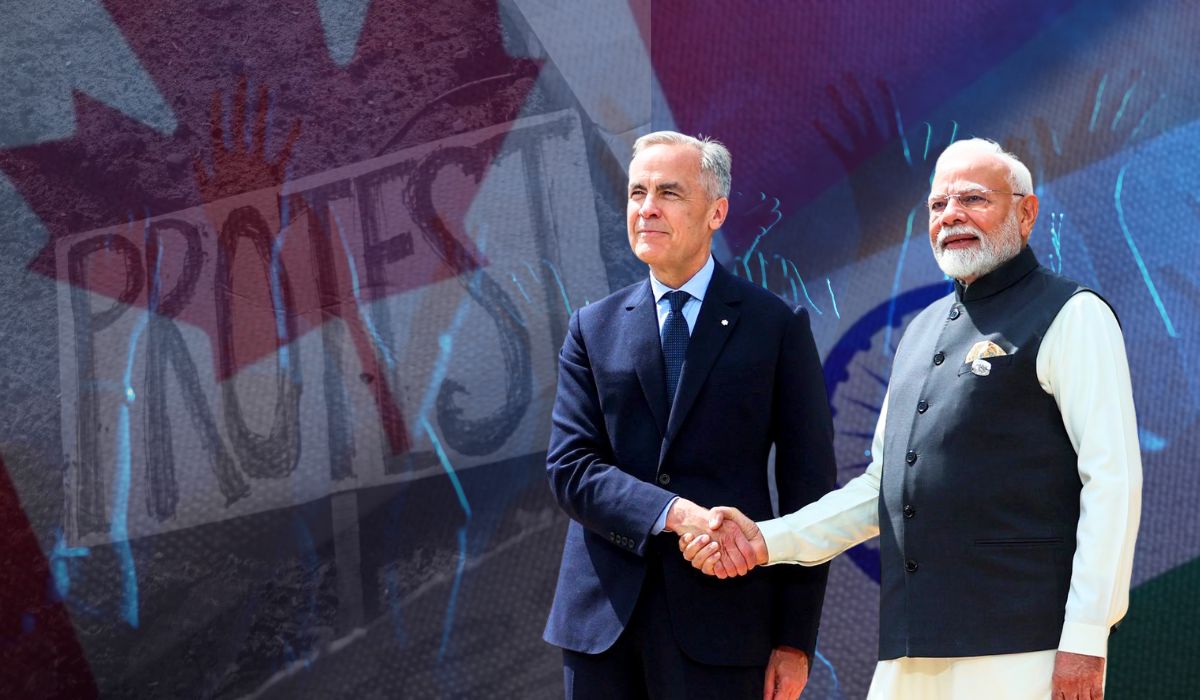

Ever since the Mark Carney-led government assumed office in March 2025, Canada has shown a discernible shift in addressing India’s concerns over Sikh separatism, marking a departure from the approach of the previous Justin Trudeau administration. Prime Minister Mark Carney’s visit to New Delhi last month—the first by a Canadian premier in eight years—underscored this recalibration.
By prioritising trade, investment, energy security, supply-chain resilience and talent mobility, Ottawa has signalled its intent to stabilise ties through pragmatic, forward-looking cooperation rather than political friction. For New Delhi, long wary of Canada’s perceived permissiveness towards extremist elements, this shift represents a cautious but welcome reset.
Yet, this diplomatic uptick appears to have unsettled the Sikh separatist groups. Gurpatwant Singh Pannun, the US-based leader of the banned outfit Sikhs for Justice (SFJ), has called for protest rallies outside two prominent Hindu temples in Canada on April 5. The Triveni Mandir in Brampton and the Lakshmi Narayan Mandir in Surrey have approached authorities seeking safeguards to ensure uninterrupted access for devotees.
Local authorities, mindful of past tensions, have moved to pre-empt disruptions. Police have promised to enforce Brampton’s 100-metre bylaw, which prohibits demonstrations within close proximity of places of worship. Brampton city council adopted the bylaw in late 2024, days after Sikh separatists violently entered the Hindu Sabha Mandir on November 3. Sunday’s protests will serve as a critical test of its enforcement. In Surrey, where no such bylaw exists, temple authorities are seeking judicial intervention to impose similar restrictions.
The protests come against the backdrop of a broader legislative and security push in Canada. Parliament recently advanced Bill C-9, the Combatting Hate Act, to the Senate. The proposed law criminalises the display of terror symbols and obstruction of access to places of worship and schools, issues repeatedly flagged by the Indian diaspora.
Canada’s premier intelligence agency, the Canadian Security Intelligence Service (CSIS), in its 2024 annual report, had already warned of violent activities linked to Canada-based Khalistan extremists (CBKEs), identifying them as a national security concern.
As scrutiny tightens overseas, there are growing indications that extremist elements may be attempting to redirect their activities towards India. With no support in today’s Punjab, they are trying to stay relevant by attempting to disrupt the peace.
On Wednesday evening, a low-intensity grenade explosion targeted the BJP office in Chandigarh, damaging vehicles but causing no injuries. A short video of the attack, reportedly filmed by one of the perpetrators, surfaced online shortly thereafter. While the Khalistani group Babbar Khalsa has claimed responsibility on social media, investigators are yet to formally confirm the link.
Punjab BJP chief Sunil Jakhar described the incident as part of a broader pattern aimed at disturbing communal harmony. He pointed to recent grenade attacks on police establishments and the vandalism of a statue of Dr B R Ambedkar in Hoshiarpur as evidence of a coordinated attempt to inflame tensions.
The vandalism in Noorpur Jattan village on Tuesday has further deepened concerns. Sikhs for Justice has claimed responsibility for the act, prompting police to register a fresh FIR against Pannun and unidentified individuals.
Such incidents are not isolated. The Doaba region—home to Punjab’s largest Dalit population—has witnessed repeated targeting of Ambedkar statues, often timed around symbolic dates such as his birth anniversary on April 14 or the anniversary of his Bharat Ratna award on March 31. With over 1,500 such statues across the state, these sites remain vulnerable flashpoints for those seeking to provoke social discord.
Meanwhile, in the national capital, a bomb threat emailed to the Delhi Mayor’s office triggered a security alert at the Civic Centre. Though later declared a hoax after extensive searches, the message referenced a Sikh extremist group, adding to an atmosphere of heightened vigilance.
Disclaimer: The views expressed in this article are solely those of the author and do not reflect the views or opinions of Sadda Punjab or any affiliated organization.


Leave a Comment