

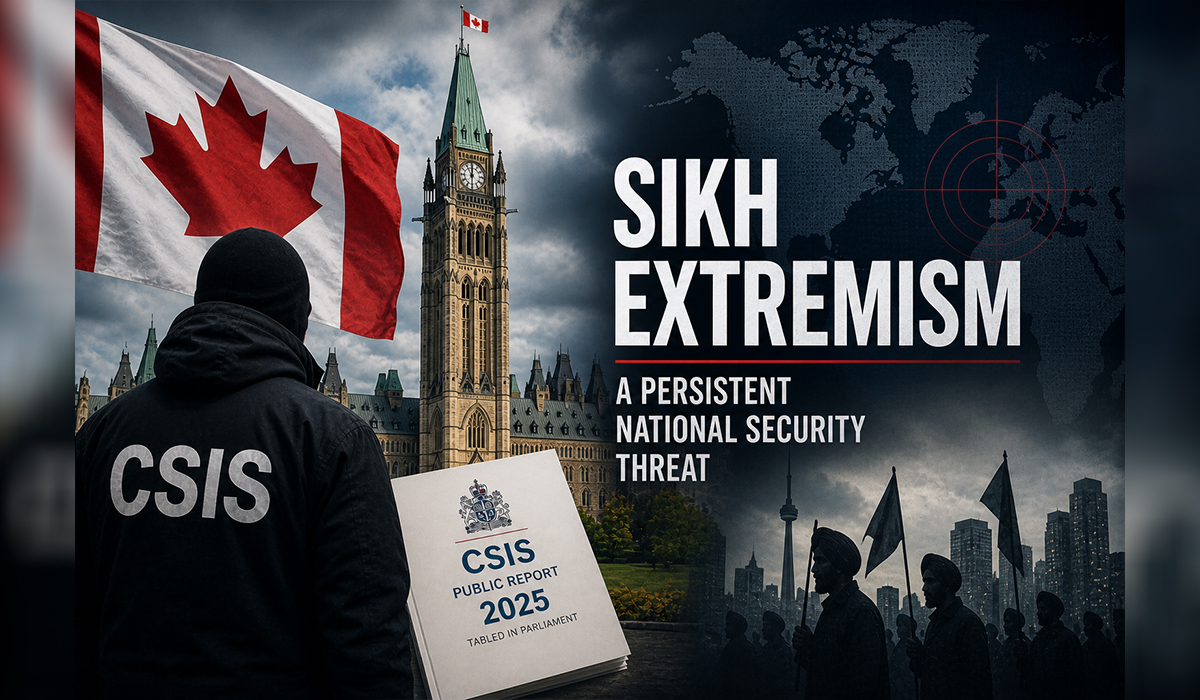

In its 2025 report tabled in Parliament early this month, the Canadian Security Intelligence Service (CSIS) has acknowledged that the threat posed by Sikh extremist activities continues to affect Canada’s national security and remains a critical operational priority.
While the agency noted that no Sikh extremist-related attacks were recorded in 2025, it warned that the “ongoing involvement in violent extremist activities by Canada-based Khalistani extremists (CBKEs) continues to pose a national security threat to Canada and to Canadian interests.” According to the report, some of these individuals maintain links with Canadian citizens and exploit institutions to promote their agenda, including raising funds that are allegedly diverted toward violent activities.
The report noted 2025 marked the 40th anniversary of the bombing of Air India Flight 182- allegedly carried out by Canada-based Sikh extremists demanding a separate state- which remains the deadliest terrorist attack in Canadian history, with 329 people killed, most of them Canadians.
According to the report, only a small group of individuals who use the country as a base to promote, fundraise, or plan violence primarily in India are considered Sikh extremists. Peaceful advocacy for a separate Sikh state continues to be treated as lawful political activity in Canada- a distinction that has long been a point of friction with India.
Relations between the two countries plummeted to an all-time low after then Prime Minister Justin Trudeau alleged in September 2023 that Indian agents were involved in the killing of a Sikh separatist leader in Canada. India firmly rejected the charge. This was followed by a diplomatic freeze, marked by the expulsion of envoys, suspension of visas, and the halting of high-level exchanges.
However, ever since the Mark Carney-led government assumed office in March 2025, Canada has shown a discernible shift in addressing India’s concerns over Sikh separatism. Carney’s visit to India earlier this year firmly set ties back on track.
Security experts, however, point to the relative impunity with which Sikh separatists use Canadian soil to issue threats against India, carry out targeted killings in Punjab and sustain drug cartels that transport narcotics and arms across the border into Punjab. Of particular concern is the sophisticated nexus between extremist groups and criminal gangs with the drug trade funding the separatist movement.
One such network, the Lawrence Bishnoi gang, was added as a terrorist entity under the Criminal Code on September 29, 2025. The gang is accused of using extortion, violence, and intimidation to create a “climate of fear,” specifically targeting the South Asian diaspora and businesses in Canada. Despite the terror listing, its operations have proven difficult to dismantle.

Late on Saturday night, gunshots were fired outside a cafe adjacent to Kap’s Cafe, a restaurant owned by Mumbai-based comedian and television host Kapil Sharma. This was the fourth violent incident in the vicinity of Kap’s Cafe since it opened in July last year in Surrey- an area with a large Indian diaspora poulation. A post by a website linked to the Bishnoi gang claimed responsibility for the incident and issued fresh threats to Sharma saying “he should fall in line”. Authorities are yet to verify the veracity of the threats.
Police have treated the incidents as part of a broader pattern of extortion-linked violence targeting diaspora-owned businesses. Sharma and his team have previously stated they would not be intimidated by such threats.
The challenge before Canada is clear- translating recognition of the threat into meaningful action. How Canada responds will not only shape its domestic security landscape but also define the future trajectory of its relationship with India.
Disclaimer: The views expressed in this article are solely those of the author and do not reflect the views or opinions of Sadda Punjab or any affiliated organization.



Leave a Comment