

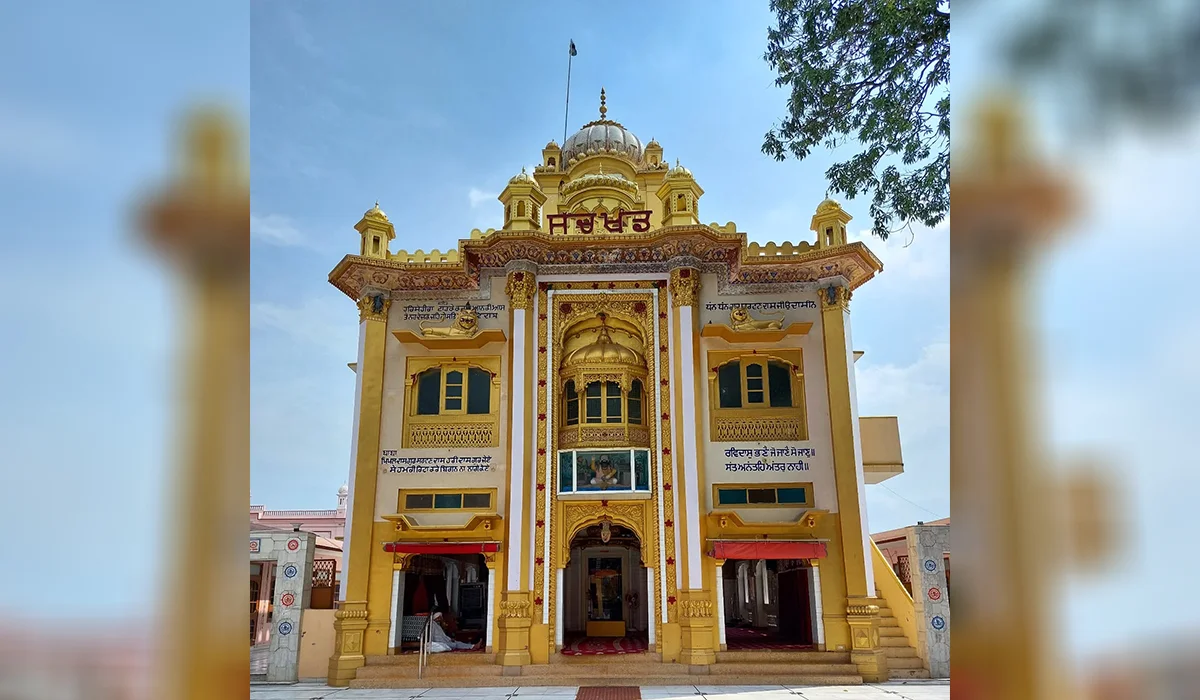

Sri Guru Granth Sahib is the Shabad Guru of all humanity. For the welfare of the universe, the Fifth Guru, Sri Guru Arjan Dev Ji, compiled in the Adi Granth Sahib the divine words of the Gurus, Bhagats, and Sikh devotees closely associated with the Guru’s house, with the assistance of the scribe Bhai Gurdas Ji. The Bani of those Bhagats who rose above the narrow boundaries of religion, caste, place, language, poverty, wealth, and other such divisions, and fully conformed to the philosophy of Gurmat, was included in the Adi Granth. Bhagat Bani made people who had been rejected since birth realise equality, gave the message of universal brotherhood, awakened a sense of self-respect, and intensified an ideological revolution against the inhuman behaviour based on caste and religion in contemporary society. The fifteen Bhagats awakened people against the evils that had developed in Hinduism and Islam and began an ideological dialogue. To remove the decline that had entered the society of that time, Bhagat Bani brought major change at the ideological level on the social, economic, political, and cultural planes. By giving human beings the message to abandon animal instincts and create an ideal society based on moral values, it gave Indian society a distinct identity. By creating among people who had been subjected to contempt for centuries the awareness of being human, it envisioned a welfare society where no one was high and no one was low. Neither did anyone oppress another, nor did anyone fear another.
Begampura sehar ko naa-o, dookh andoh nahi tih thaa-o.
Na tasvees khiraaj na maal, khauf na khata na taras jamaal.
Bhagat Bani strongly rejects Brahmanism, hollow customs, and ritualistic practices. The Bhagats challenged the dominance of Brahmanism and created a sense of self-confidence among the lower castes that had been oppressed for centuries. The priestly class was misleading innocent people from the lower sections of society by trapping them in empty rituals for its own benefit. At such a time, the Bhagats stood by the lower sections and exposed the hollow rituals of the Brahmin and Mullah classes, which had sustained injustice for centuries. Bhagat Bani made people aware that the religious customs of the Brahmins and Mullahs were based on hypocrisy and held no real value for the people:
But pooj pooj Hindu mue, Turak mue sir naaee.
Oi le jaare, oi le gaade, teri gat duhoo na paaee.
The Bhagat poets raised their voices against caste discrimination and, through the message of universal brotherhood, gave those rejected by the caste system a sense of equality. They intensified an ideological revolution against the inhuman discrimination based on caste and religion in the society of that time. By awakening consciousness among the Dalit community, they developed a new way of life and taught them to live with self-respect. Bhagat Bani regards all human beings as equal in the eyes of God. It removes the false notions of superiority and inferiority created by the Brahmin class and gives all humanity the message to rise above caste and discrimination and unite as one:
Aval Allah noor upaaya, kudrat ke sabh bande.
Ek noor te sabh jag upjeya, kaun bhale ko mande.
In medieval religious culture, divisions and conflict between Hinduism and Islam had reached their peak. At such a time, the Bhagat poets made determined efforts to end the religious narrow-mindedness of both faiths. By rejecting outward displays and practices such as fasting, namaz, pilgrimages, ritual fasts, and idol worship, they established the values of equality and mutual love. By giving the message to rise above the worship of temples and mosques, they directed the attention of Indians towards a universal faith that stood above religious narrowness:
Hindu anna, Turku kaana.
Dohan te gyaani syaana.
Hindu poojai dehura, Musalmaan maseet.
Naame so-ee sevia, jah dehura na maseet.
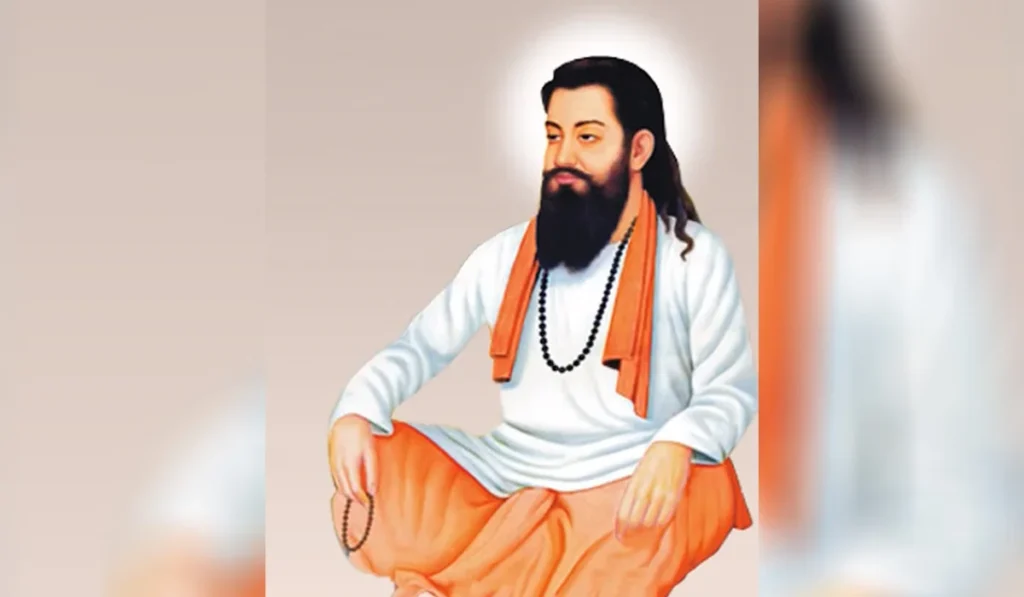
Sri Guru Ravidas Ji was born at a time when Indian society in the medieval period was developing in such an environment. People were engaged in rituals, outward forms of devotion, idol worship, and the worship of deities. A look through history shows that caste divisions also existed in earlier ages. There is no doubt that caste discrimination and untouchability still exist in society. However, when Guru Ravidas Ji was born, the leaders of society had divided people into four categories. Those who performed religious recitations and worship were considered members of a higher lineage and were called Brahmins. Those who fought for their country or community were called Khatris or Kshatriyas. Those who worked as landowners or were engaged in agriculture were called Vaishyas. Those who performed hard labour in the homes or fields of the upper classes were called Shudras. The other groups regarded the Shudras as a lower caste and hated them. Even if people from the Shudra community practised devotion, it was considered a sin. Shudras did not even have the right to worship. Al-Biruni, a traveller who came to India in the eleventh century, writes on page 125 of his book Al-Biruni’s India that not only the Shudras, but even people of the Vaishya caste were not permitted to practise devotion. If a Vaishya was heard uttering the sacred word “Om”, his tongue was ordered to be cut off immediately.
By the will of God, Sri Guru Ravidas Ji was born into the Shudra community. From childhood, he accompanied his mother to the gatherings of saints and holy men. As a result, a deep love for devotion to God arose in his heart. By the age of nine, he had already become deeply immersed in the devotion of God. Seeing this inclination, his parents tried to divert his attention from spiritual devotion by engaging him in the family’s ancestral occupation. His ancestral profession was making footwear (shoes). Although he learned and adopted this family trade, it did not diminish the love for God that filled his heart. He had such deep reverence for saints and holy men that he would make shoes for them for only a nominal price. Referring to his own caste in his Bani, Guru Ravidas Ji wrote:
Naagar janaa meri jaat bikhiaat Chamaran.
Historians have presented different views regarding the date of Guru Ravidas Ji’s birth. While showing people the true path of devotion to God, Guru Ravidas Ji had to face many difficulties. One very important incident took place when he devoted himself firmly to the worship of God and began preaching the path of devotion. Narrow-minded people born into so-called upper castes complained to the king that Ravidas, despite being a Shudra, was worshipping God and should be stopped. The king summoned Ravidas Ji to his court and said, “Shudras do not have the right to worship God, so why are you committing this sin?” Guru Ravidas Ji replied, “O King, devotion to God has no connection with caste.” The king had no answer to this. Then an idea suddenly came to his mind. He ordered an idol of God to be brought and placed in the court. He called the Brahmins and Ravidas Ji and said that whoever could bring the idol towards himself through his devotion would be considered a true devotee. The Brahmins were given the first turn. They performed their regular prayers and rituals, but the idol did not move from its place. Then came the turn of Ravidas Ji. Although he was opposed to miracles, considering the seriousness of the situation, he prayed to the Lord with great humility:
Aisee jan kar ho Maharaj.
Door maahi tum baithe dekho,
Bigarat hai yon kaaj.
Kaanch katheer patit hamte ho,
Nainan dekho aaj.
Khal hal Kaashi lok bahu aaye,
Dekhan bhagat samaaj.
Birad tajo kai birad sambhaaro,
Kahai Ravidas Chamraaj.
It is said that, after hearing the prayer offered by Ravidas Ji with faith and humility, the idol came and rested in his lap. Sant Paltu Sahib of Uttar Pradesh also mentioned this incident in one of his poetic compositions. This entire episode clearly shows that Guru Ravidas Ji had true love for God. To uphold the honour of his devotion and of the devotee, the Lord stood in support of Guru Ravidas Ji. After this incident, every person born into a Shudra family was given the freedom to worship God. This was a great act of service for the Shudra community. Such a step was the need of the time. The great task that even major social reformers could not accomplish could only be achieved by a supreme saint like Guru Ravidas Ji. Apart from his many devotees, Raja Pipa and Meera Bai, the queen of Mewar, were also his devoted followers. Meera Bai herself confirmed this:
Guru Ravidas mile mohi poore, dhur se kalam bhiri.
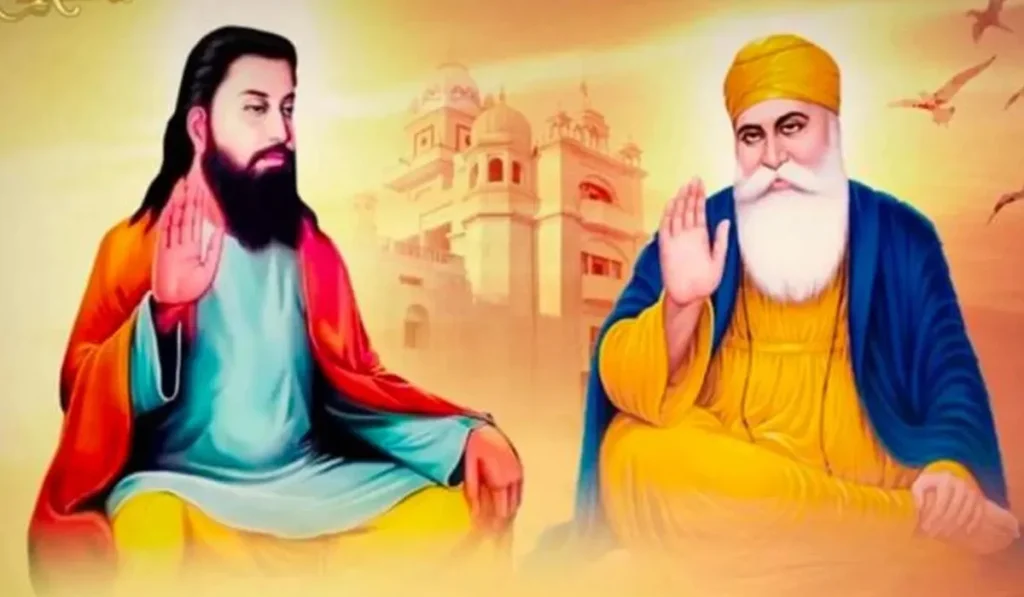
Guru Ravidas Ji is also said to have met Sri Guru Nanak Dev Ji. It was at the beginning of Guru Nanak Dev Ji’s first Udasi that he met Guru Ravidas Ji. Praising Guru Ravidas Ji, Kabir Ji wrote:
Santan mein Ravidas sant hai.
The Fifth Guru, Sri Guru Arjan Dev Ji, the Crown of Martyrs, wrote the following about Sant Kabir Ji, Baba Namdev Ji, Guru Ravidas Ji, and Guru Nanak Dev Ji:
Kabir dhiaaio ek rang.
Namdev Har jio basahi sang.
Ravidas dhiaae Prabh anoop.
Gur Nanak Dev Govind roop.
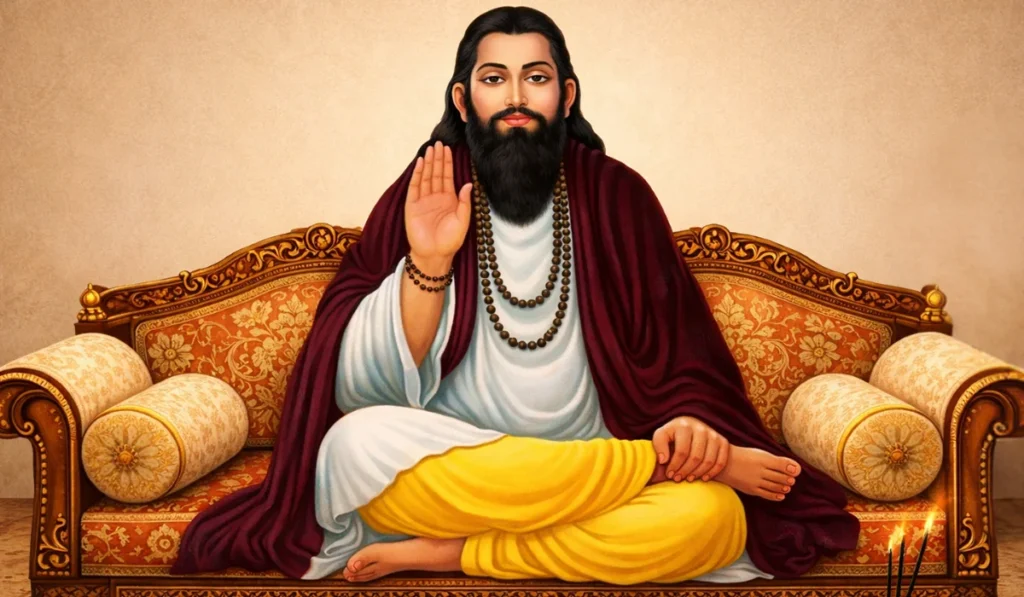
This makes it clear that Sant Kabir Ji, Baba Namdev Ji, Guru Ravidas Ji, and Guru Nanak Dev Ji shared the same spiritual belief. The Bani of Guru Ravidas Ji is filled with love for God and humility. Recognising its greatness, Guru Arjan Dev Ji included 40 hymns from his Bani in the Adi Granth Sahib. Some of these verses are also recorded in Raag Sorath and Raag Maru. A book titled Sant Guru Ravidas Bani was published by Beni Prasad Sharma in 1978. This book contains 177 hymns attributed to Guru Ravidas Ji, including 41 traditional accounts. This shows that he was a great saint and an accomplished spiritual teacher. He taught that firmness and unshakable faith are essential for achieving one’s purpose. Guru Ravidas Ji devoted everything to attaining God. In his Bani, he wrote that the person who lovingly meditates upon the Naam bestowed by the Guru and considers this to be the purpose of life does not have to take birth in the world again. The form and subject matter of Bhagat Ravidas Ji’s Bani are in harmony with the Gurbani of Sri Guru Granth Sahib. He taught that a person should not go from door to door begging, but should earn a living through honest labour. Every person must answer for wrongful deeds. He showed the way of living a humble and egoless life while performing noble actions. According to Bhagat Ravidas Ji, Saadh Sangat is supreme because wherever the Saadh Sangat gathers, the praises of God are sung. Through the Saadh Sangat, all kinds of sins are destroyed:
Saadhoo kee jau lehi ot.
Tere mitahi paap sabh kot kot.
Bhagat Ravidas Ji regarded the Name of God as supreme. One who meditates on the Divine Name does not suffer from any kind of physical or mental pain. Through Naam Simran, the devotee becomes one with the Lord. This priceless jewel, the Naam, is obtained from the Perfect Guru. Nothing in this world can equal the value of the Divine Name. It was through the blessing of Naam Simran that Bhagat Kabir Ji became renowned throughout the world and the sins of countless lifetimes were erased.
Har ke Naam Kabir ujaagar.
Janam janam ke kaate kaagar.
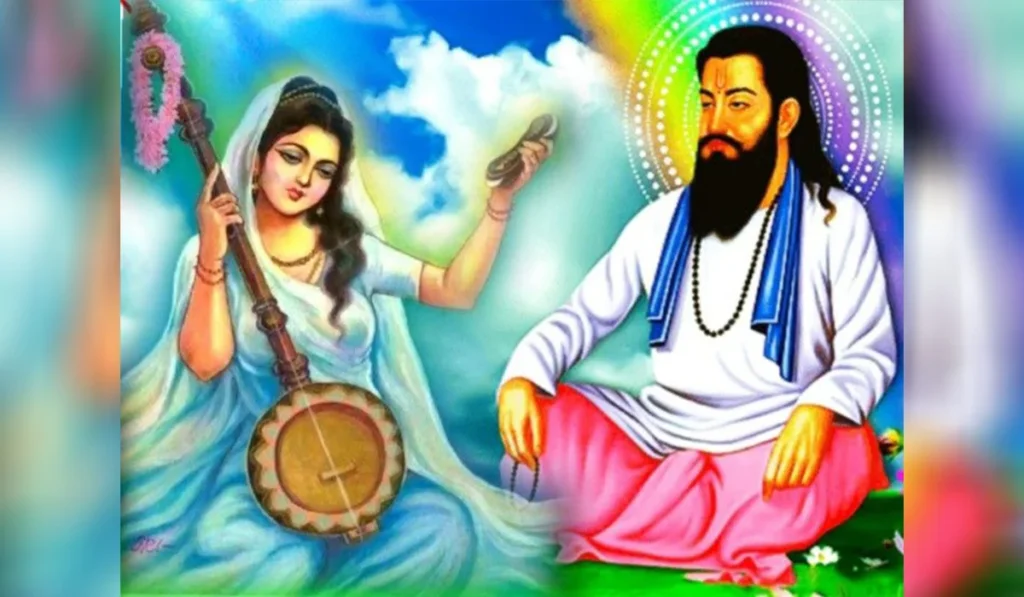
Guru Ravidas Ji was so deeply immersed in the love of God that the lotus of his heart held no other desire. The following incident clearly illustrates this. People used to taunt Meera Bai, saying, “You live in palaces, while your Guru earns his livelihood by making shoes.” One day, Meera Bai brought a very valuable diamond to Guru Ravidas Ji. With great humility, she requested, “O Gurudev, please sell this diamond, build a beautiful house, and live a comfortable life.” Guru Ravidas Ji replied, “My child, what use is this diamond to me? Whatever I have received has come through making shoes.” The True Guru further said, “If you are troubled by what people say, then stay at home and devote yourself to the worship of God.” As she was leaving, Meera Bai quietly left the diamond there. She believed that when Guru Ji noticed it, he would sell it and build a house. After a long time, she returned for his darshan. On the way, she thought that perhaps Guru Sahib had sold the diamond and had begun living a prosperous life in a fine house. But when she arrived, she was astonished to see Guru Ji still making shoes as before. After paying her respects, she said, “Gurudev, I had left the diamond here for you.” Guru Ravidas Ji replied, “My child, pick it up from the place where you left it.” The diamond was lying exactly where Meera Bai had placed it.
After this, in the year 1515 CE, Guru Ravidas Ji spent four years, nine months, and eleven days at Khuralgarh. This place is associated with a large grinding mill and the sacred site known as Charan Chhoh Ganga, both connected with his life. A fair is held there every year at the site of his meditation. The grinding mill connected with the famous incident from Guru Ravidas Ji’s life still exists at the same place in Khuralgarh, in present-day Hoshiarpur district.
It was through the efforts of Guru Ravidas Ji that people considered to belong to the lower sections of society received the right to equality in society. Influenced by the Bani of Ravidas Ji, many scholars emerged in society who secured equal rights for these lower castes and also helped them gain the status of a distinct social category. Great personalities such as Sri Jyotiba Phule, Savitribai Phule, and Dr. Bhim Rao Ambedkar carried out important work for these lower sections of society. Dr. Bhim Rao Ambedkar, the architect of the Constitution of India, secured Scheduled Caste status for these lower sections and ensured their rightful place in Indian politics. After India’s Independence, the Scheduled Caste category came into existence in 1950 in accordance with the Poona Pact passed in 1932. After the SC category, the Other Backward Classes, or OBC category, came into existence in 1990. When Haryana and Himachal were separated from present-day Punjab on 1 November 1966 and the Act was implemented, the number of Scheduled Caste people in Punjab was very high. According to the 1971 Census report, the total Scheduled Caste population in Punjab was 3,348,217, which was 24.7 percent of the total population. At present, the Scheduled Caste population has increased from 24.7 percent to 31.9 percent. This 31.9 percent includes Mazhabi Sikhs, Ramdasias, Ad Dharmis, and Ravidasia Sikhs, apart from many other communities included in the Scheduled Castes. In 2006, the Punjab Government passed the Punjab Scheduled Castes and Backward Classes Reservation in Services Act, under which 25 percent reservation in government employment was approved for the SC and OBC categories.
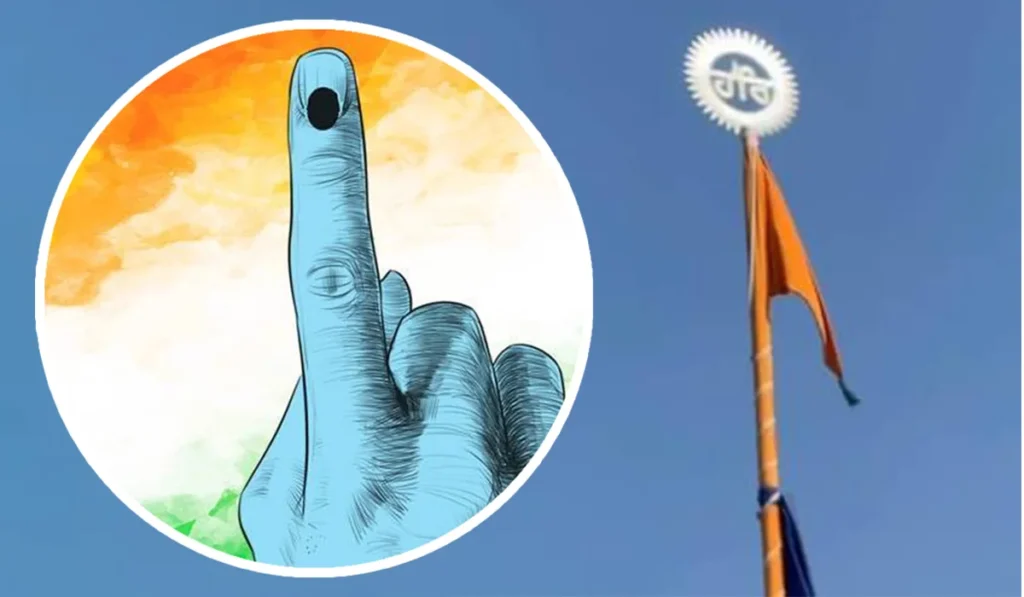
During the 2022 Punjab Assembly elections, 34 of the total 117 constituencies in Punjab were declared reserved for Scheduled Caste candidates. The number of voters belonging to the Scheduled Castes is very high in these constituencies. After the 2022 results, several members became MLAs from Scheduled Caste seats. Sukhwinder Singh Kotli of the Indian National Congress became MLA from the Scheduled Caste seat of Adampur; Dr. Jasbir Singh Sandhu of the Aam Aadmi Party became MLA from Amritsar West, an SC-reserved seat; Jaswinder Singh of the Aam Aadmi Party became MLA from Attari, an SC-reserved seat; Dalbir Singh Tong of the Aam Aadmi Party became MLA from Baba Bakala, an SC-reserved seat; Sukhwinder Kumar Sukhi of the Shiromani Akali Dal became MLA from Banga, an SC-reserved seat; Rupinder Singh of the Aam Aadmi Party became MLA from Bassi Pathana, an SC-reserved seat; Charanjit Singh of the Aam Aadmi Party became MLA from Chamkaur Sahib, an SC-reserved seat; Harpal Singh Cheema of the Aam Aadmi Party became MLA from Dirba, an SC-reserved seat; Sheetal Angural of the Aam Aadmi Party became MLA from Jalandhar West, an SC-reserved seat; Harbhajan Singh ETO of the Aam Aadmi Party became MLA from Jandiala, an SC-reserved seat; Balwinder Singh Dhaliwal of the Indian National Congress became MLA from Phagwara, an SC-reserved seat; and Dev Mann of the Aam Aadmi Party became MLA from Shutrana, an SC-reserved seat. At present, if we look at Punjab politics, nearly 32 percent of the total population belongs to the Scheduled Castes. In Punjab politics, the Scheduled Caste vote determines in whose hands the politics or the reins of Punjab will remain. At present, the people or voters belonging to the Scheduled Caste and OBC categories are those whom great thinkers such as Bhagat Ravidas Ji took responsibility for awakening and securing rights for.
Leave a Comment