

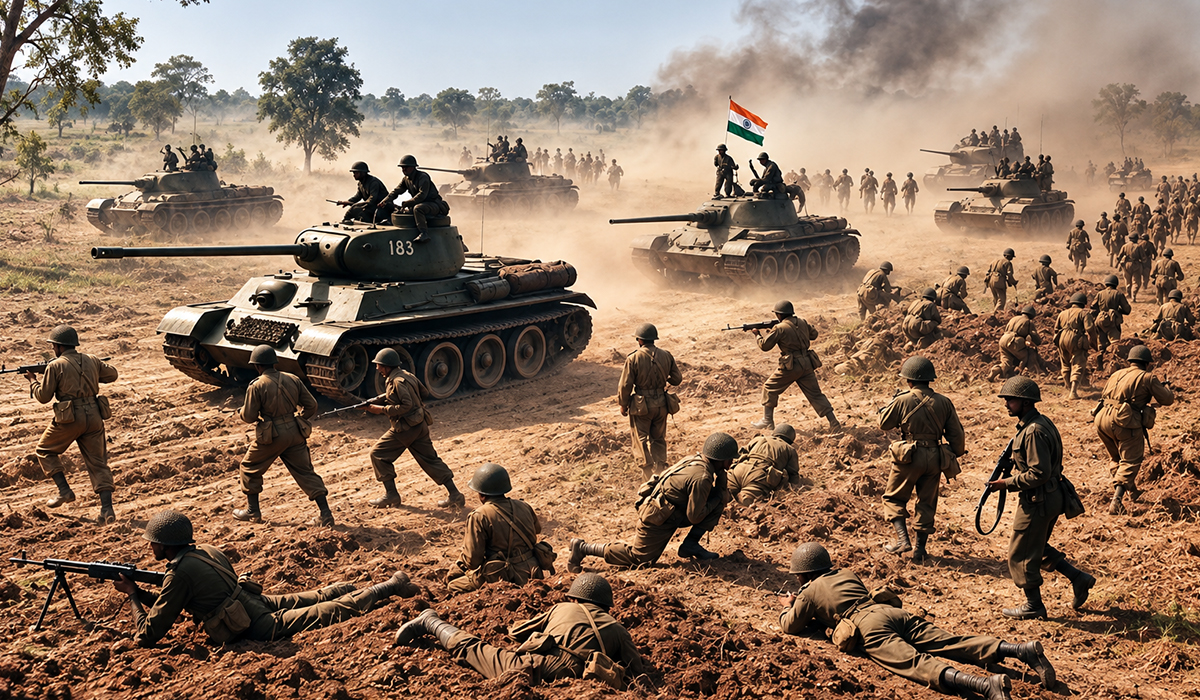

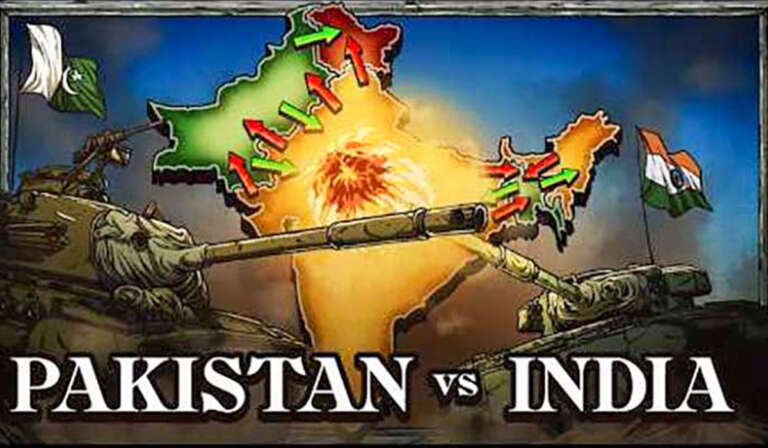
The India-Pakistan War of 1965 is an extremely important and decisive chapter in the military history of the Indian subcontinent. This war was not merely a confrontation between the armies of two countries; military strategy, political decisions, air power and diplomatic pressure all played their respective roles. Pakistan’s military leadership prepared a major military plan to resolve the Kashmir issue and push India back strategically, with the Chhamb-Akhnoor region as its most important focal point.
On 1 September 1965, Pakistan launched a major attack in the Chhamb sector under the name ‘Operation Grand Slam’. Over the next few days, this attack became a serious challenge to India’s defences. The Akhnoor bridge and the communication lines linked to it came under threat. But on 6 September, India crossed the international border and launched counter-attacks on the Lahore and Sialkot fronts, changing the very direction of the war.
Punjab’s great warrior, retired Colonel Balbir Singh Saran, writes in one of his accounts that after failing to establish control over Kashmir in the first India-Pakistan War of 1947-48, Pakistan’s military leadership prepared a new and aggressive strategy in 1965. It was named ‘Operation Grand Slam’. The first and most important stage of this plan was to capture the Chhamb region and then advance towards Akhnoor. Akhnoor was an important strategic location near the Chenab River. The bridge and road links there were extremely important for the Indian Army. Had the Pakistani Army captured Akhnoor, the Jammu-Akhnoor-Rajouri-Poonch communication route would have been affected, and supply and communication difficulties for Indian troops deployed in Rajouri and Poonch would have increased considerably.
The second stage of the plan involved advancing beyond Akhnoor to target Jammu and cutting the Jammu-Srinagar route. The attempt was to isolate Indian troops deployed in the Kashmir Valley from the rest of the country. Pakistan’s military leadership had great confidence in the success of this plan. The plan had been tested at military headquarters through maps, blackboards and sand models. The Pakistani high command expected that a rapid and sudden attack would not give the Indian Army time to recover.
Infiltration by Pakistan Before the War
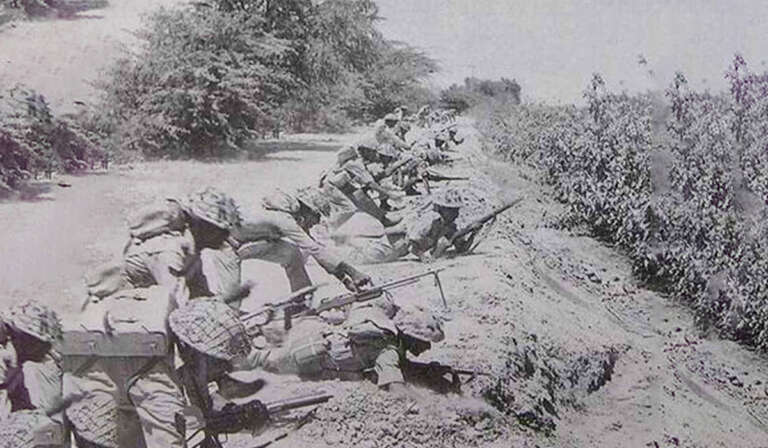
Even before the actual attack, the situation in Jammu and Kashmir was deteriorating rapidly. From the beginning of August 1965, attempts by Pakistan to send infiltrators into Indian territory had increased. The objective was to destabilise the Indian administration and security system and create turmoil at the local level. On 14 August, a large contingent of the Pakistani Army attacked forward Indian posts near the ceasefire line. Indian soldiers resisted firmly and pushed the attackers back.
After this, on 15 and 16 August, artillery, mortars and heavy machine guns were used to fire on the Chhamb sector. During this period, the Indian Army also suffered casualties. Heavy firing took place again on 18 August, and activities were intensified in other areas as well to divert the attention of the Indian Army. The United Nations Military Observer Group deployed in Jammu and Kashmir also took note of these incidents. Reports mentioned violations of the ceasefire line and attempts by the Pakistani Army to advance in the Chhamb region.
At around 4 a.m. on the morning of 1 September 1965, Pakistani artillery began heavy shelling in the Chhamb sector. The purpose of this shelling was to weaken Indian defensive lines and prepare the way for the infantry to advance. After the artillery barrage, Pakistani infantry began attacking Indian positions. Indian soldiers courageously resisted the initial assaults. But Pakistan soon brought its tanks into the battlefield as well.
This Attack Became a Serious Challenge to Indian Defences…, Then the Air Force Entered the Battle
The Pakistani Army had a considerably larger armoured force than India in this region. The attack, carried out with around 90 Patton tanks and a large infantry force, became a serious challenge to Indian defences. At that time, the Indian Army had a limited number of troops and light AMX-13 tanks in the Chhamb area. Because of the geography of the region, it was particularly suitable for tank warfare. Pakistan therefore concentrated a major part of its armoured strength there. The Pakistani Army advanced rapidly towards the Munawar Tawi. Akhnoor was now under direct threat.
In view of the growing threat to Akhnoor, the Indian military leadership sought the assistance of the Air Force. On the evening of 1 September, the Indian Air Force received permission to act, and within a short time Indian aircraft began targeting Pakistani troops and armoured formations in the Chhamb region. The Indian Air Force used fighter aircraft available at the time, including Vampires and Mystères. This action affected the speed of the Pakistani advance. However, the Indian Air Force also suffered losses and lost some aircraft. One important outcome of this air action was that it helped slow the movement of Pakistani armoured formations and gave the Indian Army some time to strengthen its defensive positions.
In the next phase of the war, the Pakistan Air Force used American-made F-86 Sabre jet aircraft. In response, the Indian Air Force deployed its Gnat fighter aircraft. Because of their speed and small size, Indian Gnat aircraft performed effectively against Pakistani Sabre jets. Several Indian pilots, including Squadron Leader Trevor Keelor and Flight Lieutenant Virendra Pathania, displayed bravery in aerial combat. This raised the morale of the Indian Air Force.
The Threat to Akhnoor Increased from 2 to 5 September
The intervention of the Air Force dealt a blow to the speed of the Pakistani attack, but the threat to Akhnoor had not yet passed. The Pakistani Army was advancing beyond Chhamb and the distance from Akhnoor was continuously shrinking. The biggest concern for the Indian Army was the security of the Akhnoor bridge. This bridge was important for communications between Jammu and the Rajouri-Poonch region further ahead. Had it fallen into Pakistani hands, the strategic and logistical situation for the Indian Army could have become considerably more serious.
At the same time, efforts to stop the war also began at the international level. The United Nations appealed for a ceasefire, but the two countries could not agree on the conditions. China also issued strong statements against India, further increasing regional tensions. At the same time, the Pakistan Air Force targeted Indian positions, further expanding the scope of the war.
India’s Historic Counter-Attack on 6 September
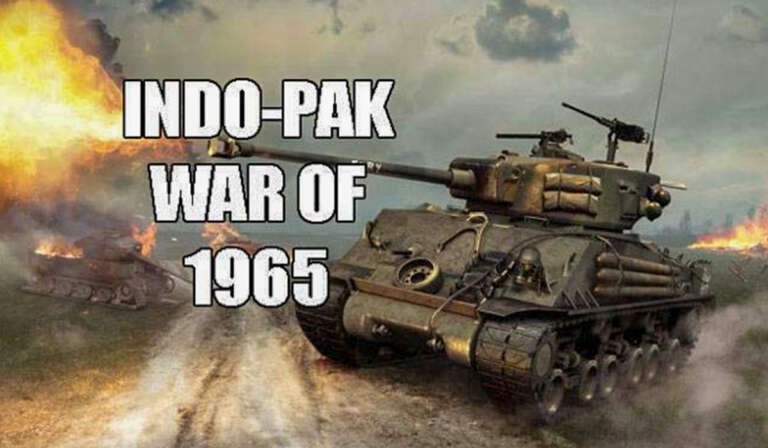
To save Akhnoor, India’s political and military leadership took an extremely important decision. On 6 September, the Indian Army crossed the international border and attacked towards Lahore and Sialkot in Pakistani Punjab. This step proved to be one that changed the direction of the war. Pakistan’s Army now had to think not only about concentrating on the Kashmir front, but also about defending its major cities and territories. The Indian Army advanced towards Lahore from several directions, putting pressure on Pakistani defences. Similarly, the Indian Army also launched a major attack in the Sialkot sector.
The biggest strategic impact of this attack was that the Pakistani high command had to reconsider the deployment of its forces. The attention of Pakistani troops advancing to capture Akhnoor was now also divided towards defending their own territory. The Indian attack of 6 September proved to be a decisive turning point in the 1965 war. Before this, Pakistan had gained the initiative in the Chhamb-Akhnoor sector and created a serious threat to Akhnoor. But by expanding the theatre of war to Lahore and Sialkot, India changed Pakistan’s strategic calculations.

This sequence of events makes it clear that the number of weapons alone does not determine the outcome on the battlefield. Timely political decisions, military strategy, air support, communications and the morale of soldiers also have a profound impact on the result of a war.
It may also be mentioned that the first six days of the 1965 India-Pakistan War witnessed rapidly changing military and political circumstances. On 1 September, Pakistan launched a major attack against India in the Chhamb-Akhnoor region through ‘Operation Grand Slam’. In the initial phase, the Pakistani Army achieved some strategic success and created a threat to Akhnoor. The prompt action of the Indian Air Force played an important role in slowing the Pakistani attack. After this, on 6 September, India crossed the international border and attacked on the Lahore and Sialkot fronts, proving to be a development that changed the course of the war.
The Battle of Chhamb-Akhnoor teaches us that the situation on a battlefield can change from moment to moment in any war. On one hand, Pakistan targeted Akhnoor through a rapid and sudden attack; on the other, India expanded the front of the war and changed the enemy’s strategy itself. In this way, the first six days of the 1965 war are remembered as an important historical account of the determination of the Indian Army, the role of the Air Force and the timely decisions taken by the political and military leadership.



Leave a Comment