

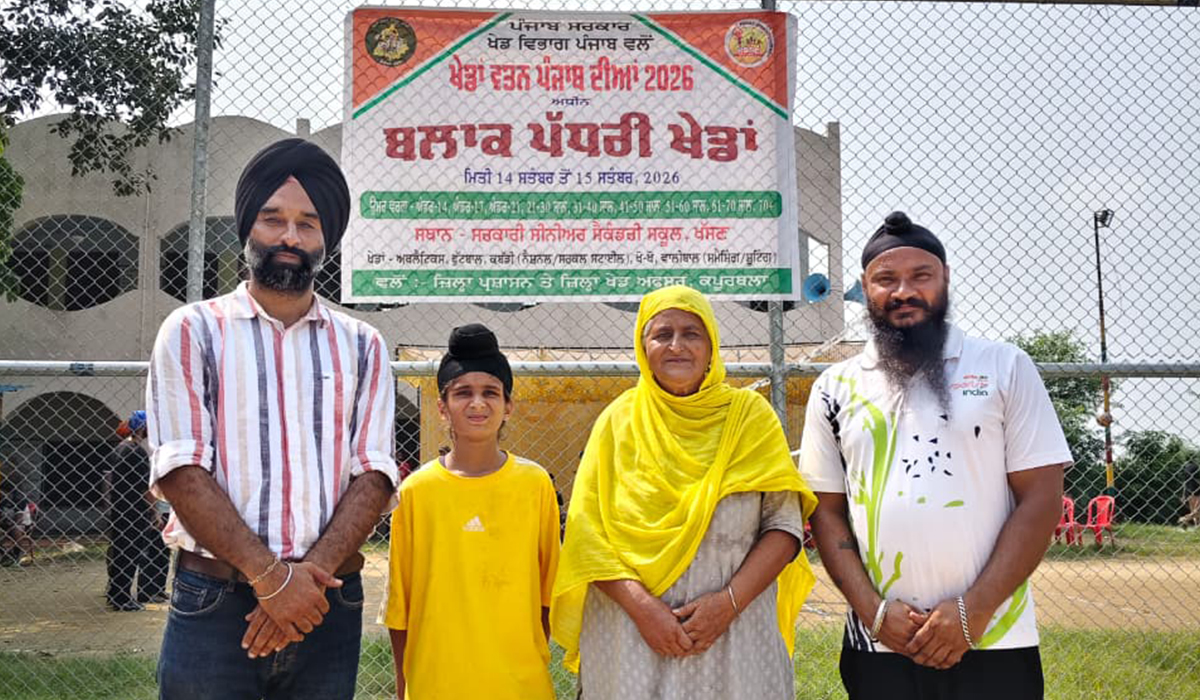

For 65-year-old Gurbaksh Kaur, running 200 metres on the grounds of a village school in Kapurthala was not just a race. It was a return to the days when she used to run during her school years. The only difference this time was that she was not alone—her 14-year-old grandson Jobanpreet was also running at the same sports meet.
A resident of Salamatpur, Gurbaksh Kaur participated in the 200-metre race in the 61-70 age category at Government High School Khassan during the block-level competitions of ‘Khedan Watan Punjab Diyan-2026’. Her grandson Jobanpreet took part in the 60-metre race. According to Gurbaksh Kaur, she used to participate in races during her school days and had once even dreamed of becoming a police officer, but life took her down a different path.
Several decades later, she was back on the running track.
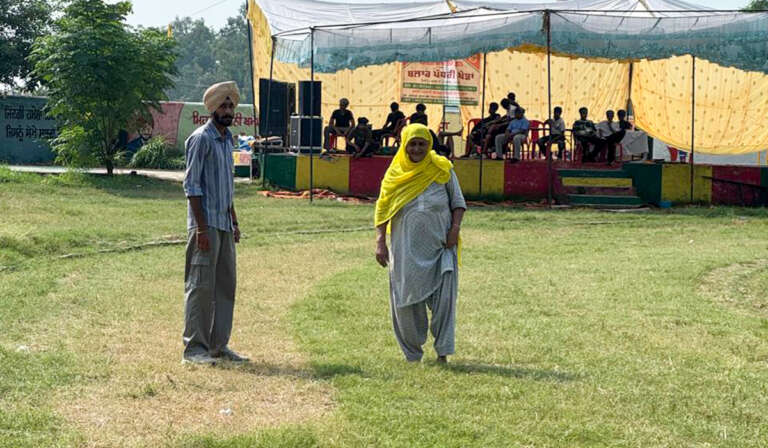
Gurbaksh Kaur’s story is interesting not because she ran at the age of 65. The bigger point is that the tournament in which she ran has formally designated age categories for people like her.
‘Khedan Watan Punjab Diyan’ has separate categories for people aged 41-50, 51-60, 61-70 and above 70 years. In the 2026 season, competitions are being held across nine age categories ranging from Under-14 to above 70 years.
This is important because discussions about sports in Punjab generally revolve around young athletes, schools, colleges and the new generation aspiring to reach the professional level. As people grow older, their role in sports often becomes limited to being spectators or encouraging family members.
At least at the level of competition, this tournament provides a space to change that thinking.
Running Even at 72, and Winning Two Medals
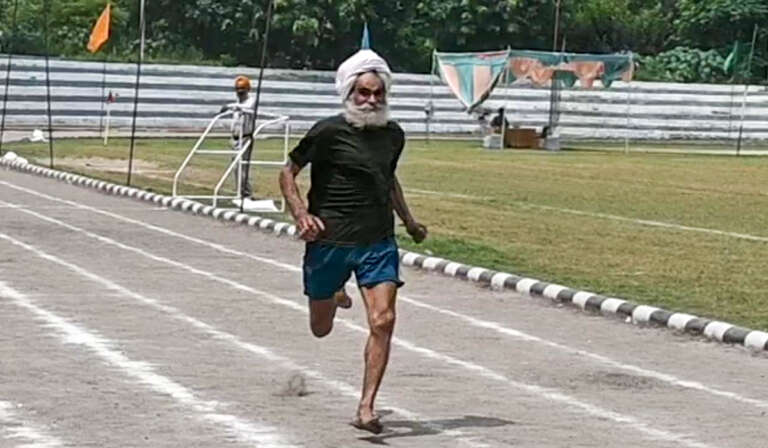
For 72-year-old Mohan Singh Chahal in Rupnagar, this was not merely an opportunity to participate. He entered the field and returned with medals.
Chahal, a resident of Dashmesh Nagar, Ropar, participated in the athletics competitions of ‘Khedan Watan Punjab Diyan-2026’ in the above-70 age category. He won the gold medal in the 800-metre race, while securing the silver medal in the 400 metres. His time was recorded as five minutes in the 800 metres and two minutes four seconds in the 400 metres.
Chahal had served as an Accounts Manager with the Food Corporation of India (FCI) and retired in 2015. Even after retirement, he continued to keep physical activity a part of his life.
Chahal said that such games give senior citizens an opportunity to demonstrate their physical ability and sporting talent. He also advised young people to include walking and sports in their daily lives and spoke about giving preference to nutritious home-cooked food.
Chahal’s story also explains why age categories are necessary. If a runner above the age of 70 is made to compete against athletes in their 20s or 30s, the competition would not remain equal. But when there is a separate category for him, he can compete with others in his own age group and run for a medal.
This year, there is another incentive for senior athletes. The Punjab government has announced separate cash prizes for veteran players in ‘Khedan Watan Punjab Diyan’. Prize money of more than Rs 12 crore has been set aside for the tournament.
It Is Not Just About Two Athletes
If one looks only at the stories of Gurbaksh Kaur and Mohan Singh Chahal, they may appear to be two exceptional examples. But the picture emerging from competitions taking place across different districts of Punjab is larger.
In the block-level competitions held in Sri Muktsar Sahib, people also participated in the 41-50, 51-60, 61-70 and above-70 age groups. Women, along with men, took part in these categories.
These age categories are not limited to any one district. Across Punjab, competitions are being held in the Under-14, Under-17, Under-21, 21-30, 31-40, 41-50, 51-60, 61-70 and above-70 age categories. Competitions are taking place at the block, district and state levels.
In Rupnagar, the district administration has encouraged elderly people, along with young people, women and children, from every village to participate in these games. The administration has also linked sports not only with physical fitness but with mental health, discipline and self-confidence.
Simply creating age categories is not enough. People who have not competed in anything for decades must also feel that they can return to the field.
Senior Athletes Are Not Competing for the First Time
The participation of elderly people is not something that began this year.
In previous seasons of ‘Khedan Watan Punjab Diyan’ as well, athletes above the age of 70 have participated in competitions and won medals.
In November 2024, Surinder Pal Sharma of Hoshiarpur won the 100-metre race in the above-70 age category at the state-level competitions held in Ludhiana. Jasbir Singh Kalsi of Jalandhar finished second and Ajaib Singh of Ludhiana finished third.
In the 400-metre race in the same age category, Sukhdev Singh of Fatehgarh Sahib secured first place, while Baldev Singh and Nachhattar Singh of Ludhiana finished second and third respectively.
These results show that Gurbaksh Kaur and Mohan Singh Chahal cannot be seen merely as two isolated examples. Veteran athletes have been present in this tournament for the past few years, and separate competitions and age categories for them continue this year as well.
Where Age Is Not a Barrier, but Becomes a Competition Category

Another aspect of ‘Khedan Watan Punjab Diyan’ also draws attention. This tournament is bringing different generations onto the same sporting platform.
The Punjab government has expressed an expectation of participation by more than 10 lakh athletes. Competitions are to be held across 153 blocks in 23 districts. It includes 38 sports and four para-sports, with age categories ranging from Under-14 to above 70 years.
The example of Gurbaksh Kaur and her grandson Jobanpreet clearly illustrates this intergenerational connection. The grandmother ran in the 200-metre race and the grandson in the 60 metres. Both had a place to participate in competition according to their respective ages on the same sporting platform.
According to Chief Minister Bhagwant Mann, three generations of the same family have also participated in these games in previous seasons.
This aspect is important in the context of Punjab. Here, sports have not merely been about individual achievement, but have also remained connected with family and village life. If a child, a young person and an elderly person can all play on the same platform in their respective age categories, sport no longer remains an activity only for the young.
What After Retirement?
Behind these races lies a larger question as well—what place do people have in sports after retirement?
After retirement from a job or business, the routine of daily life changes. Children become busy with their own work, and physical activity may also gradually decline in the lives of many people. In villages and cities, elderly people may remain active through household work, farming or walking, but it is a different matter altogether to have a platform where they can enter a competition, prepare for it and demonstrate their performance.
‘Khedan Watan Punjab Diyan’ cannot claim to solve every challenge connected with the active participation of elderly people. Similarly, it would not be correct to say, on the basis of the stories of a few senior athletes, that the lives of elderly people in Punjab have changed.
But the tournament is certainly doing one simple and important thing—it is creating a place for them on the field.
A 61-year-old woman does not have to compete against a 20-year-old athlete. A 72-year-old runner is not made to stand against young competitors. A grandmother can participate in the same sports meet as her grandson, even though their competitions are different.
For someone who may have believed for years that competitive sports are no longer meant for people of their age, simply having an age category and an opportunity to compete can itself be significant.
Gurbaksh Kaur’s Race Is Not Just 200 Metres
Returning to Salamatpur, there is another aspect to Gurbaksh Kaur’s story.
She had once wanted to become a police officer. That dream was not fulfilled. Time passed, family responsibilities came along, and the running of her school days became an old part of her life.
Then, at the age of 65, she ran again.
She describes participating in the same sports meet as her grandson as a joyful experience and believes that age should not be a barrier to sports.
Perhaps the most important thing about these elderly athletes is not their age or their medals. The bigger thing is that they are coming onto the field.
For a long time in Punjab, there has been discussion about connecting young people with sports grounds. ‘Khedan Watan Punjab Diyan’ is doing that, but the elderly people participating in these games are also bringing another point to the fore—the relationship with sports does not necessarily end with school, employment or retirement.
For Gurbaksh Kaur, the field gave a new place to an old interest from her school days. For Mohan Singh Chahal, sports remain a part of an active life even after retirement. And for other people entering the field in the 41-50, 51-60, 61-70 and above-70 age categories, this tournament is at least providing an opportunity that elderly people do not often receive in public life—the opportunity to participate, compete and make their presence felt.
The sports field is no longer only for the young. At least in these games, age is no longer a reason to stay off the field, but is becoming a category of competition.
Leave a Comment