
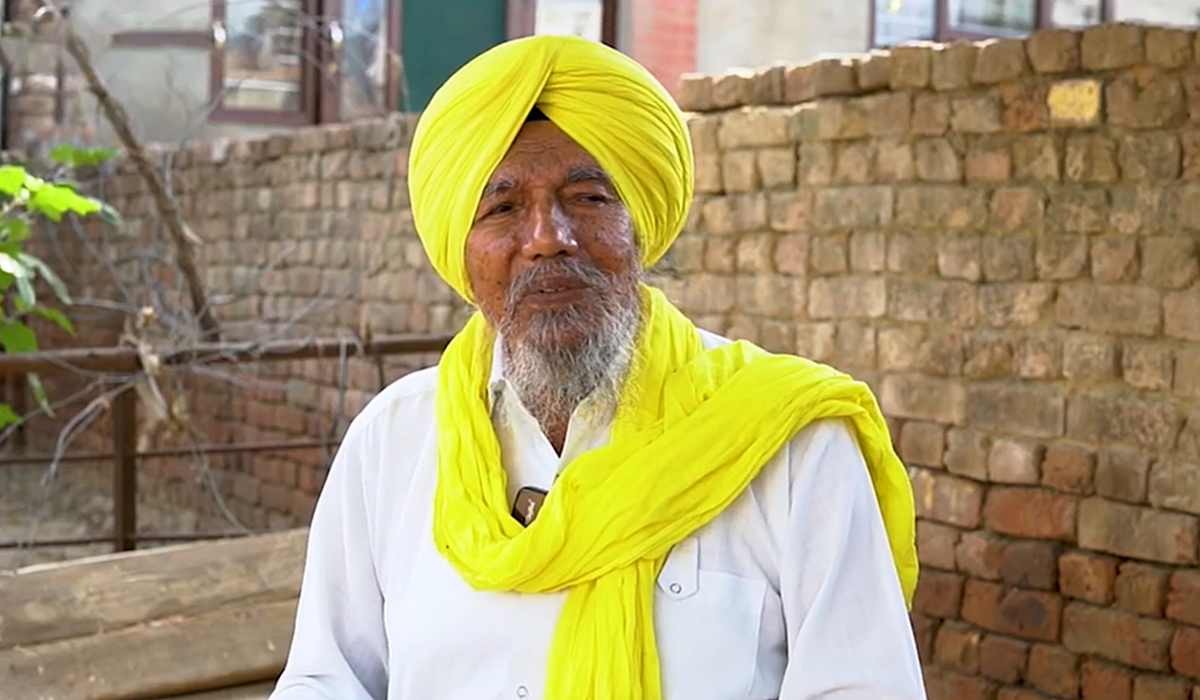

Bharatiya Kisan Union (BKU) State President Joginder Singh Ugrahan held an open discussion on the ground realities concerning the future of farming, rising debt, and the policy crisis. He shared how his consciousness developed during the era of Punjab’s historic communist Mujara (tenant farmers) movement, a movement that advocated for equality and the rights of manual laborers. Even after leaving his job in the army, the question constantly arose in his mind as to why the farmer, who provides food to society, is economically weak. This very restlessness and social consciousness led him onto the path of the farmers’ struggle, culminating in the establishment of the BKU in 2002.
Crisis of the Entire Nation
Joginder Singh Ugrahan believes that the current agrarian crisis is not limited just to Punjab, but is a common issue for the entire country. He clarified that although Punjab has been a leading state in agricultural production, natural water resources, and farmers’ struggles, agricultural policies are determined in Parliament. Under pressure from the developed countries of the world, the Central Government is framing policies that have a devastating impact on farmers across the country. Therefore, the farmers of all of India will have to unite to face this immense crisis.
Pro-Corporate Development Model
Rejecting the pro-corporate development model, the farmer leader stated that pushing large companies forward is not real development. He said that what governments term as economic progress is, in reality, the profit of big corporations. According to Ugrahan, public institutions like government schools, hospitals, electricity, railways, and ports are being privatized and handed over to corporate houses. Earlier, free treatment was available in government hospitals with a nominal registration slip, but today, education and health services have gone out of reach for ordinary families. He questioned that if the country is getting richer, then why are suicides, unemployment, and debt increasing?
Foreign Trade Agreements are Dangerous
Expressing concern over agricultural trade agreements with America, Joginder Singh said that these agreements will have a devastating effect on the local market. He explained that farmers in Western countries receive heavy subsidies, due to which they will flood the Indian market with cheap and GM (Genetically Modified) grain. Our country’s agricultural products will not be able to survive against their cheap goods, which means even the input costs of domestic farmers will not be recovered. He expressed the apprehension that after the foreign takeover of the market, farmers will drown in debt and be forced to sell their lands.
Vote Politics of Political Parties
Ugrahan clarified that there is no fundamental difference in the economic policies of mainstream political parties. He states that parties merely make rhetorical statements in favor of farmers to garner votes, but upon coming to power, they adopt the same pro-corporate path. No party’s election manifesto includes a promise to pull out of the WTO or to reject the policy of privatization. Speaking about the current government of Punjab, he stated that in 2023, experts and farmers’ organizations had jointly prepared an agricultural policy, but the government has not yet made it public.
The Root of Agrarian Debt
Speaking on the issue of debt, Ugrahan dismissed false notions. He said it is wrong to assert that farmers take loans for show-off or weddings. The real reason is that there are no savings left from agriculture after deducting input costs. When there is no money for family needs, banks provide loans under agricultural schemes, which out of compulsion are spent on domestic requirements. Due to the lack of profit, farmers become defaulters and are driven to the path of suicide.
Absence of an Agricultural Policy
According to Joginder Singh, the biggest cause of the agrarian crisis is the lack of a solid and pro-farmer agricultural policy. He emphasized that land distribution in Punjab is uneven, and the majority of small farmers do not even have enough land for subsistence. They farm by taking land on lease at exorbitant prices. When crops are destroyed due to natural disasters or floods, governments wash their hands of it by giving nominal compensation. Merely waiving loans is not a permanent solution; rather, until agriculture is made a profitable enterprise, farmers cannot escape the debt trap.
Future of Small Farming
Speaking about the future of small farmers, he presented a grim picture. In the current economic structure, even farmers with 10-20 acres are barely surviving, while small farming has reached the verge of extinction. Despite being crushed under the burden of debt and machinery, farmers are not abandoning their land because they have no other means of livelihood. For farmers, land is not just property, but the means to keep their hearths burning. When government policies attack their livelihood, no path remains except struggle.
Solution of Legal MSP
Ugrahan completely justified the demand for MSP according to the Dr. Swaminathan Commission’s recommendation of C2+50%. He clarified that the cost of production also includes laborers’ daily wages and the physical labor of the farmer’s family itself. A price 50% above the cost of the total crop produced should be given so that farming can become profitable. He argued that to save agriculture, it is absolutely essential for the government to resolve the agrarian crisis and provide a legal guarantee for MSP so that farmers can get the full value for their produce.
Value for Crop Diversification
Regarding crop diversification, Ugrahan said that farmers are ready to sow alternative crops, provided they get a guaranteed income. Punjab imports thousands of crores worth of pulses every year, whereas these could be grown in our own fields. When the government announced MSP on moong (green gram), the crop went to waste due to a lack of procurement arrangements. If the government guarantees as much profit on sugarcane, maize, basmati, or pulses as there is on paddy, farmers will definitely shift toward alternative crops.
Leave a Comment