
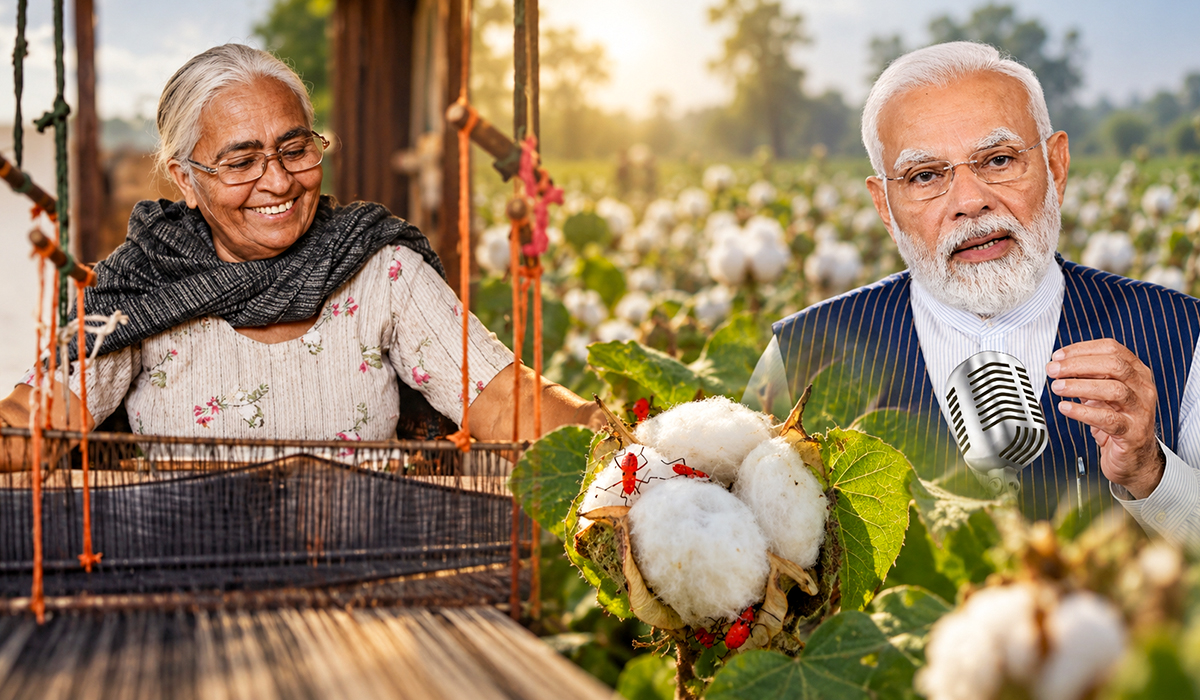

The yarn spun by the hands of rural women from Jaito, a small town in Faridkot district, has today reached households across the entire country. Prime Minister Narendra Modi began his monthly radio program ‘Mann Ki Baat’ by mentioning the organic cotton and handloom initiative ‘Nav Trinjan’ by the Kheti Virasat Mission (KVM). Praising this unique effort for about three minutes, the PM explained how the women of Punjab are setting an example of self-reliance by reviving their ancient heritage.
Fabric woven with natural colors
PM Modi shared in his address that the natural indigenous cotton, grown without any chemical fertilizers or pesticides, is spun by the women themselves using a spinning wheel (charkha). After this, the cloth prepared via handloom is dyed with natural colors, providing people with completely chemical-free fabric. He specially mentioned Ramandeep Kaur, Rajni Kaur, Rekha Rani, and Sneha Devi, who met him in Delhi on National Handloom Day. He recalled that on that occasion, a shawl prepared by ‘Nav Trinjan’ was presented to the President of the country.
Return of the old Trinjans
In the history of Punjab, ‘Trinjan’ was not just a place for spinning yarn, but it was a communal space where women shared their joys and sorrows and sang folk songs. The fast pace of modern life and the advent of mechanization brought an end to these traditional gatherings. KVM’s Executive Director Umendra Dutt stated that ‘Nav Trinjan’ has reconnected these cultural bonds. This project has assigned a central role to rural women in the entire chain, from sowing natural seeds to preparing the fabric, an effort that has also earned ‘Craftmark’ recognition.
Skill through the Weaver School (Bunkar Pathshala)
The true soul of this initiative is the ‘Nav Trinjan Bunkar Pathshala’, where master artisans Shinder Kaur and Gurmeet Kaur from ancestral weaver families teach the youth the traditional art of handloom. Even though they themselves did not receive formal schooling, they possess decades of experience. Over the past two years, 30 rural women have been trained here. Thanks to this school, Ramandeep Kaur, a mother of three who once relied on MGNREGA wages, and homemaker Rekha Rani have now proudly become the financial support for their families.
Recognition at the national level
According to Mission Director Rupsi Garg, the women who had never even seen a spinning wheel or a loom until a year ago are today representing Punjab across the country. During a recent 9-day exhibition in Jaito, indigenous khadi, dupattas, and natural-dyed clothes were showcased, where the story of the hard work of the farmer, the spinner, and the weaver woman was reflected behind every roll of fabric. This Nav Trinjan initiative, which started with just a few women, has today become a model of rural revival for all of India.
Leave a Comment