

Reading the tea leaves the BJP itself has left out
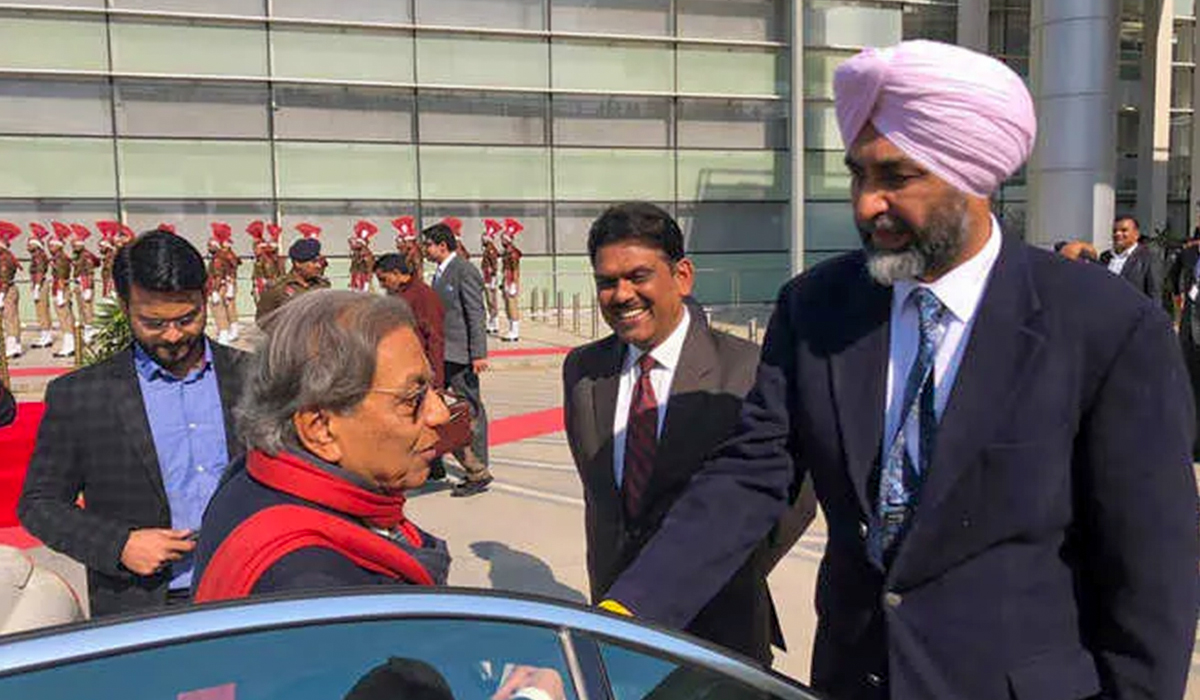
Let me begin with a date, because dates in Punjab politics are rarely accidental. On 16 August 2026 — the very day, note, before the ink on Nitin Nabin’s first organisational reshuffle as BJP national president had even dried — Manpreet Singh Badal was named a national vice-president of the Bharatiya Janata Party. Thirteen vice-presidents in all, spanning twenty-three states and union territories, a list otherwise unremarkable in its breadth. Except that this one name, placed against the Punjab canvas, is not organisational housekeeping. It is a signal, and not a subtle one, about what the BJP does not intend to do before the Punjab Assembly election due early next year.
The cousin who could not stay
To understand why, you have to go back — as with everything in the Badal saga — to bloodline before ballot. Manpreet is not some lateral entrant to the family enterprise; he is Parkash Singh Badal’s nephew and Sukhbir Singh Badal’s first cousin, which in the grammar of Punjab’s political households is a closer and more combustible relationship than any coalition arithmetic. He served as Akali finance minister from 2007 to 2011, built a reputation, deserved in my assessment since I watched the treasury and oppositione benches from the the officers’ gallery in Punjab Vidhan Sabha in those years, as the one fiscally literate voice in a government otherwise run on populism and patronage. And then, in 2010-11, he broke. Publicly, bitterly, over governance more than ideology, and was expelled by the very cousin who now leads the party he left. That cousin has himself been in the political wilderness since 2017, his own decline traceable to a single, terrible date: 14 October 2015, when police fired on sacrilege protesters at Kotkapura and Behbal Kalan, and the Akali Dal’s Panthic legitimacy never fully recovered.
The People’s Party of Punjab that followed was less a political vehicle than a public airing of a family quarrel; it went nowhere in 2012, and Manpreet eventually walked into the Congress fold in 2016, serving a second stint as finance minister under Capt. Amarinder Singh from 2017 onward. Defeated from Bathinda in 2022 — Bathinda, of all constituencies, Harsimrat Kaur Badal’s own turf — he crossed one final threshold into the BJP in 2023.
Three parties, one grudge, carried intact across all of them.
The signal in the appointment
Here is my central submission: a BJP genuinely contemplating a rapprochement with the Shiromani Akali Dal ahead of 2027 (the alliance that governed Punjab jointly for a decade before rupturing over the farm laws in 2020) does not hand its Punjab vice-presidentship to the one man whose presence in any BJP-SAD negotiating room would curdle it before the tea got cold. Sukhbir Singh Badal does not forget 2010. Harsimrat Kaur Badal, defending Bathinda against Manpreet in 2022, does not forget it either. Placing Manpreet at the organisational high table is not merely tone-deaf to that history; it is, I would argue, a deliberate closing of a door — a signal to the Akali old guard, and perhaps more pointedly to the Akali cadre the BJP hopes to poach in the coming months, that Nabin’s BJP is building its own independent Punjab architecture rather than waiting on the Badal SAD office in Chandigarh to pick up the phone.
The metaphor that keeps presenting itself to me — and I resist metaphors that arrive too easily, but this one earns its place — is that of a house divided being handed the keys to next door. You do not do that if you intend the two houses to become one again.
What the finance department actually saw
I enter this with something more than a columnist’s hunch, because I happened to be Principal Secretary, Finance, Punjab through the whole of it — appointed in 2010, serving first under Manpreet and then, after his October 2010 surprise resignation, under his successor Dr Upinderjit Kaur, right through into 2012. So let me settle one persistent myth before it resurfaces, as it always does whenever Manpreet’s name is in the news: there was no paper, no deal, no conditional offer on file, from either Pranab Mukherjee’s finance ministry or Dr Manmohan Singh’s PMO, to waive off Punjab’s debt at that time. I would know. I sat in the department that would have processed it, and continued to sit there for over a year after Manpreet’s exit, under a different finance minister, with no such file ever surfacing.
What did exist, and what Manpreet’s version of events tends to fold into the debt-waiver claim, was something looser: an informal negotiation over subsuming Punjab’s purchase tax, infrastructure cess, and rural development fund cess, especially on food grains, into what would eventually become the GST, with compensation promised through the new regime or some notional credit against it. Pranab Mukherjee would point to Andhra Pradesh before its bifurcation, and to Haryana, as agriculture-heavy Congress-ruled states he had already brought around, and tell Manpreet that Punjab now had to take the lead. That is a real conversation. It is not a debt waiver. The Centre’s denial in October 2010 was, on that narrower and more consequential point, accurate; official record and my own official knowledge line up exactly.
And I suspect, in any case, that the fiscal argument was never really the wound. Years later, in an open meeting with Capt. Amarinder Singh, by then Manpreet’s own chief minister, Manpreet said as much himself: that his only real quarrel with the Akali Dal, when it came down to it, had been one of respect and dignity, not of purchase tax formulae or GST compensation math, or anything else. A grievance like that does not get resolved by an organisational chart either.
The man behind the ledger
What the debt-waiver row obscured, then and now, is that Manpreet is not merely a fiscal hawk with a cousin problem. Spending many an evening with him — I have, more than once, across three of his four party affiliations — and the conversation drifts, unbidden, toward Ghalib and Faiz as readily as toward the fiscal deficit; toward Churchill’s wartime cabinet-room instincts as readily as toward the GST Council. He reads history the way some men read balance sheets — for pattern, not just narrative — and he has a surer feel for how the great-power chessboard is currently arranged than most people who hold actual portfolios in that field. It is, frankly, an unusual mind to find inside the transactional churn of Punjab politics.
The Advani warning
Which is exactly why, at a recent personal meeting, I gave him a piece of unsolicited advice that I will repeat here, because it belongs in any honest assessment of what BJP membership will now cost him. I told him: be the statesman you clearly want to be — read what you like, think what you like, say what you like on economics, on history, on the wider world. But inside the BJP, on Pakistan and its leadership, say nothing. No warmth, no clever aside, nothing that could later be spun as innocent history. I reminded him of what happened to Mr L. K. Advani — a man of far greater stature within the Sangh Parivar than Manpreet will ever perhaps be — who in June 2005, at Jinnah’s mazar in Karachi, offered what he plainly believed was a generous, historically defensible line about the Quaid-e-Azam’s secular instincts, and paid for it with his BJP presidency. If a founding pillar of the party could be undone by a moment of scholarly generosity at a tomb in Karachi, a recent entrant with a known appetite for nuance would not survive the same instinct half as long.
The caveat any old bureaucrat must enter
I offer both readings with the customary administrative caveat: personnel is not always policy, and parties have been known to sup with those they once expelled when the arithmetic of survival demands it. Sandeep Pathak’s parallel elevation — an AAP organisational hand now wearing BJP colours, also said to have Punjab in his sights — suggests Nabin’s team is hedging across multiple flanks rather than committing to any single strategy. But if the BJP’s Punjab calculus still had an SAD-shaped door left ajar, Manpreet Badal’s name is precisely the one you would not have put behind the counter. Bloodline before ballot, I said at the start; on 16 August 2026, the BJP confirmed it has no plans to reverse the order.

Leave a Comment