

The stuffed Amritsari kulcha ain’t stuff and nonsense; it’s serious stuff
A Banner, a Boardroom and a Bread
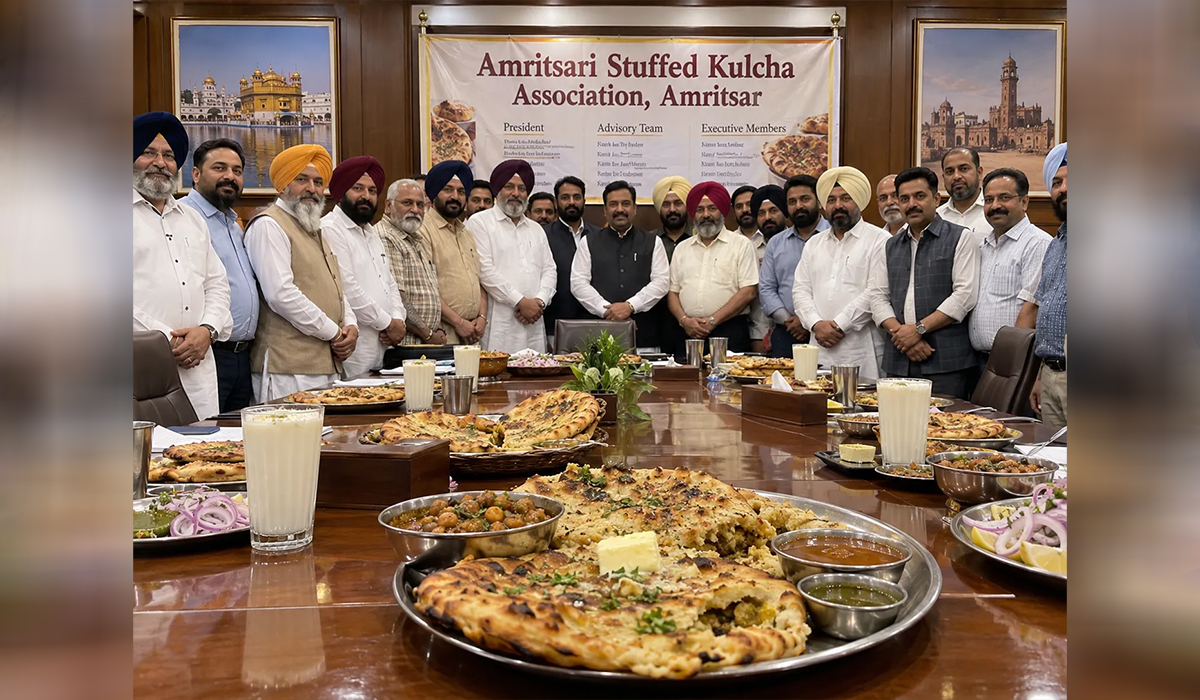
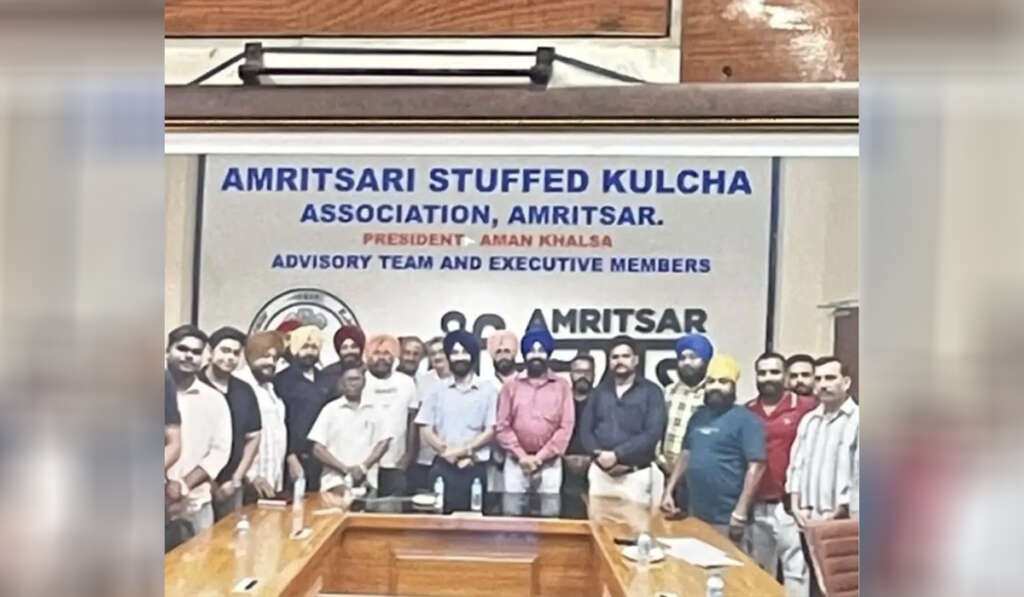
A photograph reached me this week that no Deputy Commissioner of my vintage could have imagined. Some twenty men, most of them turbaned, stand shoulder to shoulder behind a polished conference table, under a banner that reads “Amritsari Stuffed Kulcha Association, Amritsar”, with a President (Aman Khalsa, the banner says), an advisory team and executive members. Aman Khalsa runs Khalsa Kulche Wale, which by the firm’s own account began as a cart in 1966.
The kulcha has acquired a committee, and the committee has a purpose. On 19 June 2026 the Punjab Food Processing Department called a meeting at the Deputy Commissioner’s office in Amritsar to begin the pursuit of a Geographical Indication (GI) tag for the Amritsari kulcha, under the Geographical Indications of Goods (Registration and Protection) Act, 1999. The law wants an applicant who represents the producers; the city had thousands of tandoors and no association. The photograph appears to close that gap.
I held that Deputy Commissioner’s chair from 1992 to 1996. The meetings then were about curfew, cordons and, twice, hijacked aircraft. Today the agenda is a flatbread, and I can think of no better measure of how far the city has travelled.
Persian by Name, Punjabi by Nature
The word is Persian and the dish is Punjabi. “Kulcha” travels the whole arc from Iran through Afghanistan to Central Asia, where it still means a small round bread, sometimes barely more than a biscuit. It entered north India with the Sultanate and Mughal kitchens as a leavened bread of refined flour baked in the tandoor, a first cousin of the naan and the khamiri roti.
Its descent is a matter of geography, and no faith can claim it. Nor can Amritsar claim the name alone. Kashmir has its small, hard bakery kulcha, dunked in noon chai. Hyderabad cherishes the legend that a kulcha blessed the first Nizam, and put it on the Asaf Jahi flag. Delhi eats a soft, plain kulcha with matar. Lahore and Peshawar serve theirs with nihari and paye.
All of these are kulchas, and none of them is an Amritsari kulcha.
Layer upon Layer
What Amritsar did, over what local tradition puts at about two hundred years, was to turn a side bread into a meal.
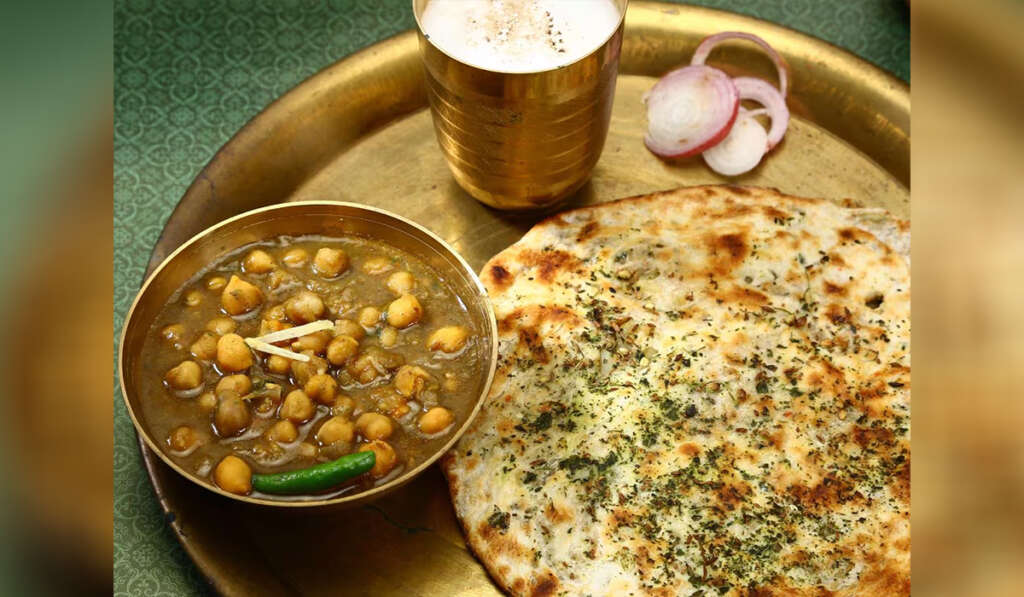
It stuffed the kulcha: spiced potato first, then cauliflower, paneer, or the mixed filling that purists insist is the only real one. It layered the dough, rolling it out with ghee, folding and rolling again, so that the baked kulcha flakes like a pastry while staying soft inside; the tandoor is kept gentler than for naan, so the fat melts slowly instead of scorching. And it made a ritual of the serving. The kulcha is crushed in the fist as it comes off the tandoor, crowned with butter, and eaten with chhole, a thin tamarind-and-onion chutney, and lassi. It is breakfast, and it is finished by early afternoon.
Two claims deserve a pinch of salt. The story that French pastry technique taught Amritsar its layers is charming and undocumented. And the old boast that it is all in the city’s water is folklore, which will be a weakness in a GI application that has to prove the link between product and place.
The Deputy Commissioner’s Beat
A correction first, for visitors. Kesar da Dhaba in Chowk Passian is rightly famous, but for its dal and its lachha parantha, not for kulcha. Lawrence Road, likewise, is the city’s address for sweets and puri-chhole. The kulcha map is a different map, and it runs from the walled city out to the newer colonies.
Every Amritsari will dispute this list. A city that argues over six kulcha shops before breakfast has a tradition that is still alive. The man from the Chungi and the man from Bazar Bikaneria do not make the same kulcha, and neither would concede the other’s is the real one.
The tradition’s most travelled son cooks in New York. Vikas Khanna, born in Amritsar in 1971, opened Bungalow on First Avenue in March 2024. The New York Times gave it three stars, the first for an Indian restaurant in this century, and listed it among America’s fifty best; it became one of the hardest tables to book in that city, with hopefuls lining up early for a walk-in seat. The Michelin Guide singles out a kulcha on his menu, and the restaurant lists Amritsari chole among its own favourites.
The Other Amritsari
The city has lent its name to one more dish, and it has travelled even further than the kulcha. Fish Amritsari, the Amritsari machhi, is river fish (singhara and sole, by tradition) from the fresh waters of Harike, at the confluence of the Satluj and the Beas, marinated with ajwain, lime and red chilli, coated in besan and fried. Makhan Fish on Majitha Road is the name most often given for it, and it sits on restaurant menus from Southall to Surrey.
It is ruled out for the strict vegetarian, and that is where the kulcha scores. The pilgrim walking out of Sri Darbar Sahib, the Jain trader, the family that keeps no egg in the kitchen can all sit at the same kulcha bench. The fish has the fame and, so far, no association. If the GI works for the kulcha, the machhi-walas of Majitha Road may well ask for their turn.
Tag, You’re It. Then What?
A revenue officer reaches for the analogy he knows. The kulcha has been in cultivating possession of Amritsar for two centuries; the GI tag is merely the mutation that enters its name in the ownership column. Possession was never in doubt; only the record is being corrected.
But a mutation entry does not till the field. Three questions will decide whether the tag is worth the paper.
- Whose recipe gets written down? A GI needs a specification. The association will have to define an Amritsari kulcha tightly enough to exclude a stuffed naan in Dubai, and loosely enough to include both the Chungi and Bazar Bikaneria.
- Who polices it? A tag that cannot be enforced against a restaurant in Delhi or Toronto is a certificate for the wall.
- Who benefits? The man at the tandoor, working since four in the morning, should see something from it: hygiene support, training, a common brand, and not merely a logo that the larger outlets print on their menus.
The association in the photograph has taken the first step, which was to exist. The specification, the enforcement and the tandoor-man’s share are what it must settle next.


Leave a Comment