
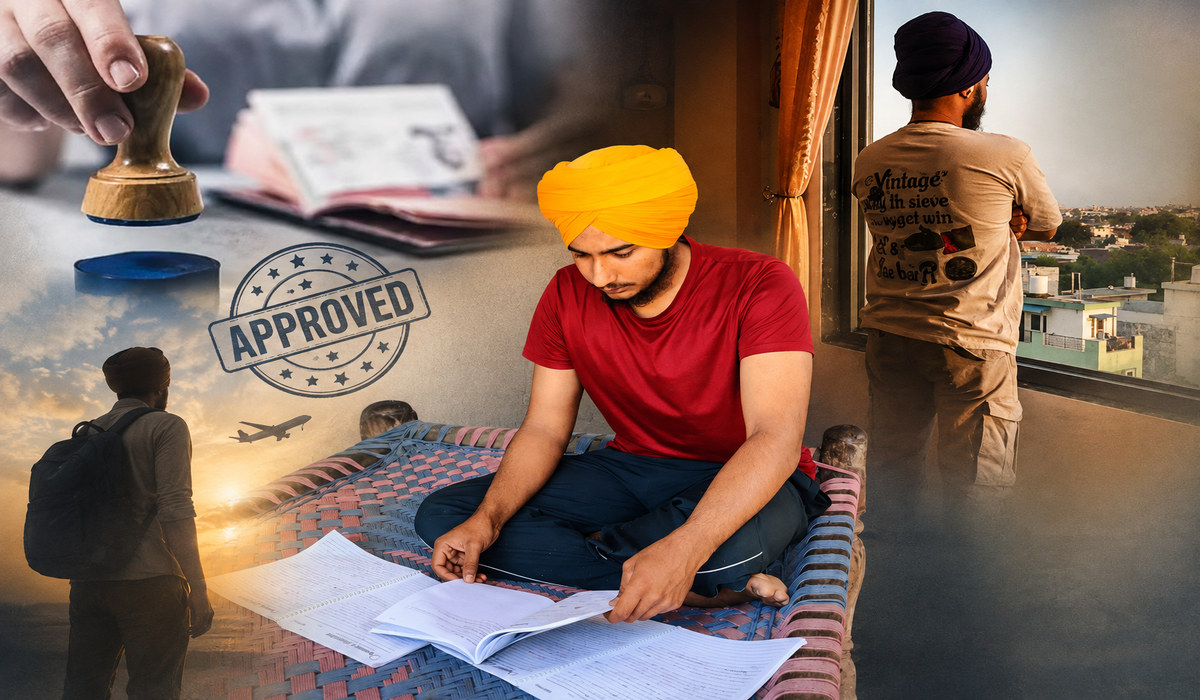

On the morning of 5 February 2025, a U.S. Air Force C-17 taxied into the arrivals bay at Amritsar’s Sri Guru Ram Dass Jee International Airport — the same tarmac that on an ordinary Tuesday sends departures to Toronto, Vancouver and beyond. This flight was inbound: 104 Indians, roughly a third of them Punjabi, deported after entering the United States without papers, amid disputed claims that some had been shackled in flight. A second flight landed eleven days later. By July, the Ministry of External Affairs would count 620 Punjabis among 1,703 Indians deported that year, roughly eight a day, nearly three times the pace recorded under the previous U.S. administration.
You would expect that spectacle (escorts, detention centres, the whole visible apparatus of forced return) to thin the queue outside the visa consultancies of Jalandhar and Chandigarh. It hasn’t, not materially. Understanding why requires separating the push from the pull, taking honest stock of what has changed on the other side of the ocean since I first flagged this drift, on the Chronicle, back in 2024, and then turning to solutions, since another lament serves no one.
Push Before Pull
Punjab’s migration has never been simply a pull story. It is, first, a push: landholdings fragmented across generations to the point of unviability, an agrarian economy unable to absorb its own young, and a social economy that three decades of chain migration have quietly rewired, so that the NRI (Non-Resident Indian) suffix now signals family success in a way domestic employment rarely does. Layer onto this the IELTS-visa-consultancy complex lining the Doaba belt’s highways — a dozen billboards between Jalandhar and Phagwara alone promise a “settled” life abroad — and emigration stops being an aspiration and becomes a default setting.
But the sharper push is arithmetic, not sentiment. A diploma-holder from a mid-tier Ludhiana college, even when placed, often earns less than a cousin driving a truck in Abbotsford. That comparison, repeated across a few lakh households each admission season, explains more than nostalgia for the old country ever could.
The Doors That Now Charge Admission
What has changed is that both principal legal doors have grown narrower and more expensive.
Canada, under the intake-management framework it introduced in 2024, has cut the national study-permit ceiling to 155,000 new arrivals for 2026 (down by nearly half from 2024’s 305,900), with provinces now gatekeeping entry through Provincial Attestation Letters. Indian study permits alone fell from roughly 188,000 in 2024 to about 94,000 in 2025; refusal rates for Indian applicants touched four in five by mid-year. The Post-Graduation Work Permit, the real prize that made a Canadian diploma worth the outlay, has been withdrawn from a swathe of the public-private “curriculum-licensing” programmes that Punjabi consultancies steered students toward, and Ontario has begun winding those partnerships down altogether, leaving mid-course students stranded and some colleges shuttering.
Washington, meanwhile, moved on the other legal pathway. The proclamation of 19 September 2025 imposed a $100,000 fee on fresh H-1B petitions filed for workers abroad — a fee the US Chamber of Commerce is contesting in court, but one that lands hardest on Indian applicants, who account for roughly seven in every ten H-1B approvals.
That leaves the irregular route — “donkey” agents charging anywhere between ₹40 lakh and ₹1.3 crore for a Latin-America transit crossing — looking, perversely, like the one door still ajar. It is the one that ends, when it ends badly, on the tarmac at Amritsar.
Efficiency’s Other Name Is Redundancy
A second disruption is under way, and students, employers, universities and the Punjab government have all, so far, declined to price it in: artificial intelligence is quietly re-engineering the entry-level rungs (copywriting, editing, graphic design, basic bookkeeping, first-level coding, back-office data work) that both Brampton and Mohali have long supplied in volume. One operator with even a rudimentary command of AI tools can now do what, three years ago, needed a team of ten copywriters, designers or sub-editors. That is a genuine efficiency gain, output per person rising exponentially, but the flip side, unspoken so far, is that the very rung migrants climb onto abroad, and the rung Punjab’s colleges are still training students for, is contracting from both ends at once. A curriculum, or a career plan, built around headcount rather than AI-augmented output is obsolete before the ink dries on the offer letter — and no one in the chain has said so.
Educated, Unemployed — and Increasingly Unemployable
None of this would weigh as heavily if Punjab’s domestic labour market offered a credible alternative. It largely does not. The state’s unemployment rate, at 6.7 per cent in the latest Periodic Labour Force Survey, sits above the national 5.3 per cent; among graduates, it is 20.6 per cent, nearly one in five degree-holders without work. The India Employment Report 2024, compiled by the ILO and the Institute for Human Development, found unemployment among Punjab’s educated youth aged 15 to 29 had risen from 22.95 per cent in 2005 to 26.33 per cent by 2022.
The uncomfortable diagnosis, one I have heard repeated by manufacturers in Ludhiana itself, is not merely joblessness but unemployability: colleges, government and private alike, turning out graduates whose training does not clear the bar that even local employers set. Punjab, unlike its peers, has no Bengaluru, no Hyderabad, no Pune to absorb its own output. That gap is precisely what the IELTS billboard exploits.
Building the Runway Homeward
The solution set is not especially original; the difficulty lies entirely in execution, where governments habitually falter. Four moves would matter.
First, retool technical education around demand, not enrolment. Every ITI (Industrial Training Institute), polytechnic and engineering college should carry an employer-linked apprenticeship component, sector-skill-council-certified, so a diploma signals competence to a Ludhiana hosiery unit or a Mohali IT firm, not merely attendance. AI-tool fluency belongs in that syllabus too, as baseline literacy rather than an elective: it is now the difference between one graduate running a small practice and ten queuing for the job it replaced.
Second, build on what Punjab already has rather than chase what it lacks. The state will not conjure a Bengaluru by fiat, but it can modernise and brand what already exists (Ludhiana’s hosiery and auto-component clusters, Jalandhar’s sports-goods trade, and agro-processing that captures value Punjab currently exports as raw wheat and paddy) through easier MSME (Micro, Small and Medium Enterprises) credit, single-window clearances and reliable power.
Third, redirect NRI goodwill from one-way tuition remittance into reverse investment. The same diaspora capital that sends roughly ₹20 lakh a year per family to Canadian colleges can, with the right instruments, fund enterprises at home instead.
Fourth, and least comfortable for a system built on volume: honest career counselling that treats emigration as one option among several, chosen from strength, rather than the default fallback of the unemployable.
The runway at Amritsar was built to send Punjab’s young outward. It need not, by policy default, remain chiefly the place they are sent back to.

Leave a Comment