


Village Gharuan: From folklore of the Mahabharata to Sikh history and ancient coins found in excavation, read the full story
The land of Punjab is called the land of history, folk traditions, religious heritage, and bravery. There is hardly any village here whose soil does not have a story buried in it. But the history of village Gharuan, located in the Kharar tehsil of Sahibzada Ajit Singh Nagar (Mohali) district, encapsulates the layers of many eras within itself. Memories of folk beliefs related to the Mahabharata period, the touch of the feet of the Sikh Gurus, the Sikh struggle, the Patiala princely state, the freedom struggle, and the development of modern Punjab are associated with this village.
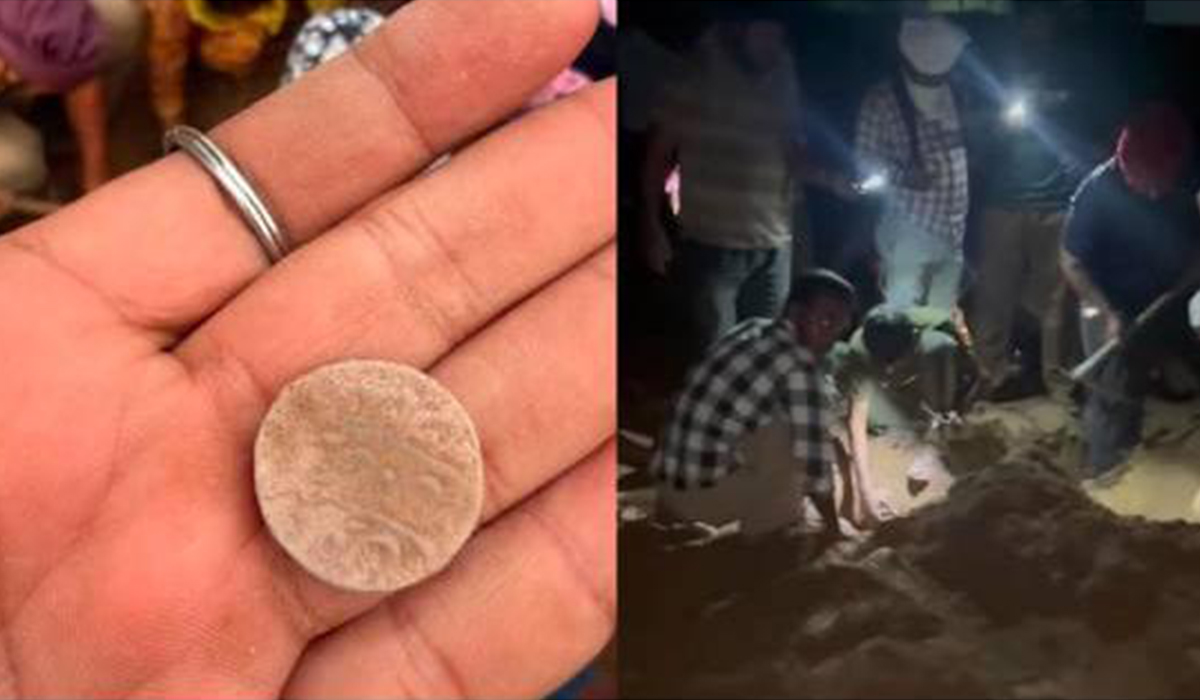
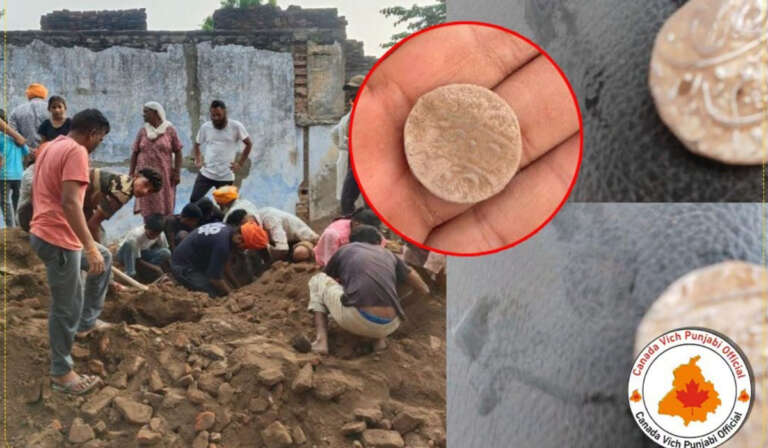
Recently, the coins found in an ancient pot during the excavation for the construction of a new library have brought the history of Gharuan back to the center of discussion. The actual age, metal, script, and time period of these coins can only be identified after a scientific investigation, but this incident in itself indicates that many more layers of history might be buried beneath the soil of the village.
Let us tell you that Gharuan is a large village situated between Kharar and Morinda on the Chandigarh-Ludhiana main highway. Geographically, its location has been very important. Even in ancient times, settlements located near the routes connecting different areas remained centers of trade, religious activities, and political upheaval.
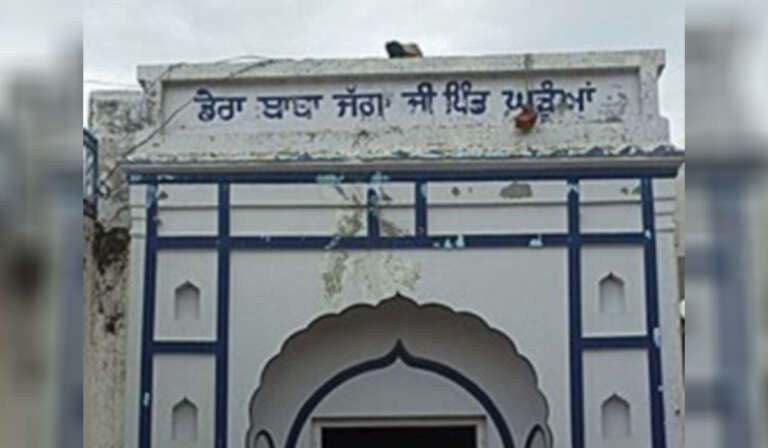
The large landmass and population of the village did not let it remain just a common rural settlement, but over time it developed into an important social and religious center. In the structure of the village, various ‘Pattis’ (neighborhoods), old havelis, gates, wells, temples, gurdwaras, deras, and other historical marks still remind us of its old form today.
The foundation of the library and the history that emerged from the soil
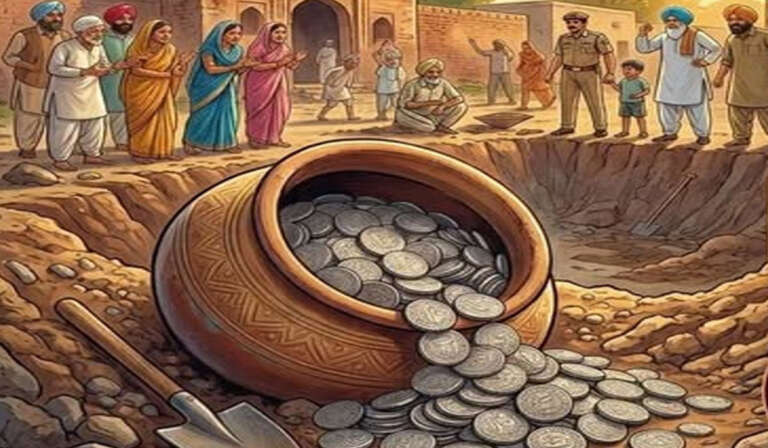
Gharuan particularly came into the limelight when excavation was being carried out for the construction of a modern library at the site of the village’s old Panchayat Ghar. The foundation stone of this library had been laid. During the construction work, when the laborers were digging deep into the ground, an old pot buried in the soil came into sight. After pulling the pot out, ancient metal coins were found in it. The news of finding the coins spread throughout the entire village in no time. People started reaching the spot in large numbers. Despite the darkness, people kept sifting through the soil and debris around the excavation site with the light of torches and mobile phones.
According to local people, many coins appeared to be of silver and some had writing resembling the Urdu or Persian script visible on them. However, these things have come forward at the local level and a scientific investigation is necessary for the actual identification of the coins. It could also not be clarified how many coins in total were in the pot, because after the news spread, a crowd of people gathered at the spot. Upon receiving information about the matter, police and administrative officials reached the spot and secured the area.
An appeal was made to the people by the Executive Officer of the Nagar Panchayat, Ravi Kumar Jindal, that the ancient item found in the excavation is a government property of historical importance. If any person has any coin found from the spot, they should hand it over to the administration. The biggest significance of this incident is that it has given a new interest to the ongoing notions about the antiquity of Gharuan. But before drawing a historical conclusion, it is mandatory to conduct a scientific investigation of the metal, script, images, weight, size, and the layer of soil where the coins were found.
Many stories behind the name Gharuan
There is no single unanimous belief found regarding the origin of the name Gharuan. Many folk tales have been passed down from generation to generation in the village. One folk belief links it to the Pandavas of the Mahabharata. It is said that the Pandavas came to this area during their exile (Agyatvas). The story of their stay near the Jharkhandi temple here is also narrated. According to folklore, Bhima was married to Hidimba and the birth of their son Ghatotkacha is also associated with this area. In this context, there is also a notion that due to the story of the marriage and the birth of a son in a very short time (a ‘Ghadi’ or a moment), the name ‘Gharuan’ was formed from the word ‘Ghadi’.
The second notion is associated with the name of Ghatotkacha. It is said that the word Gharuan was formed from the changing form of the name associated with Ghatotkacha. The third notion is related to the Gosain sect. According to this, Gosain sadhus used to address their house or dera with a special word, which over time changed and became Gharuan. According to another historical notion, Baba Jodh Singh along with his family came and settled here from the Namol, Longowal area around 1400 AD. However, notions of a settlement being here even before this exist. It is necessary to see all these stories as folk history. Which of these notions is historically proven requires further research into archaeological and written sources.
The village divided into Pattis and the touch of the Guru Sahibs’ feet
The internal social structure of Gharuan reflects its old family expansion. Mentions of divisions like Guria Patti, Jago Patti, Nahar Patti, Daggo Patti, Chand Patti, and Patti Majri are found in the village. The name of Guria Patti is linked with Baba Guria Ji. Jago Patti is linked to the name of his uncle Jago, and Nahar Patti to his other uncle Nahar. Daggo Patti is said to be related to Guria Ji’s brother Daggo. Chand Patti is associated with the time of Baba Jodh Singh. The population belonging to the Scheduled Caste has been living in Patti Majri. These Pattis were not just geographical divisions, but are also signs of the social and family history of the village.
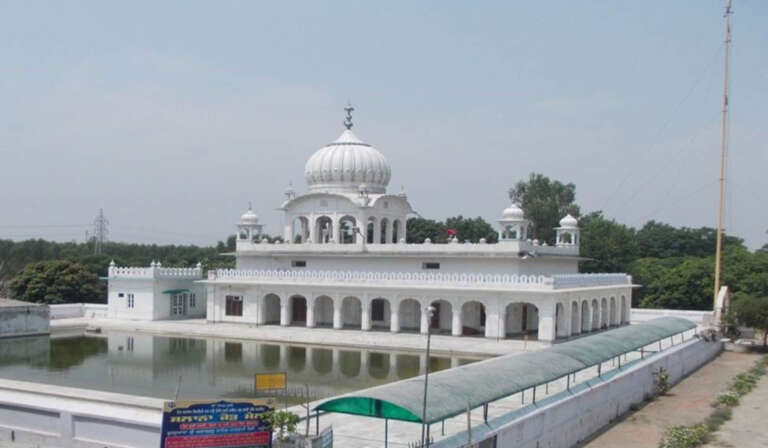
The most glorious aspect of Gharuan is its relationship with Sikh history. According to the traditions of the village, Guru Har Rai Sahib Ji set foot here around 1660-61 AD. After this, a mention is also found of Baba Ram Rai Ji coming here around 1664 AD. It is also believed that Sri Guru Tegh Bahadur Ji came here around 1670 AD. These visits deeply connected the village with Sikh religious history. Even today, the religious places here preserve these historical memories.
Guru Amar Das Ji’s Manji and the folk belief associated with Baba Rangdas Bhandari/Creation of the Khalsa
For the propagation of the Sikh religion, the third Patshah Sri Guru Amar Das Ji strengthened the Manji system. There is a tradition found of a Manji being established in Gharuan as well. The name of Baba Rangdas Bhandari is associated with this Manji, who was a Bairagi disciple related to the Hoshiarpur area. References to sources like Sri Guru Bans Binod, Sri Guru Tirath Sangrah, and Bhai Kahan Singh Nabha’s Mahan Kosh are cited in this regard. Due to this, Gharuan also makes a special place for itself in the preaching history of the Sikh religion.
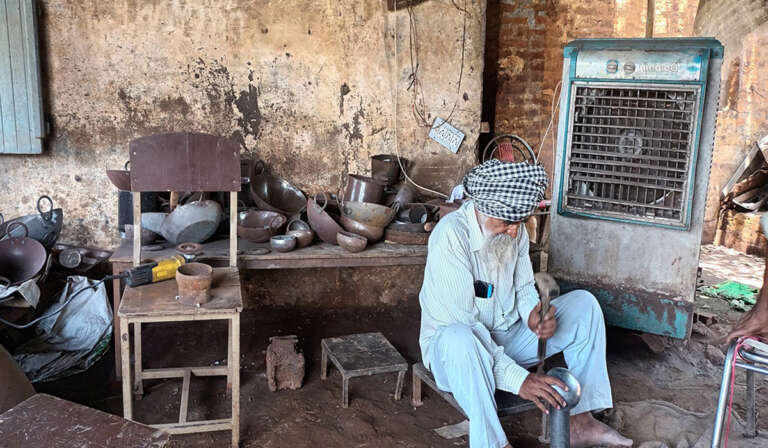
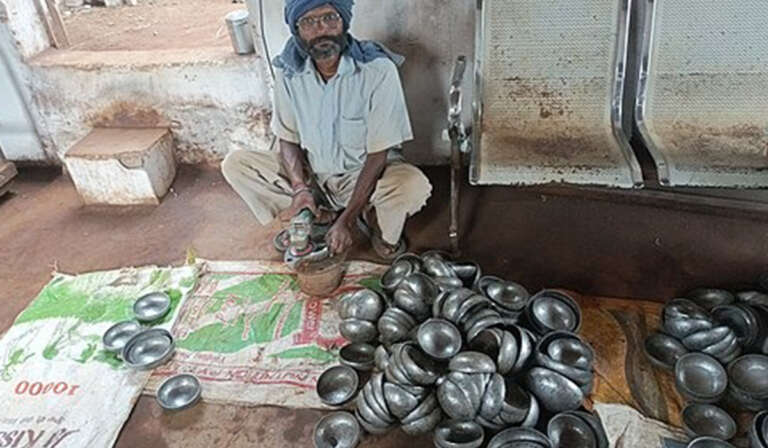
A very famous belief in the folk heritage of Gharuan is also that the holy iron bowl (Bata) used to prepare Amrit during the creation of the Khalsa Panth at Anandpur Sahib in 1699 AD was made and sent from Gharuan. This belief is an important part of the village’s religious memory. However, to solidify this claim historically, authentic documents and archaeological evidence are needed. Nevertheless, for the villagers, this belief is an integral part of their religious heritage.
For information, let us also tell you that the people of Gharuan contributed to various phases of the Sikh struggle as well. A mention is found of the Singhs of the village participating in the Battle of Rano in 1703. The role of the brave warriors of Gharuan is also described in the struggles related to Morinda in 1764. Names like Ran Singh, Dal Singh, Daya Singh, Nand Singh, and Bhag Singh are found in the traditions associated with the time of Baba Banda Singh Bahadur. References to the brave warriors of this area are also found in Rattan Singh Bhangu’s Prachin Panth Prakash. These details show that Gharuan was not just a center of religious travels, but its residents also had a role in Sikh political and military history.
Apart from this, in the later stage of the eighteenth century, Gharuan also became associated with the Patiala princely state. Around 1779-80 AD, a notion is found of Gharuan being included in the princely state by Raja Amar Singh of Patiala. After this, the administrative connection of the village was linked with the Amargarh area. This era also left its impact on the land, administrative, and social structure of the village.
In the twentieth century, when the demand for public rights and a responsible government intensified in the princely states, the people of Gharuan also joined this movement. A mention is found of a firing incident occurring and cases being registered against several individuals during activities related to the Praja Mandal in Gharuan on January 7, 1940. Several leaders including Vaid Channan Singh were punished. Many people were sent to jails. This incident is proof that the people of Gharuan did not remain limited only to the problems of their village, but also became part of the larger democratic struggle going on against the princely monarchy. Memories of former President of India, Giani Zail Singh’s visits to Gharuan are also associated with this era. Talks of many individuals from the village contributing to Netaji Subhas Chandra Bose’s freedom struggle by joining the Azad Hind Fauj are also prevalent.
Temples, Ponds and Ancient Marks/Deras, Gates and Havelis
To understand the ancient form of Gharuan, the religious and archaeological marks here are very important. The Jharkhandi Temple, Sanatan Dharam Temple, and the religious place associated with Basanti Devi are signs of the village’s old heritage. Similarly, the Tobha Malkuana Sahib pond is also seen in connection with the Pandavas. Spread over about 62 bighas, many folk tales are attached to this pond. The discovery of ancient bricks during the excavation carried out by Sant Pritam Das of Brahman Majra around 1948-49 is also recorded in the village’s history. It is said that there are claw-like marks on these bricks. If these old places are investigated using modern archaeological methods, more important information about the antiquity of Gharuan could come forward.
There have also been deras of various religious sects in Gharuan. The Dera of the Udasis, the Dera of the Bairagis, and the Dera of the Gosains bear witness to the religious diversity of the village. In ancient times, it is also said that the village had four gates. Old havelis, mosques, wells, and other architectural marks still remind us of the old structure of the village today. The protection of these buildings is also necessary because, in the era of modern development, old structures are rapidly disappearing. If they are not identified and preserved in time, future generations might lose the crucial marks of their own history.
Modern Gharuan and the renowned personalities of the village
Land consolidation (Murabbandi) took place in the village in 1952. With time, along with agriculture, education, health, sports, and administrative facilities also developed. A mention is found of institutions associated with Dera Baba Udasiyan contributing to facilities like a hospital, bank, playground, post office, telephone exchange, police post, and a water tank. In this way, taking its old heritage along, Gharuan has also developed as a modern village.
Gharuan has produced many prominent figures in the fields of politics, administration, literature, army, and social service. These include names like former Punjab minister and litterateur Harnek Singh Gharuan, former Chief Commissioner of Chandigarh and former Chief Secretary of Punjab Surain Singh Dhanoa, Sant Darshan Singh Khalsa, Gurdial Singh, Jagat Singh, Indian Air Force Wing Commander Maan Singh, retired Brigadier Rajinderpal Singh, Chief Engineer Darshan Singh Matharoo, SGPC member Jathedar Mokha Singh, and the Patiala princely state’s official Bhagwan Singh. These personalities show that the soil of Gharuan has produced people who made their mark in various fields.
The discovery of the coins has opened a new path for research
The pot and coins found during the excavation for the foundation of the library are not just an accidental incident for Gharuan, but an opportunity for a new historical study. If a scientific investigation of the coins is conducted and their date, metal, script, symbols, place of minting, and political relations are identified, it can be known which era these coins belong to. If their relationship with the Mughal or any other princely era is proven, then new information about the economic and commercial activity of that time in Gharuan can also be found.
Even more important is which layer the coins were found in and what other items were present near them. In archaeology, not only the age of an object but also its local context holds great importance. Therefore, a detailed investigation of that place should be conducted under the supervision of experts. If other ancient remains are present in the area, unplanned construction work can damage them.
The need for preserving the heritage
The history of Gharuan is a combination of folk beliefs, religious traditions, written sources, and potential archaeological evidence. Therefore, a scientific and documentary approach is needed to preserve this heritage. A survey should be conducted of the old havelis, gates, temples, ponds, deras, wells, and other historical places present in the village. Old documents, family genealogies, land records, Gurdwara records, and the oral memories of local elders should also be recorded. Along with this, with the help of archaeological experts, places where scientific excavation can be done in the future should be identified. This will not only make the history of Gharuan clearer but will also help in understanding the ancient history of Punjab.
The story of the village Gharuan is such a story in which many layers of folklore, religious heritage, Sikh history, the princely era, the freedom struggle, and modern development are seen together. From folk beliefs linked to the Mahabharata period to the touch of the Guru Sahibs’ feet, the role of the village’s brave warriors in the Sikh struggle, and the Praja Mandal movement, Gharuan has absorbed various historical phases within itself.
Now, the ancient pot and the coins found in it during the excavation for the foundation of the library are adding a new chapter to this story. Curiosity regarding these coins is natural, but their actual historical identity can only be determined after a scientific investigation. The land of Gharuan needs to be understood not just on the basis of legends, but in the light of archaeology, history, and documentary evidence. It is possible that a pot and some old coins found today may become the reason for opening up even larger layers of this village’s history in the future.
Therefore, a scientific survey of the ancient places of Gharuan, an authentic investigation of the found coins, and the preservation of historical buildings is the need of the hour. If this work is done seriously, then Gharuan can emerge not just as a historical village, but also as an important study center for understanding the multi-layered history of Punjab.


Leave a Comment