

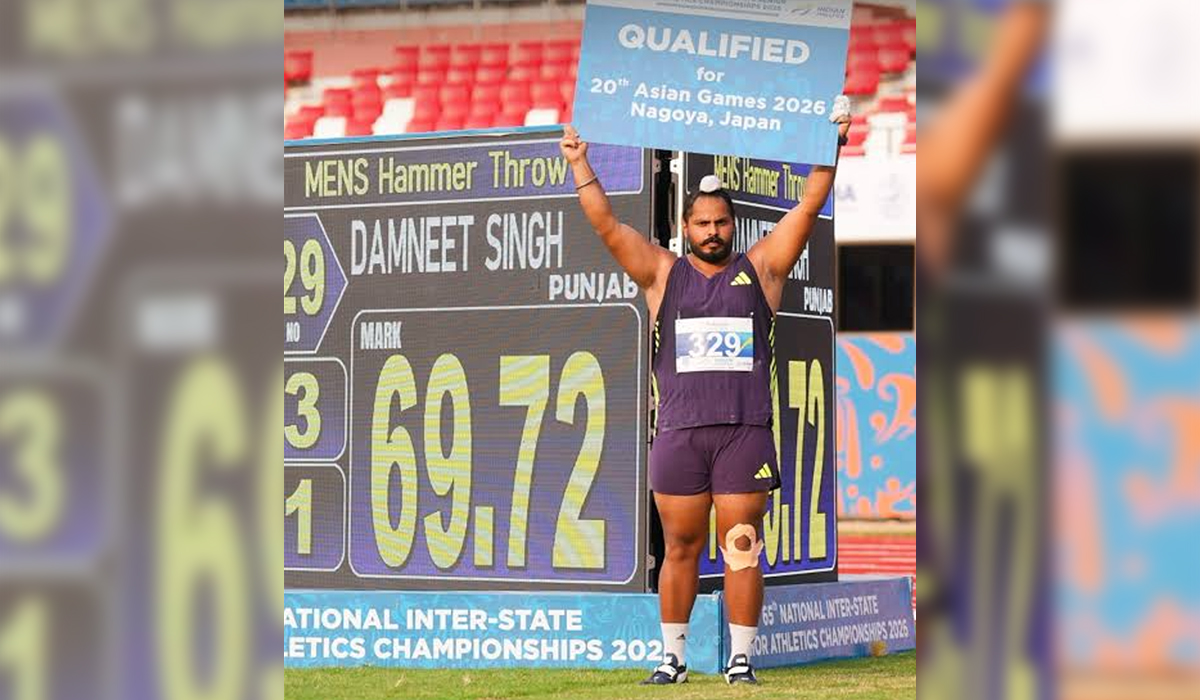

Some children grow up around sport. Damneet Singh grew up inside it.
When he was barely three or four years old, his father Baldev Singh would take him to NIS Patiala. Baldev, a national-level pole vaulter, had his own training to complete. Damneet’s world, meanwhile, was the athletics complex—watching elite athletes train, listening to the sounds of spikes on the track and absorbing the rhythm of a sporting environment long before he understood what a sporting career meant.
Years later, that same child from Barnala will, in a few days, walk into the Asian Games arena in Japan wearing an Indian jersey. And there is an amusing twist to the story.
Hammer throw was never really the original plan.
For much of his childhood, Damneet was a sprinter. He also loved football. It was only around 2012–13 that his father and childhood coach Sukhraj Singh began to believe that his powerful frame might be better suited to the throws.
The decision eventually changed his life.
“I started enjoying the hammer throw because you don’t have to run as you have to in sprints!” Damneet once joked.
The joke apart, the choice proved to be a remarkably important one.
Now, after years of waiting and rebuilding, Damneet is set to represent India in the men’s hammer throw at the Asian Games—a significant return for the event. India has not had a male hammer thrower at the Asian Games since Chandrodaya Narayan Singh competed at the 2014 edition in Incheon.
For Damneet, therefore, Nagoya is not simply another competition. It is the destination of a journey that began when he was a little boy sitting on the sidelines of a training ground.
The Punjabi athlete who found his event
Damneet comes from an athletic family. His father Baldev was a national-level pole vaulter, while his elder brother Gurmeet competed in the decathlon. Athletics was therefore part of the family vocabulary. But there was another side to his upbringing.
His mother was a school teacher and insisted that sport could never become an excuse for ignoring education. Damneet responded by doing well academically, scoring a 9 CGPA in his Class 10 board examinations.
On the field, however, his physical attributes were becoming increasingly obvious.
Coach Sukhraj Singh, who had completed a PhD in throws from NIS Patiala, and Baldev eventually guided him towards hammer throw. Damneet was only around 10 when the shift began.
The first major confirmation came at the 2014 Junior Nationals, when he won a medal and decided that hammer throw could become more than just another sporting experiment. Three years later came the performance that announced him internationally.
At the 2017 IAAF World U18 Athletics Championships in Nairobi, Damneet threw 74.20 metres with the 5kg youth hammer to win silver.
It was historic. He became the first Indian to win a global medal in the hammer throw. A silver at the 2018 Asian Junior Athletics Championships in Gifu followed. But then came the difficult part.
Seven years of waiting
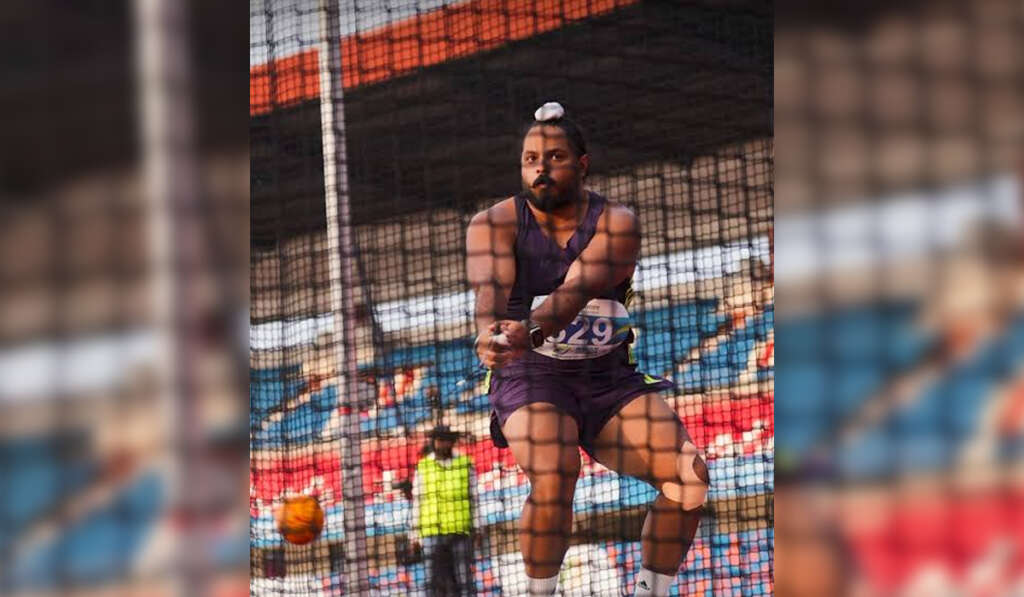
Moving from junior implements to the senior hammer is not a simple progression.
The senior men’s hammer weighs 7.26kg, 2.26kg more than the stipulated 5kg at the junior level. This made Damneet’s transition a prolonged process. For almost seven years, progress was difficult to sustain. This is where his story moves away from the familiar script of a young athlete winning medals and climbing continuously upwards.
There were injuries. There was stagnation. There was the frustration of knowing that he had once been regarded as a promising international prospect, yet still having to wait for his senior breakthrough.
His own description of the period captures the emotional side of it.
“After nearly seven years of waiting, injuries, and quiet mornings no one saw… representing India again brought tears I couldn’t hold back.”
That wait finally began to turn in 2025 and 2026.
DAMNEET SINGH — THE NUMBERS
| Milestone | Distance / Achievement |
| 2017 World U18 Championships | 74.20m — Silver |
| 2018 Asian Junior Championships | 74.08m -Silver |
| 2025 Indian Open Athletics Meet | 69.87m |
| 2025 National Inter-State Championships | 69.25m |
| 2026 Indian Open Throws Competition | 70.64m |
| 2026 National Inter-State Championships | 69.72m — Gold |
| Asian Games qualification | Secured with 69.72m |
The most significant number, however, was 70.64m.
At the Indian Open Throws Competition in Patiala in March 2026, Damneet crossed the 70-metre barrier, a landmark that signalled that the long transition into the senior event was finally bearing fruit.
Two months later, he threw 68.37m to win in Sangrur. Then came 67.62m and silver at the Federation Cup in Ranchi. And in June, at the National Inter-State Championships in Chennai, he produced 69.72m to win gold and secure his Asian Games qualification. The numbers were beginning to tell a different story.
The Steve Lemke chapter
There was another crucial change behind those numbers.
In 2024, Damneet joined the Reliance Foundation Sports programme. That brought him into contact with specialist coach American Steve Lemke—and with a completely different technical approach to the hammer throw. It wasn’t an overnight transformation.
In fact, it took around a year and a half for Damneet to adapt.
“He had a completely different technique from what I was used to, and it took me a year-and-a-half to adapt to that,” Damneet explained.
The change involved his setup and the way he allowed the hammer to move through the throw.
“The new technique helps me allow the hammer swing more freely with a deeper grip.”
For an event decided by distance measured down to centimetres, technical changes can be enormous. Damneet believes the transformation was essential.
“I joined Reliance in 2024, and meeting Coach Steve Lemke took me to a completely different level. When I look back to where I started, I think if I hadn’t changed my setup and technique, I wouldn’t be anywhere right now.”
It is perhaps the most important lesson in his journey. The athlete who eventually qualified for the Asian Games was not simply the same Damneet who had won a world junior medal nine years earlier. He had to rebuild himself as a senior thrower.
The Punjabi roots remain
For all the technical sophistication of elite athletics, Damneet’s connection with Punjab remains strikingly simple. His father introduced him to athletics. His family kept him in sport when progress was slow.
And his food preferences sound more like a Punjabi kitchen than an elite athlete’s carefully marketed nutrition plan. Tandoori chicken. Buffalo milk. Sarson da saag. There is little interest in fancy diets. Perhaps more importantly, there is little separation between his sporting identity and where he comes from.
“From a small village to wearing the Indian jersey on the international stage—this one’s for every dreamer back home,” he wrote on his social media handle after earning his place in the Indian team.
That sentiment explains why the Asian Games qualification means more than a line on a selection list. For years, the dream existed in training sessions that few people saw. Now the jersey will make it visible.
Now, Nagoya
The Asian Games will bring Damneet into a field that includes some of the strongest hammer throwers in Asia.
China’s Wang Qi won gold at the 2023 Asian Games and has a reported best of 75.40m in 2024. Japan’s Shota Fukuda has reached 74.57m, while Uzbekistan’s Sukhrob Khodyayev has a lifetime best of 78.22m.
Damneet’s best stands at 70.64m. Those numbers provide the context. But they do not define what happens inside the circle.
Damneet has already spent years learning that progression in hammer throw is rarely linear. His journey has included a world junior medal, a long senior transition, injuries, technical reconstruction and finally the return to the international stage. Now he has a much simpler objective.
“My ultimate hope is to bring a medal back home for India.”
The boy who once accompanied his father to NIS Patiala had no idea where those early mornings would eventually take him.
The teenager who joked that hammer throw was attractive because he didn’t have to run like a sprinter could not have known how much running, rebuilding and waiting would actually be required outside the circle.
And the young athlete who won a world junior silver in 2017 had to wait nearly a decade to earn his chance at the senior Asian Games.
Now that wait is over.
In hammer throw, the actual competition unfolds in seconds. The hammer accelerates, the athlete turns, releases—and then everyone waits for the number.
For Damneet Singh, the wait has lasted seven years.
For an Indian man to represent India in the hammer throw at the Asian Games, it has taken twelve years.
In Nagoya, the number on the scoreboard will tell the next part of the story.
The other part is already written—in Barnala, at NIS Patiala, in countless training sessions, through injuries, technical changes and those “quiet mornings no one saw”.
Now the boy who didn’t like to run is all set to make his efforts count, make Punjab proud, and make India chant his name.
The Men’s Hammer Throw Final at the Aichi-Nagoya 2026 Asian Games is scheduled for Friday, September 25, 2026

Leave a Comment