

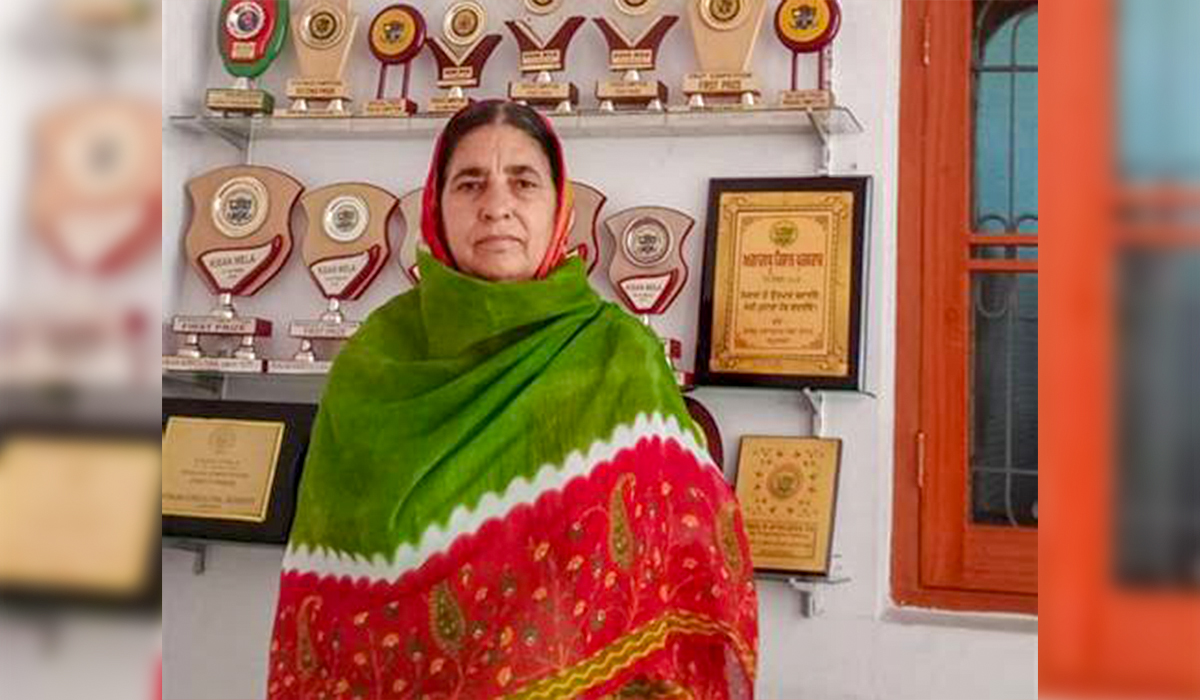

When Amarjit Kaur Chandi of Boolpur village in Kapurthala started beekeeping in 1995, she had only 50 bee colonies. Almost three decades later, her business has reached around 400 colonies. During this time, besides becoming a successful beekeeper herself, she has also trained hundreds of farmers in this profession.
Amarjit Kaur’s story also reflects the potential of new agriculture-related income sources for women in the villages of Punjab. Beekeeping is no longer limited to just honey production; instead, entrepreneurial opportunities are also being associated with it through processing, packaging, various bee products, and marketing.
A post-graduate in music, Amarjit Kaur turned towards beekeeping while living in an agriculture-oriented family after her marriage. The family was already cultivating crops like sunflower and mustard, which also created an opportunity for beekeeping.
She acquired knowledge about this profession through training programs organized by the Krishi Vigyan Kendra in Kapurthala and started her work with 50 colonies. Later, this number reached around 400 colonies. The family focused not only on honey processing but also on other bee products like royal jelly, propolis, and beeswax.
But Amarjit Kaur’s story did not remain limited to her own business.
According to published details about her work, Amarjit Kaur and her husband have trained nearly 900 farmers from Punjab and other states in beekeeping and related activities. They have also been associated with several training camps and farmer meetings. In addition, she has played a role in forming self-help groups with the objective of creating income opportunities for women.
Amarjit Kaur’s journey becomes even more significant at a time when the Punjab Agricultural University (PAU) is continuously organizing training programs to promote beekeeping.
Out of the 23 beekeepers who participated in the two-day advanced beekeeping training program organized at PAU in collaboration with the India Honey Alliance (IHA) on September 14 and 15, 2026, 11 were women.
This training provided hands-on learning not just on bee care, but on subjects like advanced queen bee rearing techniques, preparing wax cell cups and queen-rearing frames, larva grafting, the cupkit system, honey processing, bottling, and novel packaging. Information related to quality, certification, marketing, Farmer Producer Organizations (FPOs), Self-Help Groups (SHGs), and honey export was also imparted.
This is not an isolated effort by PAU to connect women with beekeeping.
In February 2024, the Krishi Vigyan Kendra of PAU in Sangrur provided beekeeping training to 43 women involved in agriculture, associated with the self-help groups of the Punjab State Rural Livelihoods Mission.
In another advanced beekeeping course held in February of the same year, 11 farmers and rural women participated. It covered topics such as queen bee rearing, bee products, honey processing, packaging, certification, and marketing.
But bringing women to the training room and sustaining them in commercial-level beekeeping are two different challenges.
A study on beekeeping in Punjab published in the Journal of Rural Studies in 2024 found that the number of men among those engaged in this profession is overwhelmingly high. Researchers included the migratory nature of commercial beekeeping among the reasons for women’s low participation.
Commercial beekeepers in Punjab move their colonies from one place to another according to the seasonal cycle of flowers and crops. According to the study, colonies can be transported to regions like Rajasthan, Madhya Pradesh, Himachal Pradesh, and Jammu & Kashmir. This kind of continuous movement can clash with the limited mobility and domestic responsibilities of women.
The researchers also documented the case of a woman who, despite participating in two training programs, could not start beekeeping on a commercial scale. She had considered keeping her colonies in one place, but the study stated that at the scale she wanted to operate, making it commercially viable was difficult.
This raises a major question for the women beekeepers of Punjab—can such business models be developed in this sector that give women the opportunity to sustain in this profession without needing to completely replicate the traditional migratory model?
A possible answer to this also appears in the changing landscape of beekeeping.
Now, the income from this profession is not limited just to honey. Areas like royal jelly, pollen, propolis, beeswax, processing, packaging, certification, and direct marketing are also being associated with it. The recent training program at PAU also emphasized the formation of FPOs and SHGs.
For women who cannot move from one place to another with bee colonies for extended periods, fields such as processing, packaging, marketing, and group-based businesses can provide alternative pathways to enter this sector.
Beekeeping is also an important sector for Punjab’s economy. A study associated with the Punjab Agricultural University estimated honey production of around 18,500 tonnes from nearly four lakh colonies in the state. The study also highlighted the shortage of skilled labor, low prices, migration costs, colony theft, and infrastructure-related problems as challenges for beekeepers.
Another PAU-linked study found stationary beekeeping economically viable in the integrated farming systems of Punjab and Haryana. This model also points to the potential of integrating beekeeping with other agricultural activities.
For women like Amarjit Kaur Chandi, however, this story is not just about honey.
It is a story of carving out a space for themselves in Punjab’s agricultural economy, where the role of men has traditionally been dominant—and then converting that space into opportunities for other women as well.
Her journey from 50 colonies to nearly 400 colonies, training hundreds of farmers, and working with self-help groups for women demonstrates that if provided with technology, markets, and continuous support along with training, rural women can build their own businesses in this sector.
The increasing participation of women in PAU’s training programs shows that interest exists in this field.
Now the major challenge is that this training should not remain limited to just a certificate for the women of Punjab, but should translate into ownership, income, and sustainable business.

Leave a Comment