


September 1965, the Indo-Pak War: a 360-degree view of the Pakistani general who set it in motion, his rise, his Decade of Development, and the country he left behind
Pakistanis have spent sixty years arguing about where Ayub Khan lost it.
The soldiers say Akhnoor, the bridge that was within reach on 2 September 1965 when GHQ changed the divisional commander in mid-advance, and which was never taken. The armour school says Khem Karan, where between 8 and 10 September the pride of 1 Armoured Division went into the sugarcane at Asal Uttar and did not come out, leaving the Indians a field of captured Pattons they nicknamed Patton Nagar. The politicians say Tashkent, 10 January 1966, where the Haji Pir Pass was handed back across a table.
Each has a case. I want to argue that none of them is right, and that the Waterloo analogy, which every one of these arguments quietly assumes, points in the wrong direction anyway. Napoleon did not lose his empire at Waterloo. He lost it in Russia three years earlier, and Waterloo was the day the arithmetic was finally presented to him. Ayub’s Russia was the winter of January 1965, and he fought it not against India but against a seventy-one-year-old woman in Karachi.
Let me work backwards from the guns.
The war he did not want and could not stop
The odd thing about September 1965 is that Ayub Khan had spent a decade arguing against exactly the sort of adventure he presided over that autumn.
His doctrine, as far as he had a written one, appears in Friends Not Masters. Pakistan’s defence lay in alliances, in equipment, in a small professional army backed by American hardware, not in gambling. He had been a colonial soldier of the cautious kind, a man whose Burma war ended in a quiet removal from the front, and he retained a colonial soldier’s respect for logistics and for the enemy’s likely response. As late as 1959 he was telling the Americans that what he wanted from India was a settlement, not a war.
Yet in August 1965 he approved the infiltration of some seven thousand men across the Cease Fire Line into Kashmir: Azad Kashmir Regular Forces, Mujahid battalions and razakars stiffened by regulars, moving in columns named Tariq, Qasim, Khalid, Ghaznavi, Babur and Salahuddin. The name of the operation was the argument. Tariq bin Ziyad crossed at Gibraltar in 711 with a modest force and took Spain; a small body of determined men, properly timed, would do the same in the Valley. They were to cut communications, seize the radio station, and act as the spark. A “Revolutionary Council” would then announce itself, and Pakistan would step in as the liberator of a rising already under way.
Why did a cautious man do this? Three things worked on him.
The Rann of Kutch skirmish that April had ended in arbitration, and looked, wrongly, like proof that limited pressure paid. The Foreign Office and the Kashmir Cell told him the Valley was ripe after the Hazratbal episode, and that India, still shaken by 1962 and rudderless after Pandit Nehru’s death the previous May, would confine any response to Kashmir itself. And his hardware advantage, all of it American, stood at its historical peak and would erode steadily as India rearmed. If ever, now.
It was a use-it-or-lose-it calculation, made by a man who had stopped listening to the part of himself that knew better.
Kashmiri villagers around Tangmarg reported the infiltrators to the Indian authorities within days. That single fact demolished the political premise on which the whole enterprise rested. There was to be no rising, because there was nobody who wished to rise. India did not stay on the defensive either: on 28 August it crossed the Cease Fire Line and took the Haji Pir Pass, closing the corridor.
Pakistan escalated on 1 September with Operation Grand Slam, driving on Akhnoor to cut the Jammu-Srinagar road at the bridge and strangle the Indian position in Kashmir. It went well for a day. Then, on 2 September, GHQ replaced the divisional commander in mid-advance with Major General Yahya Khan. The handover cost something close to a day, and the bridge was never taken. Whether the reason was operational or something less creditable is still argued in Pakistan, mostly by people with an interest in the answer.
Then, on 6 September, India crossed the international border towards Lahore and Sialkot, which was the one response Ayub had been assured would not come.
Asal Uttar, from 8 to 10 September, wrecked the bulk of 1 Armoured Division. Chawinda ground on for three weeks and stopped India’s armour in turn. Neither side achieved its object. The ceasefire came on 23 September, with India holding rather more ground, Pakistan’s ammunition state approaching crisis, and an American arms embargo now in force that hurt the client far more than it hurt the larger neighbour it was meant to be even-handed towards.
Tashkent: the ruin of a reputation
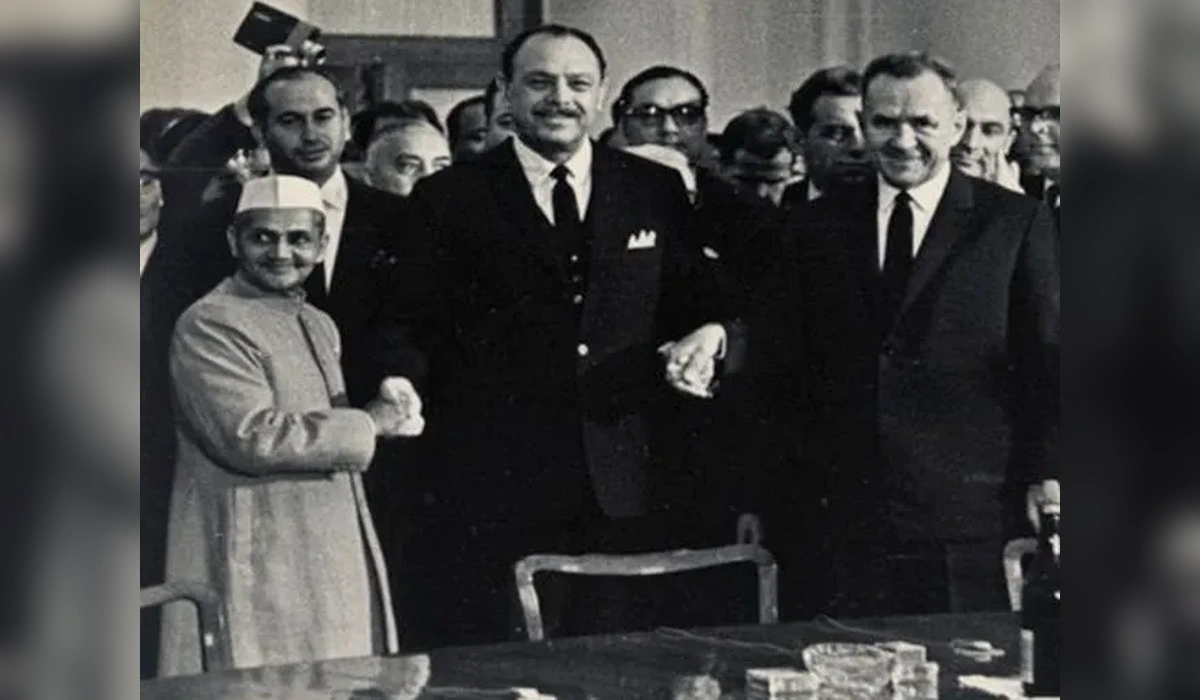
Kosygin brought Ayub to Tashkent on 4 January 1966. The declaration of 10 January restored the positions of 5 August. Haji Pir went back. Lal Bahadur Shastri died that night.
In the narrow sense, Ayub had done the responsible thing. He had a depleted army, an embargo, no ally willing to fight his war, and a country that could not sustain another round. But he had spent seventeen days of war telling Pakistanis on the radio that they were winning it, and he came home with nothing. Lahore and Rawalpindi rioted. The formula that would finish him was already circulating in the bazaars: what the soldiers won, the politicians gave away. It was unfair, and it was fatal.
Something in him broke at Tashkent. The confident Field Marshal of the Decade of Development becomes, from 1966 onwards, a defensive and increasingly isolated man, and after the heart attack of early 1968, an ill one.
How he got there
Born on 14 May 1907 at Rehana village in the Hazara hills, into a Tarin Pathan family; his father a risaldar-major of Hodson’s Horse. Aligarh, then Sandhurst from 1926 to 1928, then the 1/14th Punjab. He opted for Pakistan in 1947, commanded in East Bengal, became Adjutant-General, and in January 1951, aged forty-three and superseding several seniors, became the first Pakistani Commander-in-Chief.
He then did two things that shaped everything after.
He built the army’s foreign patron: the Mutual Defence Assistance Agreement of 1954, then SEATO and the Baghdad Pact, and the Pattons, Sabres and Starfighters that came with them. And he took a seat in Bogra’s 1954 “cabinet of talents” as Defence Minister, which gave the army its first taste of direct political office and set a precedent that has never been unlearned.
The seizure of power came in two stages, twenty days apart. On 7 October 1958 President Iskander Mirza abrogated the 1956 Constitution, cancelled the elections due early the following year, and named Ayub Chief Martial Law Administrator. On 27 October, Ayub removed Mirza and put him on a plane to London, where he died in 1969 in something close to poverty.
Ayub made himself Field Marshal shortly afterwards. Nobody conferred it.
Basic Democracies: a pyramid with a filter at every level
His answer to the problem of legitimacy was the Basic Democracies Order of October 1959. A pyramid: union councils at the base, then tehsil or thana councils, then district councils, then divisional councils. Eighty thousand “Basic Democrats”, split evenly between the two wings regardless of their very unequal populations, formed an electoral college. That college ratified him in the 1960 referendum, and under his 1962 Constitution it elected the President and the legislatures.
The theory had a genuine argument behind it, and he made it plainly. His people were not ready for direct adult franchise; party politics had produced only the squalid instability of 1947 to 1958; development had to precede democracy. Union councils would build roads and schools and teach the villager self-government from the bottom up.
The practice was a manageable college of eighty thousand small-town notables, each dependent on the deputy commissioner for development funds, and therefore biddable. A system designed to be filtered can always be filtered a little further, and everybody knew it.
January 1965: the campaign against Fatima Jinnah
The proof came in the presidential election of 2 January 1965, and it is the episode that most damages him.
The combined opposition put up Fatima Jinnah: the Quaid’s sister, seventy-one years old, unimpeachable, and until then a recluse from active politics. She campaigned on a single demand, direct adult franchise and the restoration of parliamentary government. The crowds she drew in Dhaka, Chittagong, Karachi and Lahore were the largest anyone had seen since Partition, and they frightened the regime badly.
The rigging was not crude ballot-stuffing. It did not need to be. The electorate was eighty thousand men whom the administration knew by name. Deputy commissioners were the returning officers and also the men who released development funds to each union council; Basic Democrats were canvassed, rewarded, warned, and where necessary replaced. Government servants worked the campaign openly. The state radio and the official press were Ayub’s entirely, and she was given nothing. The theological artillery was brought up as well: ulema were produced to rule that a woman could not head an Islamic state, by the same government whose Muslim Family Laws Ordinance those same ulema had been denouncing for four years.
Ayub took about sixty-three per cent of the college. He lost Dhaka and Karachi outright, which tells you what the result would have been on adult franchise. Few Pakistanis believed the count then, and fewer believe it now.
What followed was worse than the election. She was not left in peace. Her movements were restricted and her house in Karachi watched; visitors were noted, her correspondence interfered with, her public appearances obstructed. A woman who bore the most protected name in Pakistan spent her last two years under what amounted to house arrest and continuous surveillance, harried by the state her brother had founded. She died on 9 July 1967, alone, in circumstances her family has questioned ever since. Ayub, who could not touch her while she lived, gave her a state funeral once she was safely dead.
And in Karachi’s Lyari, a Bengali-majority quarter that had voted solidly for her, a victory procession led by Ayub’s son Gohar ended in violence and a number of deaths. The regime celebrated its win on the bodies of the people who had voted against it, and his own family supplied the image.
Eight months later he took the country to war on the strength of a mandate nobody believed in.
That is the whole sequence in miniature. A man who has hollowed out his own legitimacy has no reserve to draw on when the guns turn out to be pointed the wrong way. Worse, and this is what the battlefield arguments miss, he cannot afford to be told by anyone whose position depends on him that the Kashmiris will not rise and the Indians will cross at Lahore. Khem Karan was the battle he lost. January 1965 was the campaign.
The Decade of Development, and its bill
The ledger is real, and it should be stated before the bill is presented.
Growth close to six per cent a year. Industrial output rising faster than anywhere else in South Asia. The Green Revolution package of tubewells, fertiliser and Mexican wheat that turned West Punjab into a surplus province. Islamabad built from nothing. The Indus Waters Treaty of 1960, signed with Pandit Nehru at Karachi, and the Mangla and Tarbela dams it financed. And the Muslim Family Laws Ordinance of 1961, restricting polygamy and regulating divorce, which the clergy never forgave him for and which still stands on the statute book.
The counter-ledger was compiled by his own chief economist. Mahbub ul Haq’s “twenty-two families”, holding two-thirds of the country’s industrial assets, became the most quoted phrase in Pakistan. Growth had gone almost entirely to a narrow class created by licence and permit, which is to say created by the state that Ayub ran. His son Gohar, who had left the army in 1962 and married into the family that built the Gandhara industrial group, was Exhibit A; whether the specific allegations were ever proved mattered a great deal less than that they were universally believed.
The geography of it was worse than the class arithmetic. East Pakistan held the majority of the population and earned much of the country’s foreign exchange through jute, and watched it invested in the west. Per capita income diverged steadily across the decade. Bengalis were a token presence in the officer corps and the senior civil service. The Basic Democracies gave the two wings equal seats despite unequal populations, which was parity dressed up as fairness.
And in September 1965, when the war came, East Pakistan was left effectively undefended: one under-strength division, on the doctrine that the defence of the East lay in the West. Whatever the military logic, the political message received in Dhaka was that they were not defensible, and that nobody had tried.
Did he sow the seeds of Bangladesh?
He did not sow them. The ground was seeded before him, in the language riots of 1952 and in the treatment of Bengal from 1947 onwards. But he cultivated the crop with unusual thoroughness, and 1965 was the season it came up.
Mujibur Rahman’s Six Points, announced in February 1966, read as a direct invoice for the war: separate foreign exchange accounts, separate fiscal powers, a militia for the East, federal subjects limited to defence and foreign affairs. Ayub called it secession, and in January 1968 prosecuted Mujib in the Agartala Conspiracy Case for plotting with Indian assistance. The case was legally shaky and politically suicidal. It converted a regional politician into the undisputed voice of a nation-in-waiting, and when Ayub was forced to withdraw it in February 1969 and release him, the transformation was complete. Mujib went into that courtroom a party leader. He came out Bangabandhu.
So he was not the author of the break-up, but he was the man who took a grievance still negotiable in 1958 and made it non-negotiable by 1969. One-unit, parity, the undefended East, the jute earnings, the twenty-two families, the filtered electoral college, and finally the treason trial: each of them individually defensible in some administrative note somewhere, and collectively a demonstration to sixty million people that they would never govern themselves within Pakistan.
If Ayub had a second Russia, this was it, a retreat that ran east and took six years to complete.
The fall
From November 1968 the agitation ran continuously in both wings, students first, then lawyers, then labour, then everyone. He was sixty-one and had had a heart attack. His Round Table Conference of March 1969 conceded what he had spent a decade refusing: direct adult franchise and a parliamentary system. It came a year too late, and the principal opposition leaders stayed away.
On 25 March 1969 he resigned. He did not hand over to the Speaker of the National Assembly, as his own 1962 Constitution required. He handed over to his Commander-in-Chief, General Yahya Khan, who abrogated that Constitution within hours and declared martial law. It was the second time in eleven years that Ayub had stood on one side or the other of precisely this transaction.
Yahya held Pakistan’s first direct general election in December 1970, refused to seat the winner, and lost the eastern wing within the year. Ayub watched it from a house in Islamabad, a city he had built.
Afterwards
He was never tried, never rehabilitated, and never quite left alone. He lived under loose surveillance, saw few people, and kept a diary that was published only in 2007. Friends Not Masters had appeared in 1967, and reads now as the self-justification of a man who already suspected he would need one.
He died of a heart attack on 19 April 1974, aged sixty-six, and was buried at Rehana beside his father. The government of the day kept the funeral small and did not attend. There was no state mourning for the only Field Marshal Pakistan has ever had.
The family did better than the man. Gohar Ayub Khan entered the National Assembly, became its Speaker in 1990, and was Foreign Minister under Nawaz Sharif in 1997, in office during the nuclear tests of 1998. His son, Omar Ayub Khan, has been a federal minister and remains in politics. Four generations, from a risaldar-major of Hodson’s Horse to the front benches. Ayub Khan spent a decade insisting that he had come to save Pakistan from its political families, and he left behind one of the more durable ones.
So where was the Waterloo?
Armies survive a lost bridge, and Akhnoor was a bridge lost to a change of command. They survive a broken division too: Chawinda, a fortnight after Khem Karan, showed that Pakistan could still fight. And Tashkent returned a mountain pass that had been taken in the first place because Ayub’s own operation had failed, which no signature at a Soviet conference table could have retrieved.
The defeat was in the deputy commissioners’ offices the winter before the war, where eighty thousand Basic Democrats were counted, coaxed and instructed, and it was inflicted on an old woman who asked only that Pakistanis be allowed to vote for themselves. He won that one. It cost him the war, because a ruler who cannot be told the truth by his own officials will eventually be told it by somebody else’s army.

Leave a Comment