

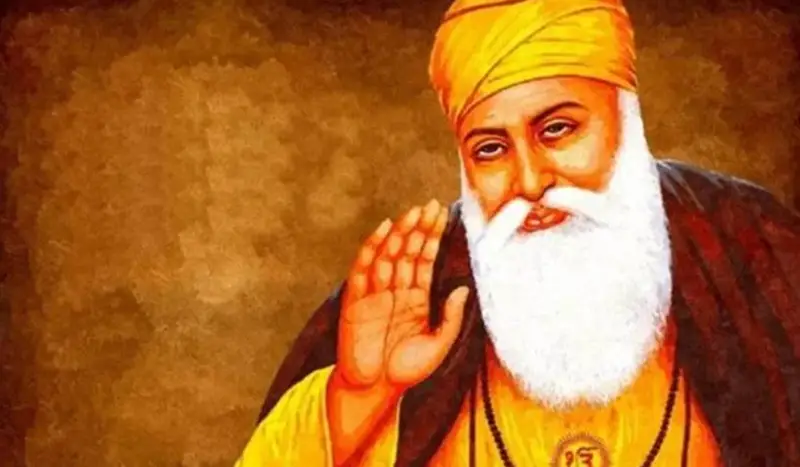

In the accounts of his Udasis, various kinds of ordinary-extraordinary human beings keep coming and going, in each of whose experiences invaluable lessons of life are inherent. In Kamrup of Assam, he meets a queen named Nurshah who had acquired mastery over magic and witchcraft. In the forest of Multan, he meets a thug whose name is Sajjan. He shows the right path to both of them.
The most important Gurbani associated with the Nurshah episode is ‘Kuchajji’, which Guru Nanak Dev Ji composed in Raag Suhi, Mahala 1, Ang 762. Although Nurshah’s name itself does not appear in the Guru Granth Sahib; its connection with Nurshah is found from the Janamsakhi-tradition. Nanak Ji says:
Kalaru keea vanjaaria, jhoongay musaku mange-n
Amalaa baajahu Naanaka, kiu kari khasami milen
That is, this world is like the salty land of salt and man has come into it like a merchant. He asks for a valuable object like musk, but he does not have the deeds worthy of it. Without good deeds, how can he meet his Lord?
In Patna, he found a gem one day. He said to Mardana, sell this and bring food. Mardana kept roaming in the market with the gem. Someone gave some copper coins, someone a little grain. Finally he reached the jeweler Salis Rai. The jeweler gave a hundred rupees in exchange for it, just because he got an opportunity to see that gem. Mardana felt that the jeweler had gone mad. Guru Nanak returned the rupees. Then he explained that this gem is like the life of man. Most of the people of the world do not know its value and lose it in exchange for trivial things.
Guru Ji’s second Udasi took him to South India and then up to Sri Lanka. During this, he also reached Rameswaram. In the tradition of this journey, his dialogues with many pilgrimages, saints-sages, and religious centers of South India are found. The story of meeting King Shivnabh in Sri Lanka is also associated with this very journey.
King Shivnabh of Sri Lanka was in search of truth, but had seen a lot of hypocrisy in the name of saints. Impressed by the devotion of a disciple of Guru Nanak, he called him and sent beautiful dancers to test him. But when they reached in front of Guru Nanak, they themselves were impressed hearing his hymns. The king understood that this is not that saint who can be caught in a little test. Guru Nanak told the king that the Formless has no form, therefore the boundaries of name, caste, race, and sect are also ultimately made by humans.
The third Udasi was towards the Himalayas. In this, traditions associated with Kashmir, the Himalayas, Tibet, Ladakh, Sumeru Mountain, etc., come up. In these journeys, the mention of places like Bilaspur, Jwalaji, Spiti, Tibet, Ladakh, Kargil, Amarnath, Srinagar, Kumaon, Garhwal, and Baramulla comes up.
This is that extensive northern travel-region in which his dialogues with the Siddhas and Yogis are placed. In your document too, Gorakh Matta, Sumeru Mountain, Gorakh Hatari, and Achal Batala have been described as the places of his major dialogues with the Yogis.
The fourth Udasi is counted among the journeys going to the farthest distances. Its center was the West – from Punjab towards Afghanistan, Iran, Iraq, and Arabia. In the tradition, the mention of places like Mecca, Medina, Baghdad, Basra, and Karbala is found.
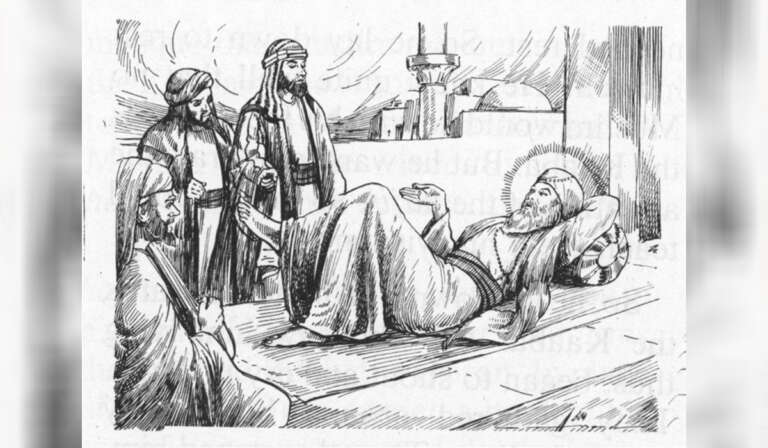
The episode of Mecca is of this very journey. There an objection was raised upon Guru Nanak’s feet being in the direction of the Kaaba and he raised that famous question that his feet should be turned in that direction where God is not there. This story is among the most famous Udasi-stories expressing his religious universality.
In this fourth Udasi, many scholars also add China, Iraq, Jordan, Turkey, and Russia among those places where Guru Nanak conversed with the local people. Solid evidence of this is not found, but even today he is remembered by the name of Nanak Kadamdar in Russia and Baba Foosa in China.
A fact is worth noting here. Guru Nanak did not tell people of different religions to leave their religion, but to recognize the soul of their religion. For example, he said to the Muslims met in Mecca –
Musalmaanu kahaavanu musakalu ja hoi ta musalmaanu kahaavai
Avali auli deenu kari mithaa, masakal maanaa maalu musaavai
Hoi musalimu deen muhaanai, maran jeevan ka bharamu chukaavai
Rabb di rajai manne siru oopari, karataa manne aapu gavaavai
Tau Nanak sarab jeeaa miharanmati hoi, ta musalmaanu kahaavai
That is, it is not easy to be called a Muslim; the one who can actually become like this, only he is worthy to be called a Muslim. First of all, he should make his religion the sweet and dear foundation of his life and should rub and take out the dirt of ego, greed, and illusion from within himself just like an object is scoured and cleaned. He is the true Muslim who hands over the rudder of his life in the hands of religion and becomes free from the illusion of birth and death. The one who accepts the will of God on his forehead, considers the Creator as his Doer and erases his ego. Guru Nanak says, when mercy and compassion for all living beings arises in his heart, only then can he be called a true Muslim.
In those days there were neither roads, nor trains, nor maps, nor modern communication. Still, Guru Nanak left Punjab and reached far-flung parts of India, Sri Lanka, the Himalayas, Tibet, and Muslim religious centers. That was a work of extraordinary courage. He did not create any safe, convenient religious world for himself. He came out of his home-family and established life and continuously kept going among strange people. He kept asking questions and kept facing questions.
Today, when different religious and social identities again appear so rigid, that great traveler of five hundred years ago seems even more extraordinary, who instead of sitting in one place and calling people to him, went to the people himself.
Guru Nanak’s Udasis are not merely lines drawn on a map. They are guidelines carved on the map of human consciousness. While going from Punjab to Bengal, from the South to Sri Lanka and then to the land of Arabia, Guru Nanak actually said only one thing to different people, in their own language and in their own questions – before finding God, learn to live like a human being.


Leave a Comment