

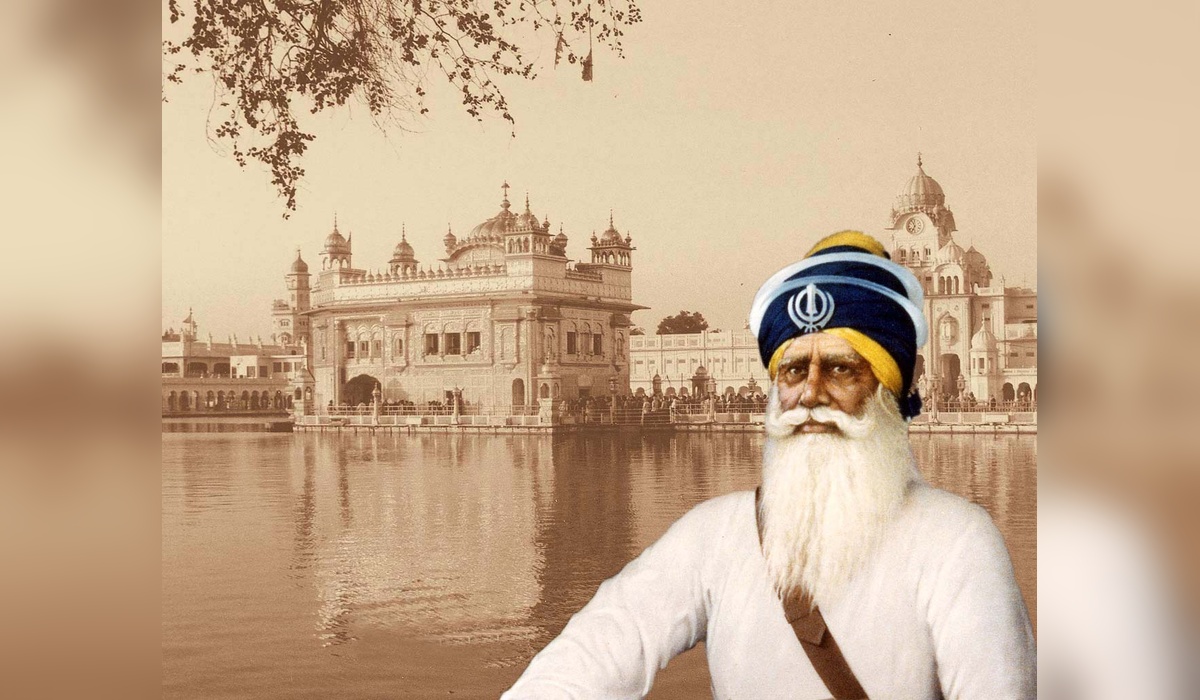

Those who adopt faith as a way of life become the embodiment of great transformation for themselves and for the world around them. Through this revolutionary change, they stand firmly before truth in the spiritual realm. As a result, a rare vastness and cosmic consciousness arise within them. They try to view the physical world through the lens of their eternal truth. For this very purpose, they struggle against those who violate the values laid down by their spiritual guides. They stand guard over truth and, for the restoration and preservation of these values, they are even willing to sacrifice their lives.
Among such great warriors was Baba Deep Singh Ji, who is honoured and remembered with the title “Shaheed.”
Baba Deep Singh Ji was born on 14 Magh, Samvat 1739, corresponding to January 1682, in the village of Pahuwind in Amritsar district, to Mata Jioni Ji and Bhai Bhagta Ji. Historians differ on Baba Deep Singh Ji’s caste background. According to Giani Niranjan Singh, he belonged to the Sandhu Jat lineage. However, Kahn Singh Nabha writes on page 638 of Mahan Kosh that he belonged to the Khaira gotra of Jats, which is considered more authentic.
Giani Niranjan Singh prepared Baba Deep Singh Ji’s genealogy. Baba Deep Singh Ji remained celibate throughout his life. His brother was Bhai Lala Ji; Bhai Lala Ji’s descendants included Bhai Karam Singh, Bhai Gulab Singh, Bhai Ala Singh, Sardar Kishan Singh, Sardar Gurbakhsh Singh, Sardar Gurbariam Singh, Sardar Gurdatar Singh Ji and Sardar Gurmahinder Pal Singh.
Although Baba Deep Singh Ji had no children to preserve his name and legacy, the indelible imprint of his words and deeds will remain engraved on people’s minds for as long as the world exists.
In childhood, Baba Deep Singh Ji was called Deepa. His parents were devoted followers of the Guru’s house. Listening to stories of the Guru’s house from his father had a deep impact on young Deepa’s mind. Baba Deep Singh Ji learned Gurmukhi very quickly. He acquired knowledge of Arabic and Persian while staying at Guru Gobind Singh Ji’s court in Anandpur Sahib.
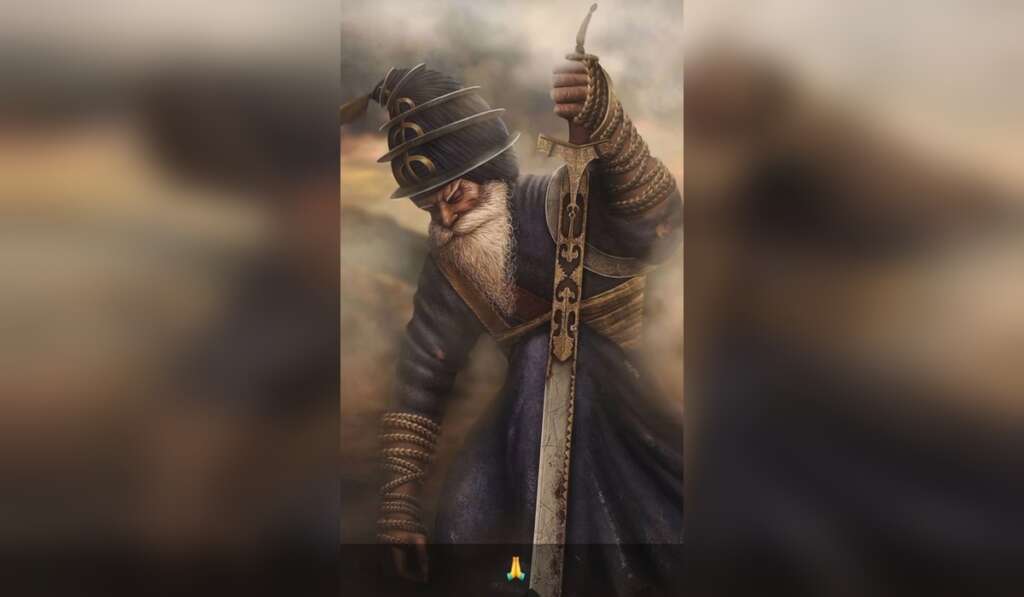
Guru Gobind Singh Ji created the Khalsa Panth in 1699. The following year, in 1700, Deepa reached Anandpur Sahib with his parents on the occasion of Vaisakhi to have the Guru’s darshan. The extraordinary events performed by the Tenth Master at the creation of the Khalsa left a deep impression on Deep Singh’s mind. At that time, Baba Deep Singh Ji was around 18 years old. Many historians believe that in 1700, Baba Deep Singh Ji received Khande Baate da Amrit and became Deep Singh from Deepa.
The word “Deep” comes from Sanskrit. In Punjabi, it means lamp or light — one that gives light to others. Baba Deep Singh Ji truly spent his entire life spreading the divine light of Gurbani among people.
While living at Anandpur Sahib, Baba Deep Singh Ji participated not only in the recitation and study of Gurbani, but also in langar, sweeping and many other forms of service. Through physical service and the reading of Gurbani, his mind became purified. His family stayed in Anandpur Sahib for three months and eleven days before returning to their village Pahuwind. Deep Singh, however, obeyed the Guru’s command and, with his parents’ permission, stayed back in Anandpur.
During his stay in Anandpur, Baba Deep Singh Ji became skilled in both spiritual and martial disciplines. He learned the meanings of Gurbani from Bhai Mani Singh Ji and memorised it. Along with this, he gained expertise in spear-fighting, horse-riding, swordsmanship and gatka. In his free time, Deep Singh served in the langar.
Seeing Baba Deep Singh Ji’s devotion to service and meditation, Guru Gobind Singh Ji included him among his Hazoori Sikhs, who remained present in the Guru’s service at all times. Because of his calm and devout nature, Bhai Deep Singh Ji earned a place of respect even among the Hazoori Sikhs. Everyone respected him and accepted his advice. Guru Ji’s affection for Baba Deep Singh Ji grew so much that he would take him along while going hunting.
From 1700 to 1705, for nearly five years, Baba Deep Singh Ji remained with Guru Gobind Singh Ji at Anandpur Sahib. In all the battles of Anandpur, Bhai Deep Singh Ji displayed great bravery and stood firmly by Guru Ji.
When Guru Gobind Singh Ji left the fort on the cold night of 6–7 Poh, he entrusted the care of Mata Sundari Ji and Mata Sahib Kaur Ji to Bhai Mani Singh, Bhai Deep Singh, Bhai Dhanna Singh and Bhai Jawahar Singh, sending them towards Delhi along with two maidservants. After staying for some time in Delhi at Bhai Jawahar Singh’s house and receiving the blessings of the Mothers, Bhai Deep Singh returned to his village Pahuwind. There, he would narrate Gurbani to the sangat twice daily, and the flow of kirtan continued.
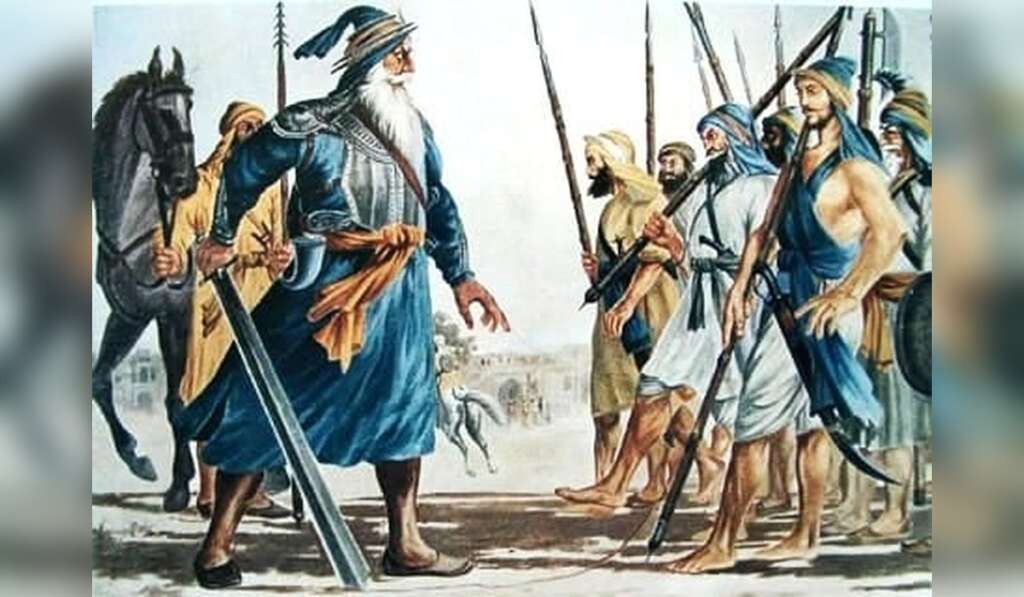
Meanwhile, after the battle of Muktsar, Guru Gobind Singh Ji reached Damdama Sahib, Sabo Ki Talwandi, in Bathinda district. There, he included the hymns of the Ninth Master, Sri Guru Tegh Bahadur Ji, in Sri Guru Granth Sahib. Since Dhirmal refused to hand over the original Adi Bir, Guru Gobind Singh Ji decided to prepare a new Bir. Bhai Mani Singh Ji also reached Damdama Sahib from Delhi. On Bhai Mani Singh Ji’s suggestion, Guru Ji called Bhai Deep Singh Ji to Damdama Sahib.
Guru Gobind Singh Ji assigned Bhai Mani Singh Ji the task of writing Gurbani and entrusted Bhai Deep Singh Ji with the service of preparing paper and pens. After the winter of 1705 ended and spring began, Guru Ji set up a tent and began the work of preparing the Bir. Guru Ji would dictate, Bhai Mani Singh Ji would write, and Bhai Deep Singh Ji would lovingly serve by arranging the paper and pens.
The 115 shabads and saloks of Guru Tegh Bahadur Ji were included in the Adi Granth according to the ragas. The first Bir contained 30 ragas, but in this Bir, one more raga, Jaijavanti, was added. As a result, the Damdami Bir contained 31 ragas. When the Bir was completed, the Tenth Master thanked Akal Purakh.
The historical importance of this Bir is evident from the fact that at the place where this sacred Bir was written, Gurdwara Likhansar now stands near the sarovar. Pilgrims visit the place and mark their presence by writing the Punjabi alphabet. Guru Gobind Singh Ji called this place “Guru Ki Kashi” and blessed it, saying that even the mute and the ignorant would gain education here and become scholars.
When the Tenth Master left Damdama Sahib for the south, the responsibility of this place was given to Bhai Deep Singh Ji. Guru Ji instructed him to stay there as a devoted servant of the Guru’s house and establish the tradition there: teach students, administer Amrit and make them firm in Rehat Maryada, preach Gurbani and Sikh history according to Gurmat, stand with the Panth in every difficulty, and write copies of the Adi Bir to spread the source of Gurbani.
Bhai Deep Singh Ji stayed at Damdama Sahib and began preaching Gurbani. He wrote gutkas of Gurbani with his own hands and distributed them to the sangat. While staying there, he made four handwritten copies of Sri Guru Granth Sahib and sent them to the four Takhts. Through this service, he rendered a great service to the Panth.
The first Bir was sent to Sri Akal Takht Sahib, Amritsar. It is known as the Darshani Bir and is decorated with two seers of gold. His handwriting appears as if golden pearls have been beautifully set in place. This Bir is shown to the sangat on different Gurpurabs. The second Bir was sent to Takht Sri Kesgarh Sahib, Anandpur Sahib. The third Bir was sent to Takht Sri Patna Sahib, Bihar. The fourth Bir was sent to Takht Sri Abchal Nagar, Nanded, Maharashtra.
Apart from writing Birs in Gurmukhi, Baba Deep Singh Ji also wrote one Bir in Arabic. Giani Niranjan Singh, citing Kirpal Singh Artist, says that Bhai Deep Singh Ji was the first renowned scholar and scribe of the Panth who wrote a Bir in Arabic with great devotion and reverence and sent it to the Arab world. Because of this, the message of Baba Nanak Dev Ji’s Bani is still present in the Islamic world.
While staying at Damdama Sahib, Baba Deep Singh Ji developed the Damdami Taksal. This Taksal is now known in three branches: the Bhindranwale Taksal, to which Sant Baba Sundar Singh Ji gave great prominence; the Mehta Sahib Taksal, established by Sant Kirpal Singh Ji; and the Amritsar Taksal, founded by Sant Amar Singh Ji Giani. In these Taksals, traditional meanings and knowledge of Gurbani are taught with great devotion, love and respect.
Many scholars educated in these Taksals have spread the message of Gurbani in India and abroad. Former head granthi of Sri Darbar Sahib, Giani Kirpal Singh Ji, was also a student of Damdami Taksal. The credit for the contribution these Taksals have made to Sikhism goes, in essence, to Baba Deep Singh Ji.
In 1708, Guru Gobind Singh Ji administered Amrit to Banda Singh Bahadur and sent him towards Punjab. Hukamnamas were sent to the Sikhs, instructing them to support him. One such hukamnama also reached Baba Deep Singh Ji at Damdama Sahib. Baba Deep Singh Ji read the Guru’s hukamnama to the sangat and called upon them to bring weapons.
No sooner had the hukamnama been heard than thousands of Sikhs gathered within a few days. A heap of weapons was collected. Baba Deep Singh Ji entrusted Bhai Natha Singh Ji with the care of the gurdwara, along with around 100 Sikhs, and himself set out with thousands of Sikhs to support Baba Banda Singh Bahadur. Among them were also 300 to 400 horsemen.
On the battlefield of Sirhind, they joined Banda Singh Bahadur and raised the cry of victory. They destroyed Sirhind and ended the tyranny of the cruel Wazir Khan. After Banda Singh’s victories, when Banda Singh Bahadur came to Anandpur Sahib for darshan, Baba Deep Singh stayed with him there for three months. At Anandpur, Baba Deep Singh restarted the earlier routine: kirtan would take place twice daily, and the sangat was taught the meanings of Gurbani.
During his stay at Anandpur, Banda Singh once publicly praised Baba Deep Singh Ji’s support before the sangat. But Baba Deep Singh Ji stopped Banda Singh from praising him and said, “I am a Sikh of Guru Gobind Singh Ji. I will continue to perform my duty all my life.”
As Banda Singh gained victories everywhere, public respect for him increased. Seeing so much honour coming his way, he began to develop pride in his own power. He started believing that these victories had become possible only because of him, although many warriors like Baba Deep Singh had supported him. Banda Bahadur forgot the Guru’s teachings and began living in royal splendour. His greatest mistake was sitting on a throne at Harmandir Sahib.
When Baba Deep Singh Ji learned of Banda’s action, he came to Harmandir Sahib and challenged Banda Bahadur in a thundering voice. Seeing Baba Deep Singh Ji’s face red with anger, Banda Bahadur trembled from head to toe. In the sangat, Baba Binod Singh and Baba Kahan Singh rose and removed Banda from the throne.
In this way, Banda Singh Bahadur maintained a separate code of conduct. Because of this, the Sikhs gathered at Akal Takht Sahib to form a separate group. Baba Deep Singh returned to Damdama Sahib at that time. At the gathering held at Akal Takht Sahib, the decision to form a separate group from Banda Bahadur was finalised. The Tat Khalsa came into existence.
On Vaisakhi in 1716, a large gathering of the Khalsa took place at Amritsar. Many offerings were made, but a dispute arose between the two groups over the offerings. Baba Deep Singh Ji resolved this dispute with his wisdom and understanding.
In 1734, Bhai Mani Singh Ji was martyred. After that, Zakariya Khan, the governor of Lahore, continued plotting politically to establish control over the Sikhs. He cleverly formed a committee of some prominent leaders for the management of Harmandir Sahib and appointed Massa Ranghar as its head.
After gaining authority, Massa Ranghar’s evil mind became corrupted. He placed a cot inside Darbar Sahib, smoked a hookah and held dance performances there. Strict royal guards were posted around Amritsar. The Sikhs could endure many forms of oppression, but how could they tolerate the desecration of Harmandir Sahib, which was dearer to them than life?
At that time, Guru’s Sikhs were living away from Amritsar, in Bikaner, Rajputana and Damdama Sahib. News of Massa Ranghar’s vile actions reached Bhai Budha Singh in Rajasthan. He immediately reached Gurdwara Damdama Sahib with his jatha and met Bhai Deep Singh Ji. Bhai Budha Ji narrated Massa Ranghar’s deeds to Baba Deep Singh Ji. Baba Ji’s body trembled with emotion and his face turned red. He was filled with martial spirit.
In the full divan at Damdama Sahib, Baba Ji narrated the entire incident to the sangat. Hearing it, the blood of the Sikhs boiled. From the divan, two Sikhs — Bhai Sukha Singh of Mari Kamboki, Amritsar district, and Bhai Mehtab Singh of Mirankot Khurd, Amritsar district — sought Baba Deep Singh Ji’s permission to bring Massa Ranghar’s severed head. Baba Deep Singh Ji performed ardas, took the Guru’s command, blessed the two Sikhs and sent them off. Disguised as village officials, they beheaded Massa Ranghar. Massa Ranghar was punished for his evil deeds.
In 1746, in an attempt to wipe out the Sikhs, Yahya Khan, the governor of Punjab, and the Hindu Diwan Lakhpat Rai surrounded the Sikhs gathered in the Kahnuwan forests with the help of royal forces. Baba Deep Singh Ji was also among the besieged Sikhs with his jatha. The forest was set on fire and attacks were launched, but because of Bhai Deep Singh Ji and other wise Sikhs, the Sikhs survived.
As Gurbani says:
“Jis da Sahib daadha hoi,
Tis no maar na sakai koi.”
When one’s Master is powerful, no one can destroy them.
The merciful hand of the Tenth Master was upon the Sikh Panth.
In 1748, considering the conditions of the time and the intentions of tyrannical rulers, Punjab was divided into 12 major Sikh groups, known as misls. One of the prominent misls was the Shaheed Misl, associated with Baba Deep Singh Ji. Baba Deep Singh Ji became the founder of the Shaheed Misl.
In 1758, Baba Deep Singh Ji also mediated a settlement between the princely states of Jaisalmer and Bikaner. During the invasions of Ahmad Shah Abdali, Baba Deep Singh Ji, along with Jassa Singh Ahluwalia and his Sikh soldiers, freed many Sikh youths, girls and women from Abdali’s clutches. When Abdali learned of this, he decided to teach the Sikhs of Punjab a lesson. He now wanted to erase the Sikhs completely.
When Abdali attacked again, he asked royal informers about the whereabouts of the Sikhs. They told him that the Sikhs had a sacred pool in Amritsar, and by bathing in it they gained great strength. Hearing this, Abdali angrily ordered that the sacred sarovar of Harmandir Sahib be filled up. The Mughal army obeyed and attacked Amritsar. The Amritsar sarovar was filled in. This incident caused great anguish across Punjab.
The news quickly reached Baba Deep Singh Ji at Damdama Sahib. He entrusted the care of the dera to Bhai Masadda Singh Ji. Before setting out to liberate Harmandir Sahib, many people from nearby villages came and joined Baba Deep Singh Ji. After performing ardas, they marched towards Harmandir Sahib.
During the ardas, Baba Deep Singh Ji said, “O Master of martyrs, standing at your feet, I vow that until I uproot the flags of the oppressors from Amritsar, I shall remain alive. I am going to embrace martyrdom, but I will be martyred only after reaching the feet of Guru Ram Das Ji.”
This was a unique ardas in world history — a vow to remain alive until the task of dharam yudh was completed.
With 5,000 Sikhs, Baba Deep Singh Ji reached the plains of Chabba between Amritsar and Tarn Taran. From the other side, Jahan Khan advanced with 20,000 soldiers to stop the Sikhs. Both armies came face to face at Gohalwar, about six miles from Amritsar. The Sikhs were surging with zeal to destroy the Mughal tyrants.
As soon as both armies entered the battlefield, fierce fighting began. Jahan Khan’s companions, Yaqub Khan and Aman Khan, were encouraging their troops. Baba Gurbakhsh Singh Ji arrived from Anandpur Sahib with his jatha. Seeing the number of Sikhs increase, panic spread among the Mughal army.
Dayal Singh struck Jahan Khan with his spear, which passed through his body. Another Sikh cut off his head and raised it on a spear. Seeing their leader’s severed head, the Mughal army was thrown into chaos and began retreating.
Baba Deep Singh Ji advanced, cutting down the enemy. While fighting, Baba Nodh Singh Ji was martyred. After him, Baba Deep Singh Ji took command of the jatha. The Sikhs attacked the Mughals from all sides. Mughal commander Jamal Khan confronted Baba Deep Singh. Both warriors blocked each other’s blows for nearly two hours. Then, in a simultaneous strike, both were severely wounded.
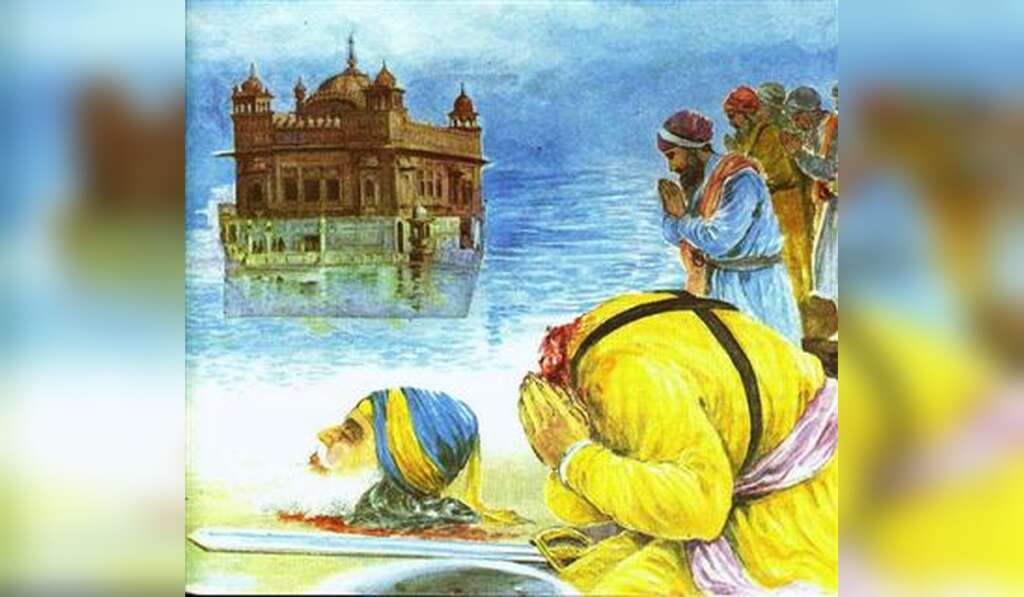
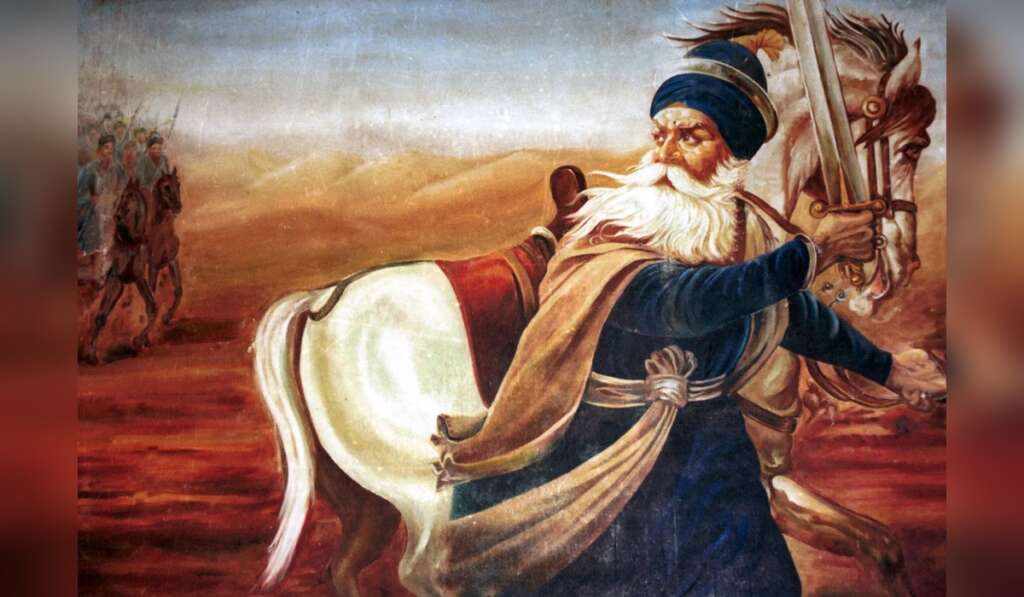
Baba Deep Singh Ji’s head was separated from his body. As his body was about to fall, a Sikh reminded him that he had vowed to offer his head at the feet of Guru Ram Das Ji in Amritsar — and that he had not yet reached there. Hearing this, Baba Deep Singh Ji placed his severed head on his left palm and, with his right hand, continued swinging his 18-seer khanda, cutting through the enemy and advancing forward.
Seeing Baba Deep Singh Ji fighting in this state, the Mughals fled in fear. At the place where Baba Deep Singh Ji’s head was separated from his body, Gurdwara Tahla Sahib stands today. After this, carrying his head on his palm and fighting as he advanced, Baba Deep Singh Ji reached the parikrama of Harmandir Sahib. He bowed his head before Harmandir Sahib.
Where his body fell, Gurdwara Baba Deep Singh Ji da Bunga stands today inside the parikrama. Where these martyrs were cremated, Gurdwara Shaheed Ganj stands today. Devotees come from far and wide to Gurdwara Shaheed Ganj, and the elders of Amritsar say that anyone who comes there with a sincere ardas always has their prayer fulfilled.
This warrior, true in both word and deed, offered his head in the name of the Guru and fulfilled his vow. He placed his head at the feet of the Sodhi Master and, by dying, became immortal forever.
About such martyrs, Bhagat Kabir Ji has said:
“Marta marta jag mua,
Mar bhi na jania koi.
Aisi marni jo marai,
Bahur na marna hoi.”
The world dies again and again, yet does not know how to die.
One who dies such a death does not have to die again.
Baba Deep Singh Ji was cremated east of Gurdwara Ramsar, outside the Chatiwind Gate. Gurdwara Shaheed Ganj stands there in his memory. Apart from this, Baba Deep Singh Ji’s waist-belt, sword, steel weapon and a five-foot-long matchlock gun are preserved at Gurdwara Sees Ganj.
Because of this great sacrifice, Deepa became Deep, Deep became Deep Singh, and Deep Singh became immortal as Shaheed Baba Deep Singh Ji.

Leave a Comment