
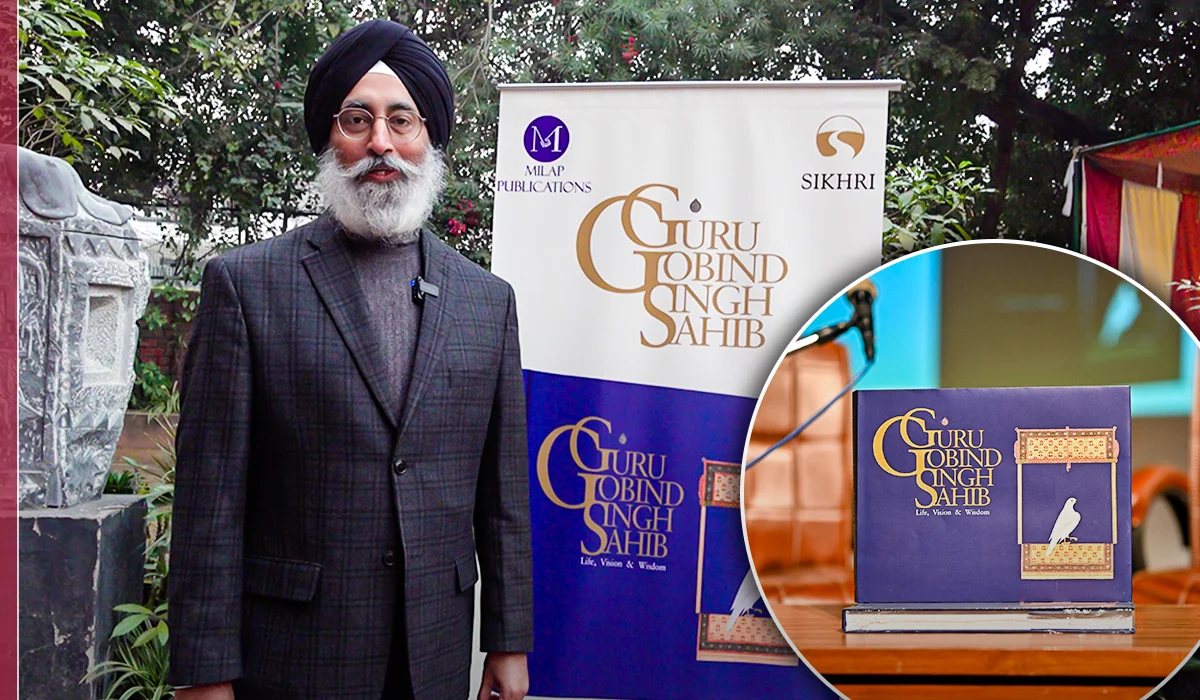

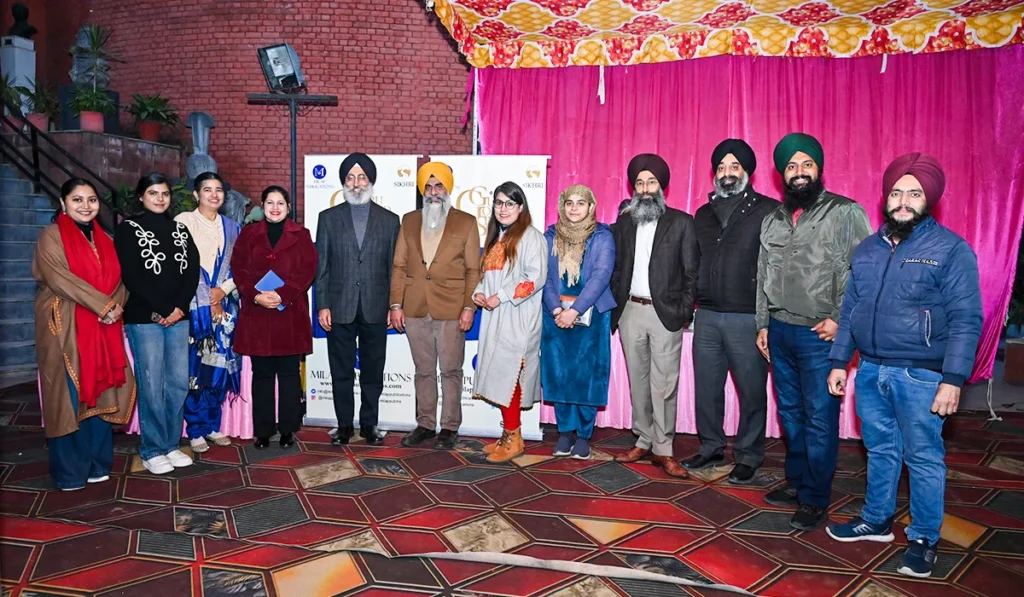
A thought-provoking and knowledge-rich dialogue was held at Punjab Kala Bhavan, Chandigarh, centred on the book “Guru Gobind Singh: Life, Vision, Wisdom.” Sikh scholar and author Harinder Singh participated in the discussion, which saw active engagement from leading scholars of Punjabi and Sikh studies as well as attentive readers.
Senior journalist and writer Rupinder Singh joined Harinder Singh in the conversation. Various dimensions of Guru Gobind Singh Ji’s life, vision, and legacy were explored, allowing the audience to engage deeply with the book’s literary and spiritual foundations.
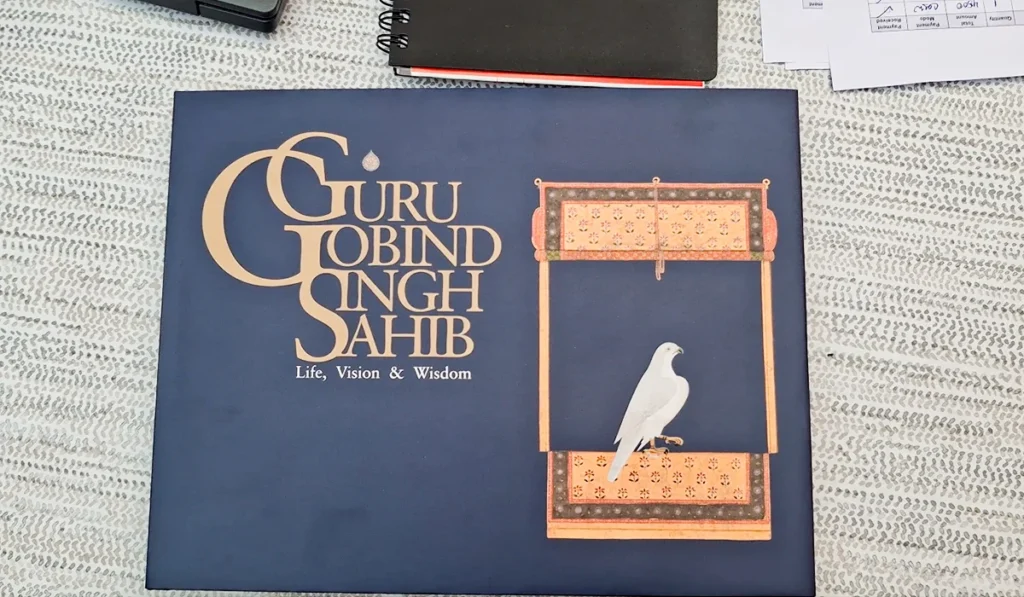
The book is primarily anchored in the compositions of Shabad Hazare, which reflect the Guru’s timeless vision and boundless compassion. In accordance with Sikh tradition, no image or portrait of Guru Gobind Singh Ji appears in the book. Rather than visually depicting the Guru, the book seeks to awaken the Guru’s presence within the reader through wisdom and reflection. The presence is not displayed on the page — it is awakened within the mind.
Following the dialogue, Harinder Singh spoke with the Sada Punjab team. The interaction is presented verbatim in a question–answer format, preserving the depth of discussion, the emotional authenticity linked to the Guru’s greatness, and the seriousness of the author’s thought.
Question: What inspired you to work on a book based on the life of Guru Gobind Singh Ji?
Harinder Singh: I have worked on a book based on the life of Guru Gobind Singh Ji — though it would be more accurate to say that I have compiled it. The Bani belongs to the Guru. What I have done is bring together the writings of the Tenth Guru’s court poets, such as Bhai Nand Lal Goya and Chand Sen Senapati.
The motivation arose because we often do not fully understand the intellectual and spiritual vision of Guru Gobind Singh Ji. What took shape between Patna Sahib and Anandpur Sahib? Between the martyrdom of Guru Tegh Bahadur Ji and the creation of the Khalsa on Vaisakhi — nearly two decades — what kind of poetry, art, warrior ethos, spiritual literature, and collective consciousness was emerging?
The challenge was how to present the Guru’s vision — through the words of his own poets and those who lived in his presence. This book is an attempt in that direction.
Today, there is a growing trend of idolization of the Gurus, and it was important to explore how the Shabad could be presented without creating a physical image. This aspect has been given special attention.
Question: During the dialogue, perceptions surrounding the Guru were discussed. Could you explain this further?
Harinder Singh: In reality, we all carry personal assumptions about the Gurus — including Guru Nanak Sahib and Guru Gobind Singh Ji. The important question is why these assumptions exist.
We often do not view the Guru through the framework of Guru Granth Sahib Ji — we view him through our own intellect, politics, and limited perspectives. But the Guru exists on a cosmic and universal scale, while our mental frameworks are small. This mismatch leads to personal interpretations.
People say he was a great poet, a great warrior. There have been many poets and warriors. Guru Gobind Singh Ji was both — but above all, he was a Badshah Darvesh, a king-saint.
The Guru’s poets help us move beyond narrow perceptions and present the Guru in his complete form. Only when we understand this completeness do we grasp why the Guru fought wars, why he wrote the Zafarnama, how he dealt with kings who were sometimes allies and sometimes adversaries, and why Anandpur Sahib was established.
We struggle to understand these realities because we do not yet comprehend the Guru’s wholeness. Expanding that understanding is essential.
Question: How can religious and spiritual knowledge be meaningfully shared with the world today?
Harinder Singh: Knowledge can never be copyrighted. In the Gurbani tradition, the Shabad existed before it was revealed. The Guru showed us the path, and by following that path, we draw closer to truth.
Understanding the original language and context is essential for anyone translating or presenting it in another language. One must understand the Guru’s linguistic world before rendering it into English or Persian.
The Gurus never discriminated between languages. They used Persian, Arabic forms, Sanskrit, Sadh Bhasha, old Punjabi, Sindhi, Braj — every language available to them.
As Gurbani says, “Bhakhia bhaao apaar” — the language of love is infinite. The responsibility is to present the Guru’s complete vision in the language and context of the people, while remaining connected to original sources.
Question: Without images, how can readers experience the Guru’s presence?
Harinder Singh: This is a matter of love (preet). Through love, intellect becomes refined. Our thinking is constantly shaped by education, books, and media. Gurbani says, “Gharheeai shabad sachi taksaal” — the self is forged through the Shabad.
We receive vast information today, much of it necessary. But the most refined knowledge closeness to the Guru emerges only through love.
True scholars of the Guru possess mastery over language, but what matters most is expressing understanding through the language of love. That is where genuine connection begins.


Leave a Comment