

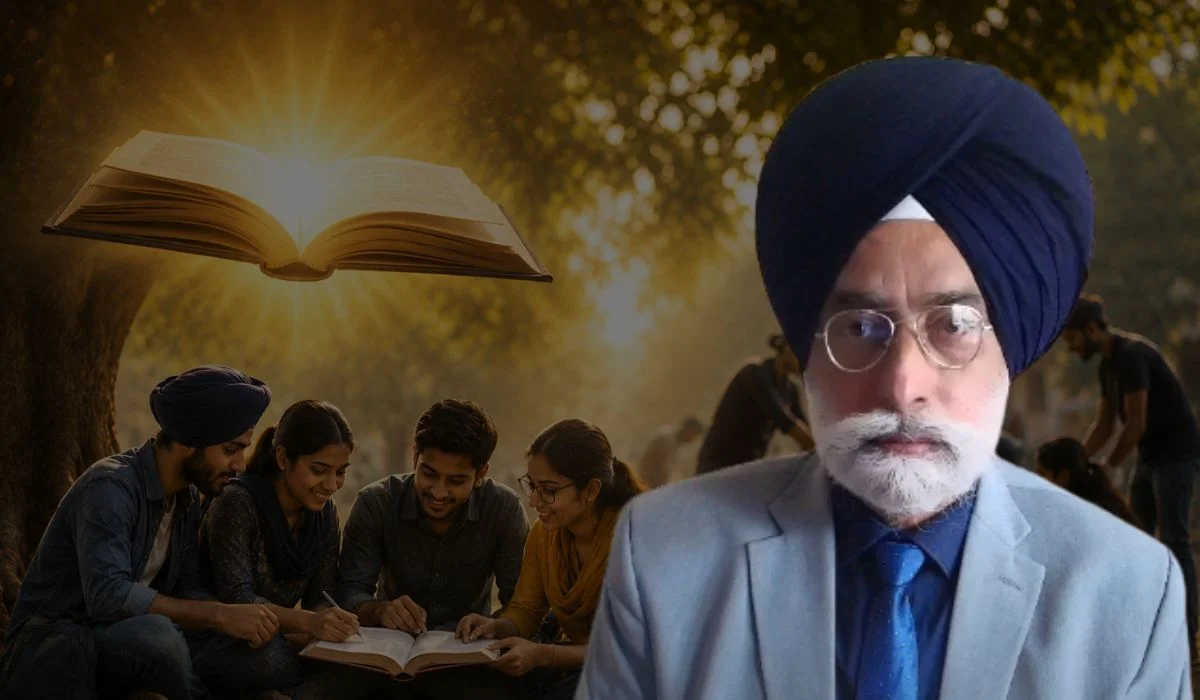

In today’s world, education is often viewed primarily as a pathway to degrees, lucrative careers, and financial success. However, according to Dr. Inderpal Singh, Life Trustee of the Global Sikh Education Mission, the teachings of Guru Nanak Dev Ji offer a much deeper perspective. Guru Nanak’s words, “Vidia Vichari Ta Parupkari” (True knowledge, when reflected upon, leads to service of humanity), emphasize that education should ultimately make a person beneficial to society. Knowledge used only for personal gain cannot bring meaningful change to the world.
The growing incidence of cybercrime and other unethical activities among educated individuals highlights a serious gap in modern education systems—the erosion of moral values. For the past 53 years, the Guru Gobind Singh Study Circle has worked to revive these principles of ethics, character, and selfless service. Dr. Inderpal Singh has played a significant role in the organization’s growth and evolution over the decades.
Origins of the Study Circle
The Guru Gobind Singh Study Circle was not established through a formal long-term plan. Rather, it emerged as a response to the social circumstances of its time.
In 1972, a student movement in Moga demanding cheaper cinema tickets led to police firing, resulting in the deaths of two students. The incident intensified the influence of left-wing student movements across Punjab. During this period, five students of Government College, Ludhiana—Jatinder Pal Singh, Gurmeet Singh, Balwinder Singh, Manmohan Singh Salani, and Harpal Singh—sought permission to celebrate Guru Nanak Dev Ji’s Gurpurab on campus. Fearing tensions, the college principal refused.
The refusal deeply disturbed the students. They questioned how, in the very land where Guru Nanak had preached “Ik Onkar” and the welfare of all humanity, discussion of his teachings could be discouraged. Determined to proceed, they organized the celebration themselves on the college football ground in September 1972.
The following year, Dr. M.S. Randhawa, Vice-Chancellor of Punjab Agricultural University, recognized and encouraged the initiative, leading to the formation of the first official unit of the Study Circle. According to Dr. Inderpal Singh, the organization has since continued guiding generations of young people toward constructive social engagement.
Building Character Through Education
The central mission of the Guru Gobind Singh Study Circle is to cultivate ethical values among youth.
The organization conducts moral education examinations, camps, and educational programs in schools and colleges. In 2025 alone, more than 150,000 students participated in these examinations. The objective is simple yet profound: regardless of whether students become doctors, engineers, entrepreneurs, or professionals, they must first become responsible human beings.
One of the most remarkable features of the movement is its volunteer-driven nature. Since its inception, no member has worked on a salary. Volunteers contribute their time, resources, and often a portion of their earnings through the Sikh tradition of dasvandh (contributing one-tenth of one’s income for community welfare).
As a result, individuals who joined the movement as students over five decades ago continue to serve actively today, working alongside younger generations.
Embracing Technology While Preserving Values
The Study Circle has consistently adapted to changing times.
In its early years, communication relied on cyclostyle machines and typewriters. As technology evolved, the organization established computer facilities at its Ludhiana headquarters among the earliest educational and social institutions to do so.
Dr. Inderpal Singh believes technology itself is neutral; its impact depends on how it is used. In the age of Artificial Intelligence, young people must engage with technology rather than fear it. Since AI systems learn from the content available online, the responsibility lies with society to create and promote positive, constructive content.
According to this vision, technology should become a vehicle for ethical education rather than a source of misinformation or division.
Understanding Heritage and History
Dr. Inderpal Singh also stresses the importance of historical awareness.
He observes that many members of Generation Z prefer to focus only on the present and future, often dismissing history as irrelevant. However, he argues that no society can build a meaningful future without understanding its past.
Communities that forget their history eventually lose their direction and identity. Awareness of heritage provides both inspiration and guidance for future generations.
He points to the era of Maharaja Ranjit Singh, during which educational institutions were closely connected to gurdwaras, temples, and mosques. Education was deeply integrated into community life. According to Dr. Inderpal Singh, if modern religious institutions allocated even ten percent of their resources toward education, transformative social change could occur.
The Power of the Pen
For Dr. Inderpal Singh, ideas and words possess greater long-term power than weapons.
He cites Guru Nanak Dev Ji’s response to the invasions of Babur. Rather than responding through violence, Guru Nanak challenged injustice through truth and fearless expression, famously condemning oppression through his verses.
This demonstrates the enduring power of intellectual and moral courage. The pen, he argues, remains one of society’s strongest tools for confronting injustice and shaping public consciousness.
The Sikh Ideal of a Complete Human Being
The philosophy of Guru Granth Sahib presents a vision of the complete human being.
Historically, society divided responsibilities among different social groups—knowledge, governance, commerce, and service. The Sikh Gurus rejected this fragmentation and instead sought to cultivate all these qualities within a single individual.
According to this ideal, a complete person should possess:
* Knowledge and wisdom
* Physical courage and strength
* Economic responsibility and honesty
* Humility and a spirit of service
The goal is not specialization alone, but balanced human development.
The Dignity of Labour
Another key principle emphasized by the Study Circle is the dignity of labour.
Dr. Inderpal Singh notes that in many developed countries, highly educated individuals perform everyday tasks themselves without feeling any loss of status. Sikh teachings similarly emphasize honest work, self-reliance, and service.
Manual labour is not viewed as inferior; rather, it helps eliminate ego and cultivate humility. Through work and service, individuals remain grounded and connected to society.
A Relay Race Across Generations
Dr. Inderpal Singh describes the journey of the Guru Gobind Singh Study Circle as a relay race.
Each generation carries the responsibility for a period of time before passing it to the next. The organization’s objective is to ensure that future leadership remains in the hands of educated, ethical, socially conscious young people.
Its vision extends beyond academic success. It seeks to create individuals who combine knowledge with character, achievement with service, and progress with moral responsibility.
In a time when education is increasingly measured by salaries and credentials, the Guru Gobind Singh Study Circle continues to advocate a broader vision—one in which learning, labour, ethics, and service work together to build both strong individuals and a stronger society.

Leave a Comment