
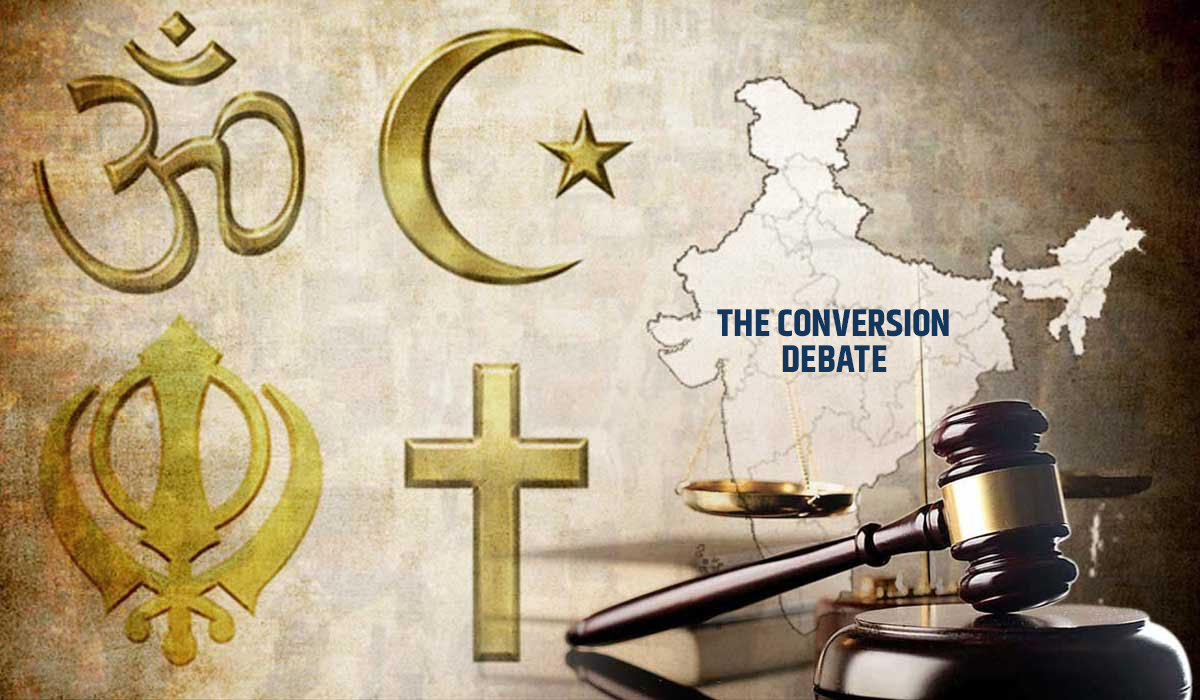

The Constitution of India gives every citizen the right to adopt any religion or belief of his own free will in Articles 19 to 25. In any developed democracy and secular country, religion is a personal matter for the individual. But for the last few years, the issue of religious conversion has been gaining momentum in the country’s politics. All political parties are cashing in on conversion politics – either by opposing conversion or supporting the freedom to convert. Many BJP-ruled states have already enacted strict anti-religious conversion laws.
Parties opposing conversions claim that preachers of other religions are converting people, especially the poor and Dalits, by force or lure. However, those opposing anti-conversion laws argue that the reasons for religious conversion lie in socio-economic inequality and the centuries-old system of caste and untouchability, still practiced in many parts of the country.
The issue of conversion is widely being debated in Punjab these days. It is being said that Dalit Sikhs and Hindus are converted by Christian preachers who offer them bribes. The number of churches in Punjab is seen to have increased over the years, especially in the Doaba and Majha regions. According to the 2011 census, the population of Christians in Punjab was at 1.5 percent. It is estimated that it has increased since then but there are no exact figures available. At the non-governmental level, the increase in numbers is estimated to be 15 percent but these facts do not seem to match the reality.
In Punjab, the number of people going to churches, especially those run independently by priests without affiliation to traditional Catholic or Protestant churches, has increased in the past few years. People gather in such churches every week. Churches have been built in many villages in the border areas of Punjab, especially in Gurdaspur and Amritsar, which are mostly attended by Balmik and Mazhabi Sikhs from the Dalit community. Most of the religious gurus who run these churches are from the so-called upper castes.
On social media, one can find many hymns and songs devoted to Jesus Christ, the singers of which are also from ordinary Dalit families. There are some Dalit artistes who say these churches have given due recognition to their art. Dalit devotees say these churches provide them with mental and physical solace. In educational institutions run by Christian gurus, their children get good education for free or at a very low fee. Devotees also say that the respect and honor they receive here is not accorded to them in their old religion. Dalits who adopted Christianity would mention their old religion in government records to avail the reservation quota. However, the Supreme Court has now put an end to this by barring reservations for those who get converted.
There are a large number of turbaned people among those who go to churches. There are some who perform the rituals or prayers of their old religion and the ‘mantra’ or prayer given by Jesus Christ is also recited by the priest. For this reason, many scholars of Punjab see it as Deraism instead of conversion, where people believe in the head of the Dera (saint) in the hope of getting rid of their suffering but remain attached to their old religion at the same time. In many Dalit houses of Majha, one can find a picture of Jesus Christ alongside those of the Sikh gurus.
The converts argue that their old religion discriminates against them on the basis of caste. They oppose their targeting by the hardline Sikh groups saying, like others, they too have the right to follow their religion of choice. No one has the right to obstruct their religious freedom. They also demand that their right to reservation should be maintained even after they adopt Christianity. The issue of land for cemeteries in the border areas is the main issue of these Christian followers.
The population of Dalits in Punjab stands at 32 percent. In rural areas, it goes up to 37 percent. In many areas of the Doaba region, this population goes up to 45 to 50 percent, but the entire vote bank of Dalits never swings to one side. There are many reasons for this. The Dalit community in Punjab is divided into 39 castes, whose mutual interests are in conflict with each other.
However, it is believed that the condition of Dalits in Punjab is better compared to other states (especially North India). There is no place for casteism in Sikhism either. But there are some truths of the present and the past that cannot be wished away.
In the early 20th century, discrimination against Dalits was prevalent in the Golden Temple. There was a separate time slot for them to visit the Darbar Sahib and a separate place for bathing. The Mahant Pujari class, patronized by the British at that time, did not accept offerings from the hands of Dalits, nor were prayers offered for them. The Sikh community itself had to fight a long battle against this evil.
Punjabi writer Balbir Madhopuri, in his article ‘Aadi Dharm Aaye Dalitan Saal Kupre Sakae’ published in the ‘Punjabi Tribune’ on 25 June 2020, wrote that before the 1931 census, when ‘Aadi Dharm’ was registered as a new religion in Punjab, organizational oppression of the society considered untouchable by Hindus and Sikhs, was evident. Hindus and Sikhs questioned how those who were considered slaves for centuries had become their equal. Therefore, the ‘untouchables’ were surrounded in protest. They were attacked in many places. At that time, Dalits who had their religion listed as ‘Adi Dharam’ in the census were killed.
Balbir Madhopuri, the author of the autobiography ‘Chhangya Rukh’, which exposes the caste discrimination against Dalits in Punjab, says, “The castes considered lower in Punjab have certainly improved somewhat economically after independence. But their fight against social inequality is still ongoing. Since childhood, I have personally witnessed and endured oppression, such as untouchability, prohibition of Dalits from entering gurdwaras, and physical abuse of Dalit daughters and sisters. News of Dalits being banned from many gurdwaras in Punjab is still being received. That is why separate gurdwaras and deras for Dalits came into existence and many Dalits became Christians. In many villages, Dalit crematoriums are separate. Announcements of social boycott of Dalits are still made in gurdwaras today.”
In 2003, tension between Jats and Dalits over the participation of Dalits in the management committee of ‘Gurdwara Shaheed Nihal Singh’ in village Talhan in Jalandhar district became a topic of discussion at the national level. After this, the Jat community called for a boycott of Dalits. There were large-scale protests by Dalits during which a Dalit activist named Vijay Kumar died.
In 2014, a ‘Ghar Wapsi’ campaign was launched in different parts of the country, under which poor Christians and Muslims were reconverted to Hinduism. In a village in Bathinda district of Punjab, Dalit Christians (who were also religious Sikhs) were reconverted to Sikhism. During the ceremony, a locket featuring Bhai Jaita Ji was placed around the neck of the converts. Following this incident, the Jathedar of Akal Takht criticized it and called this action an interference in Sikhism. He said in a statement that forcibly converting someone was against Sikh principles. Many Sikh scholars also criticized this incident saying that the issue of conversion was not an issue in Sikhism. It was alleged that certain hardline Hindu organisations were trying to force their traditions and thoughts on Sikhism.
Following this, an incident of desecration of Guru Granth Sahib in Punjab hurt Sikh sentiments. A series of similar incidents took place, the full truth of which could not be revealed. Gradually, religious and emotional issues gained momentum in Punjab politics. In the past few years, Sikh leaders also started opposing the conversion of Dalits to Christianity. The Shiromani Gurdwara Parbandhak Committee has even started its own campaign to stop this.
In the past, certain hardline Sikh groups have made hateful statements against Christian preachers and have vandalized Christian events. Before going to jail, Member of Parliament Amritpal Singh also kept making hateful statements against Christianity and Jesus Christ. Keeping their vote bank in mind, other political parties also stoked the issue. During the 2024 Lok Sabha elections, all leading parties openly spoke about Dalits becoming Christians. Religious conversions have become an important issue for political parties in Punjab. However, hardly any party is willing to go into the reasons behind the conversions.
Many Sikh scholars like Jaspal Sidhu have been raising the point strongly that opposing religious conversion is against Sikh principles. Sikhism stands on the philosophy that one should remain steadfast in one’s religion, however, if someone decides to change their religion then they should be allowed to do so without forcing them to reconvert. With elections around the corner, the principles of Sikhism seem to have taken a backseat, as the anti- and pro- conversion parties stir up the conversion debate to garner votes.
Disclaimer: The views expressed in this article are solely those of the author and do not reflect the views or opinions of Sadda Punjab or any affiliated organization.

Leave a Comment