



There was a time when one of the biggest concerns in independent India’s political, social and economic circles was the country’s rising population. An uncontrolled population was seen as one of the biggest obstacles in the path of national progress. Slogans like “Hum Do, Hamare Do” and “Small Family, Happy Family” echoed in government offices, bus stands, radio and television.
Family planning was implemented across the country as a national campaign. But today, in the third decade of the 21st century, the story has almost completely reversed. Many Indian states that once feared a “population explosion” are now witnessing such a sharp fall in birth rates that governments are becoming worried about an ageing population, emptying schools and a shrinking working-age workforce.
Old Ideas of Family Planning Have Been Shaken
The latest and most striking example of this demographic shift has come from Andhra Pradesh. Chief Minister N. Chandrababu Naidu has made an announcement that has shaken old assumptions about family planning. Under a proposed scheme, the Andhra Pradesh government is preparing to offer special financial and social support to families having more than two children.
The draft scheme proposes direct financial assistance of ₹30,000 on the birth of a third child and ₹40,000 on the birth of a fourth child. The government is also seriously considering free education for the third child up to the age of 18 and nutritional support for newborns.
Naidu’s move is not merely a local policy decision. It is one of the first formal signals that India’s population story has reached a serious turning point.
The Mathematics of Fertility Rate and Worrying Numbers
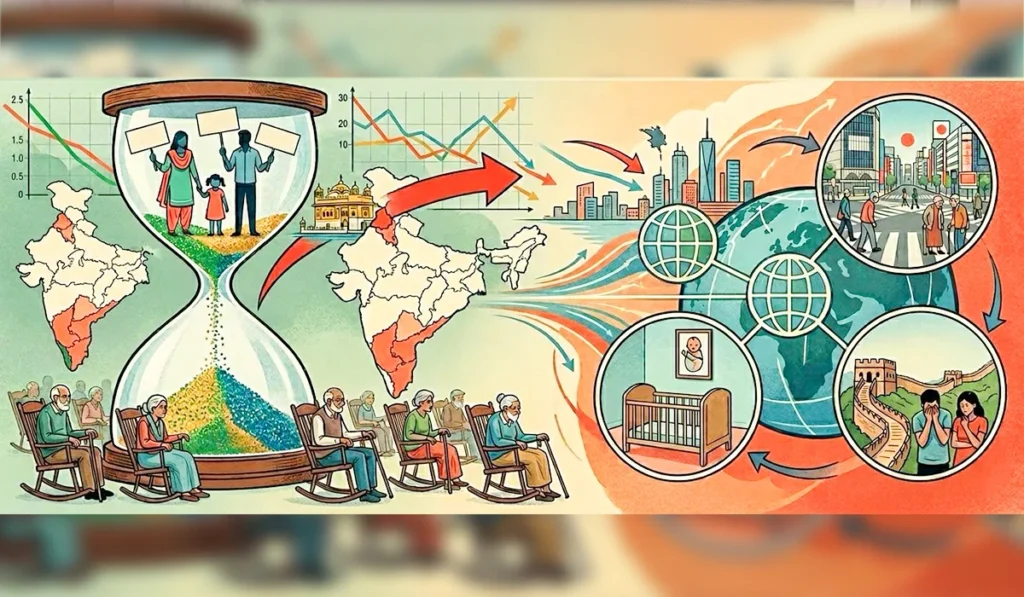
At the centre of this debate is an important technical term: Total Fertility Rate, or TFR. In simple terms, it means the average number of children a woman is expected to have during her lifetime.
According to demographers, a fertility rate of 2.1 is necessary to keep a country or region’s population stable. This is known as the replacement level.
If the fertility rate falls below 2.1, it means the next generation will be smaller than the current one, and over time, the population may begin to decline. Data from the National Family Health Survey-5, conducted by the Union Ministry of Health and Family Welfare, shows that India’s national average fertility rate has now fallen to 2.0, which is below the replacement level.
In the 1990s, India’s fertility rate was around 3.4. But in many Indian states, especially in the south and west, the decline has been much sharper. In Andhra Pradesh, the rate has fallen to between 1.5 and 1.7. In developed states such as Kerala, Tamil Nadu, Karnataka and Maharashtra too, the figure is well below 2.1.
Punjab’s Falling Birth Rate and the Double Crisis of Brain Drain
Like the southern states, Punjab is now among the leading states with a low birth rate. According to NFHS-5 data, Punjab’s total fertility rate has fallen to just 1.6. This is deeply worrying because Punjab’s situation is different and more complicated than many other states.
Punjab is facing a double crisis. On one side, fewer children are being born in homes. On the other, a large number of young people are migrating abroad.
Young Punjabis are moving to countries such as Canada, Australia, Britain and the United States for education and jobs. This trend, often described as brain drain, has left many villages in Punjab emptier than before. On one side, not enough children are being born; on the other, the youth who are already there are leaving the state.
If this trend continues for another decade or two, Punjab may face a severe shortage of working-age people needed to take care of the elderly and sustain agriculture and industry. Although the Punjab government has not yet announced any direct financial incentive for larger families like Andhra Pradesh, concern over this issue is clearly visible at both administrative and social levels.
Lessons From Japan, South Korea and China
This demographic crisis is not limited to India. Many developed countries are already facing its consequences. Japan is one of the biggest examples, where the fertility rate has remained around 1.2 for several years. As a result, thousands of schools have shut down due to lack of children, villages have emptied, and the ageing population has placed a heavy burden on pensions and healthcare.
South Korea’s situation is even more alarming. Its fertility rate has fallen to around 0.72, the lowest in the world.
The biggest lesson comes from China. The country that once strictly enforced the One-Child Policy to control its population has now realised the long-term cost of that decision. A shrinking workforce is affecting China’s economy. The government first allowed two children, then three children, and is now offering tax benefits and other incentives to encourage families to have more children.
Several European countries, including Italy and Norway, offer long paid parental leave and childcare allowances. Yet people remain reluctant to have more children.
Changing Mindsets and Socio-Economic Reasons
Why do people now want fewer children? There are deep social and economic reasons behind this shift.
The cost of living in cities has risen sharply. It has become difficult to accommodate large families in small flats. In today’s world, giving one child a good education and upbringing has become so expensive that middle-class families hesitate even before planning a second child.
Women’s higher education and growing career awareness have also changed family patterns. Marriages are happening later, which reduces the fertility window, or the age period during which couples are likely to have children.
The biggest irony of this situation is that the same country that spent decades and crores of rupees trying to reduce population growth is now becoming concerned about demographic imbalance.
India still has a large young population because of states such as Uttar Pradesh and Bihar. But if the decline continues in developed regions such as Punjab, Kerala and Andhra Pradesh, regional and economic imbalance within the country may increase sharply.
Andhra Pradesh’s move marks the beginning of a new chapter in India’s population policy. In the coming years, Punjab and other states may also have to move beyond population control and frame positive policies for demographic balance, so that the country does not grow old before it grows fully prepared.


Leave a Comment