
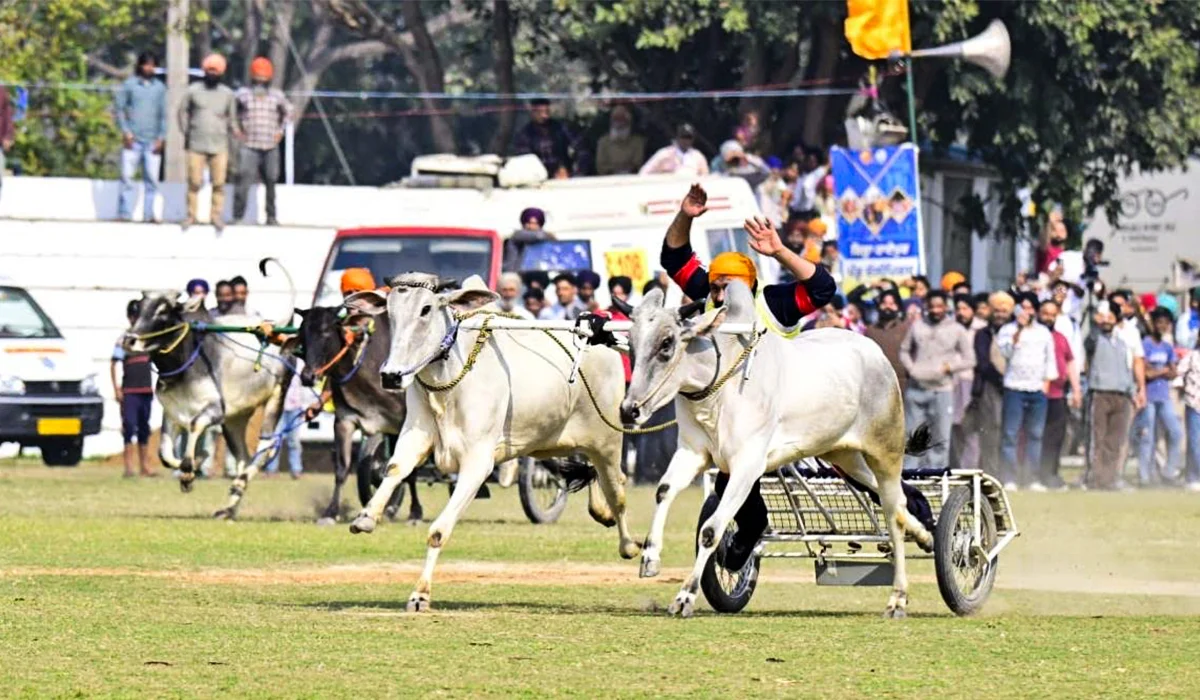

The Kila Raipur Games began yesterday. Punjab’s Agriculture and Animal Husbandry Minister, S. Gurmeet Singh Khuddian, arrived to inaugurate the bullock cart races. The Bhagwant Singh Mann government has earned appreciation by fulfilling the aspirations of bullock cart drivers. Now it is the responsibility of the drivers to adhere to the newly framed rules and regulations.
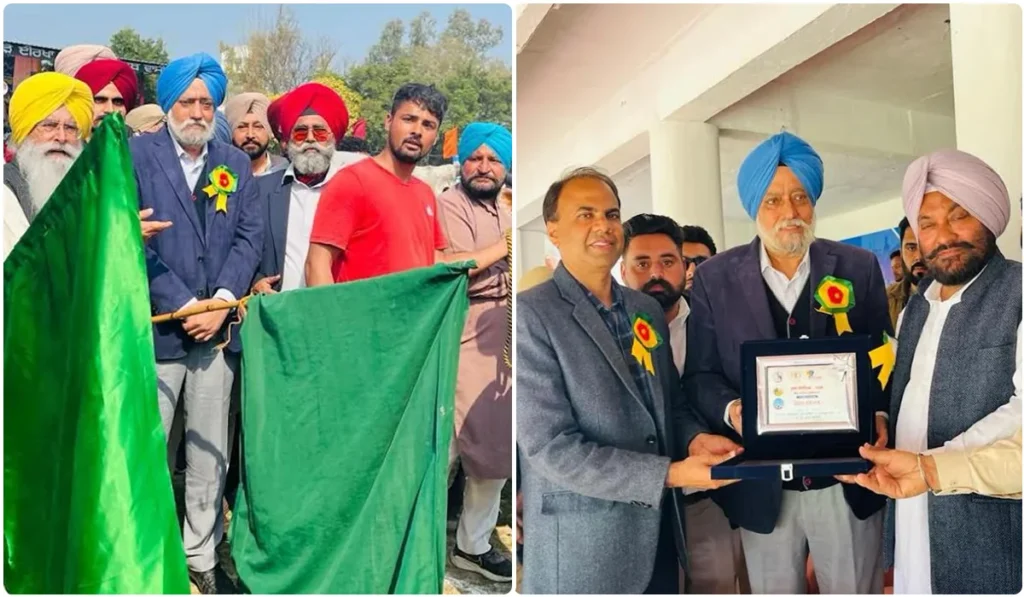
I first witnessed these games in 1974–75. That year, President V.V. Giri was expected to attend. However, due to dust and fog, the aircraft could not land and he had to return. Inspired by S. Barjinder Singh Hamdard, I wrote an article about these games for his monthly magazine Drishti. The article included a photograph of Teja Singh, a bullock cart driver from Gujjarwal. At that time, four bullock carts would race together. For the first time, I met the founder of this race, S. Bakshish Singh Grewal, through Paramjit Pammi. His son, Surjit Singh Grewal, led the games for many years. Years later, we had his portrait painted by PAU teacher Sukhwinder Saggu. All India Radio’s Assistant Director Harbhajan Singh Batalvi conducted an interview of Bakshish Singh for radio and also wrote an article. It was published in the Kila Raipur Games souvenir under the title:
“Bakshi chaalak nahi kise ban jaana, ghar-ghar putt jamde.”
Today, Batalvi ji is no longer in this world, and Bapu Bakshish Singh too has passed on, but their memories remain alive.
In December 1978, I married Nirpajeet in Kila Raipur. Through this bond, I stayed closely associated with family friends here — Harbhajan Coach, Jindu Bai, Daljit Singh Grewal, Harjit Singh Hari, Pammi Ghuggi, Billu, Dara, Gyan, Sarba, Noti, Meeta, Kamal, Rajwinder, and Gyani Harjit. For many years, I continued writing about the games and helped invite folk singers.
S. Joginder Singh Grewal, PT Sahib, used to give lively commentary. Later, Dara took over the microphone, then Gyani Harjit and many others. PT Sahib may rightly be considered the originator of rural sports fair commentary. He was a very affectionate soul. It was he who brought Karamjit Singh Dhuri to the games every year, even bestowing on him the title “Kaka Dhuri Wala.” Karamjit was born in Doaba, originally from Mand Butala on the banks of the Beas River. He belonged to the Ball clan but never used it as a surname, he never wrote it with his name. Because of his excellent singing, Principal Sant Singh Sekhon brought him to Mata Gujri College, Sri Fatehgarh Sahib.
It was at the Kila Raipur Games that, at my request, he performed live a song written by Gurdev Singh Mann:
“Bai mitran di loon di dali,
Ni tu mishri barobar jaani.
Ni mitran di garvi da,
Mitha sharbat varga paani.”
Years ago, he even had a stage competition with Jagmohan Kaur. Both had deep knowledge of Punjabi and Urdu poetry. One would step aside, the other would take the mic. The contest lasted an hour and a half. I have never witnessed such an engaging and rich competition in my life. Twice, we also staged plays by S. Gursharan Singh ji at these games, and once even organized a rationalist show.
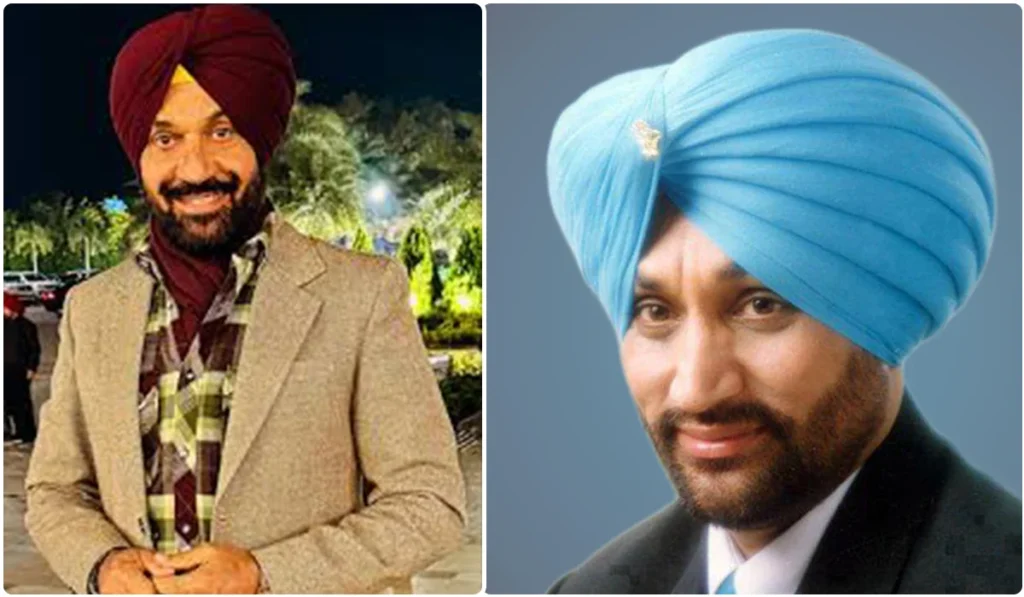
The late singer Surjit Bindrakhia was presented here for the first time at Pammi Bai’s suggestion, along with JG Bains, brought by Shamsher Singh Sandhu. I remember Surjit Bindrakhia arriving by bus from his village. Pammi was not even paying him full fare, but the following year, after his cassette release, the organizers invited him again for ten thousand rupees on Shamsher Singh Sandhu’s recommendation.
JG Bains too was brought by Shamsher. Sukshinder Shinda and Inderjit Bains introduced him. Initially, the organizers did not give him time, but eventually allowed him to sing one song. When he sang “Ghuggiyan da joda” in his powerful voice, the audience demanded encore after encore. He ended up singing three more songs. His attire and stage name were not what they are today. He may have forgotten that moment, but I still remember.
Photographers such as Yog Jaye, Karam Singh, Swadesh Talwar, Thakur Dalip Singh, Janmeja Singh Johal, Harbhajan Singh Bajwa, Santokh Singh Mander, Satwant Singh Nandhra, Tejpartap Singh Sandhu, Ranjodh Singh, Harinder Dhillon, and many others spread the aura of these games nationally and internationally. Publications in London and the Indo-Canadian Times featured their photographs on front pages.
In 1986, I wrote a sports anthem for the Kila Raipur Games. It was recorded by Narendra Biba ji and played for many years during the games. It was also broadcast on All India Radio’s rural program.
The song was:
**“Khedan khedo te khidao
Ae Punjab wasio!
Jarron eerkha mukao
Ae Punjab wasio!
Khedan khedna khidauna
Saada dharam nishaan.
Saade waste hai ehi
Hun deen te imaan.
Saare ral mil gao
Ae Punjab wasio!
Saare dharman de lok
Ral khedde kabaddi.
Kade aave na dhyaan
Kehdi jaat chhoti vaddi.
Ehi sabak padhaao
Ae Punjab wasio!
Bailgaddiyan di daud da
Nazara vekh lo.
Eka bauldan da jittda
Ishaara vekh lo.
Pyaar chetna vadhao
Ae Punjab wasio!
Pave kikkli te giddha
Boli paun mutiyaaran.
Lage ambran ton lathiyan ne
Koonjan dian daaran.
Koonjan agg ton bachao
Ae Punjab wasio!
Jarron eerkha mukao
Ae Punjab wasio!”**
I later included this song in my collection Phullan Di Jhanjar. It became a matter of pride for me that, at my request, eminent lyricists Inderjit Hasanpuri, Hardev Dilgir, and Pali Detwalia also wrote sports songs about the Kila Raipur Games.
Time has passed swiftly. A sports writer should write a comprehensive book on these games. The resumption of bullock cart races after twelve years is historic, and the Punjab Legislative Assembly and Punjab Government deserve congratulations. For the past three years, the Punjab Government, with village support, has been organizing these games.
You too should come today and tomorrow to witness and cherish the proud moments of the Kila Raipur Games.
Leave a Comment