
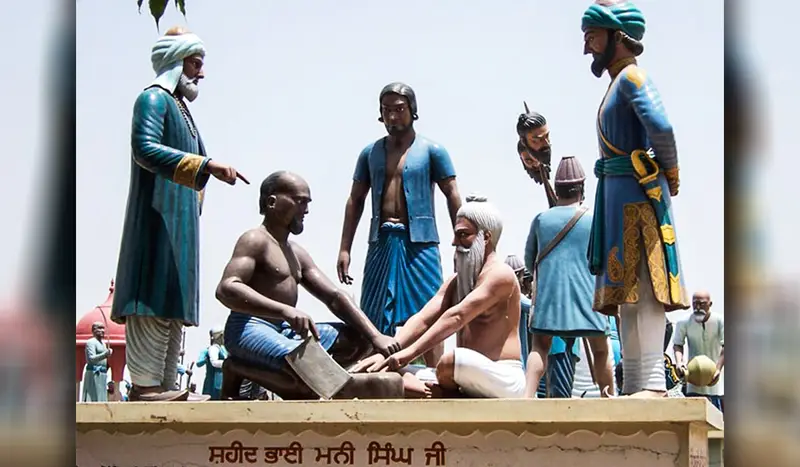

Bhai Mani Singh Ji was born in the village of Kaibowal near Sunam. When he was only five years old, his father presented him in the presence of Sri Guru Tegh Bahadur Sahib Ji. At that time, devotees often offered their children to the dera of the great saints. Therefore, from a young age, Bhai Mani Singh remained in the service of the ninth Guru and Guru Gobind Singh Ji Maharaj. Bhai Mani Singh Ji took Amrit from Guru Gobind Singh Ji and was named Mani Singh from Mani. In Sammat 1761 Bikrami, when Guru Gobind Singh Ji Maharaj left Sri Anandpur Sahib forever, he was assigned the duty of taking Mata Sundari Ji and Mata Sahib Kaur Ji to Delhi, in which he achieved great success and took both the mothers to Delhi. As per the Guru’s orders, he remained with his mothers.
Bhai Mani Singh Ji is not remembered only for his martyrdom, but for safeguarding Sikh intellectual tradition at a time when both physical survival and scriptural integrity of the Panth were under threat. His life represents the rare convergence of scholarship, spiritual discipline, and fearless resistance. When Bhai Mani Singh Ji received the information in Delhi that Guru Gobind Singh Ji had reached Talwandi Sabo, you took both your mothers with you and reached Guru Ji at Damdama Sahib.
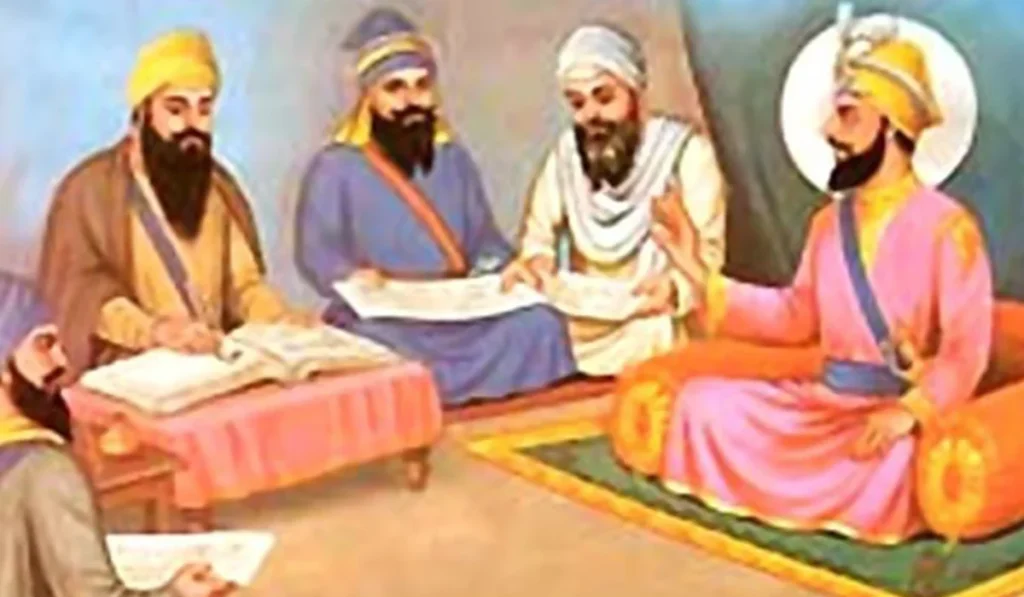
At Takht Sri Damdama Sahib, Guru Gobind Singh Ji prepared the Damdami Bir, in which the sacred Bani was standardized and compiled in its final form. Later, in 1708 at Nanded, Guru Gobind Singh Ji bestowed Guruship upon Sri Guru Granth Sahib Ji, which remains the eternal Guru of the Sikhs. Bhai Mani Singh Ji served as the principal scribe and wrote the sacred Bani as dictated by Guru Gobind Singh Ji. Guru Gobind Singh Ji kept making you write Gurbani and you kept writing. Baba Deep Singh Ji continued to serve the paper, ink and pens during the preparation of the sacred Sri Guru Granth Sahib Ji. Bhai Mani Singh Ji was not merely a granthi, but one of the foremost scholars of Gurbani of his time. His deep understanding of raag-based structure, linguistic nuance, and oral tradition made him uniquely qualified to assist Guru Gobind Singh Ji during the preparation of the Damdami Bir.
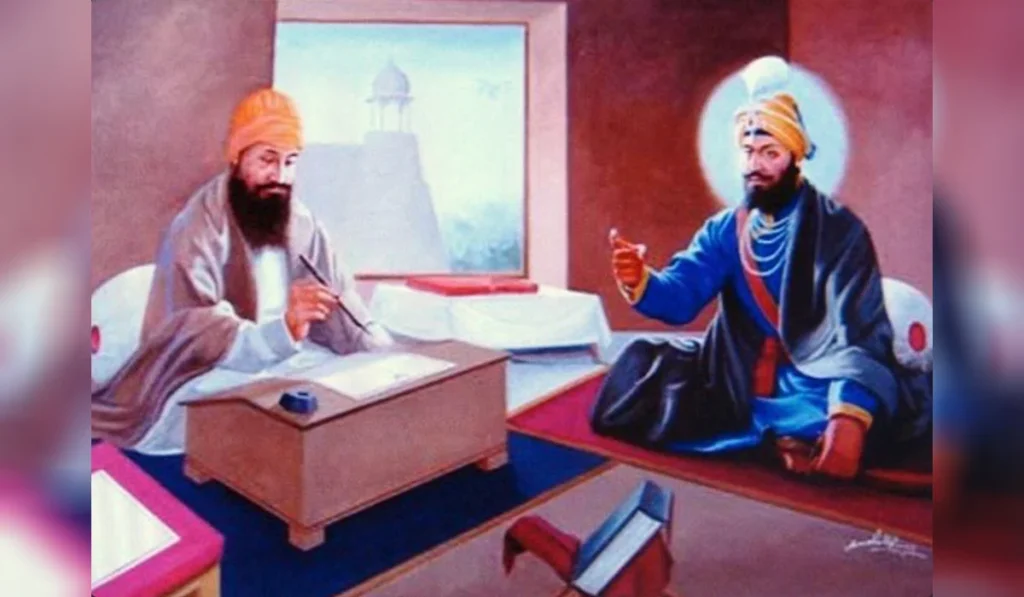
According to Bikrami Samvat 1778 (corresponding to 1721 AD), Mata Sundari Ji appointed Bhai Mani Singh Ji as the Chief Granthi of Sri Harmandir Sahib Amritsar Sahib Ji and sent him there. While staying here, Bhai Mani Singh Ji prepared a unique Bir of Guru Granth Sahib Ji. In this, different verses of all the Gurus were given in different ragas. However, this Bir was not accepted for Panthic use, and according to some traditional Sikh historical accounts, Bhai Mani Singh Ji later faced severe opposition and suffering.
During this period, the Diwan of Lahore, Lakhpat Rai, intensified the persecution of the Sikhs. He expelled the Budha Dal from the Bari Doab. The Budha Dal left there and came to Malwa where Baba Ala Singh warmly welcomed the Budha Dal in his capital Barnala and took Amrit from the hands of the head of the Budha Dal, Nawab Kapur Singh. Meanwhile, when the Budha Dal was returning towards Majha with fresh energy, Lakhpat Rai took an army of seven thousand soldiers under his command and attacked the Budha Dal. In which the Budha Dal suffered a lot of losses. When the Taruna Dal came to know about this incident, it quickly reached the help of the Budha Dal. Both the parties joined forces and attacked the Mughal army because the Mughal army had not yet reached Lahore.
A fierce battle took place near Hujra Shah Muqim where the Sikhs inflicted a heavy defeat on the Mughals. In this battle, Lakhpat Rai’s nephew Duni Chand and his two famous generals Tatar Khan and Jamal Khan were also killed. The Sikhs were encouraged by this victory and they created chaos in the entire area up to Amritsar and started surrounding and beating the Mughals. The government came into action again and they captured Amritsar Sahib. All the routes leading to here were closed. The Singhs were also prevented from visiting Sri Darbar Sahib Amritsar. The government launched a campaign of repression against the Sikhs and thousands of Sikhs were killed. For Bhai Mani Singh Ji, Gurbani was not text alone, it was lived resistance. Preserving the Guru’s word, enabling Sangat to gather, and maintaining collective Sikh practice were acts of spiritual defiance against tyranny.
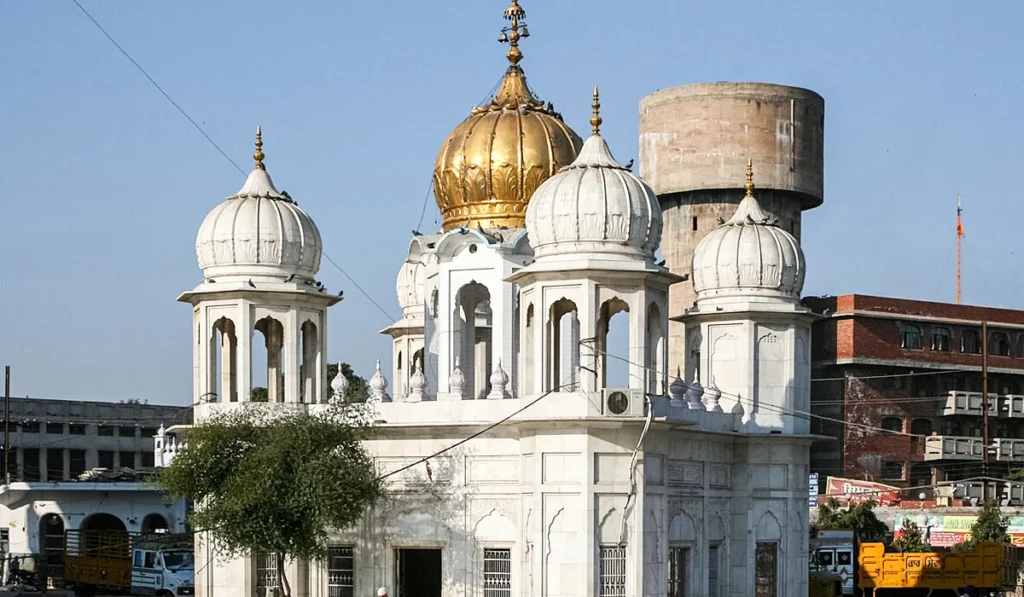
On this occasion, the great scholar and highly respected Sikh of that time, Bhai Mani Singh Ji, wrote a letter to the Governor of Lahore demanding permission to hold a Diwali fair at Sri Harmandir Sahib. The government gave this permission on the condition that a heavy monetary tax, recorded in Sikh historical sources as five thousand rupees, would have to be deposited with the government in case of holding the fair. Bhai Mani Singh Ji obtained permission to continue this fair for ten days. He hoped that a large number of devotees would gather here, from which five thousand rupees would be collected and paid to the government. However, the Governor, considering this occasion as a good opportunity, decided to massacre the Sikhs. A large army was sent to Amritsar Sahib under the leadership of Diwan Lakhpat Rai. This army set up its camp at the place of Ram Tirath. Earlier, Bhai Mani Singh had written letters to the Sikh devotees far and wide that this time the Diwali fair would be held at Sri Harmandir Sahib, Amritsar Sahib. But when he received news from the informer that if the Sikhs gathered here, they would be massacred, Bhai Mani Singh Ji tried to cancel his earlier information by sending special men.
Even then, this information could not reach the far-flung areas and the Sikhs had reached Amritsar Sahib in large numbers. The Mughal army attacked the Sikhs. Due to which the fair was scattered and the offerings could not be collected. The government arrested Bhai Mani Singh Ji on the charge that he had not paid the prescribed five thousand rupees to the government. Bhai Mani Singh Ji was told that either he should deposit the money or else he would be put to death. Along with this, he was offered to convert to Islam to escape death, but Bhai Mani Singh Ji, while not giving up his Sikh religion, on the contrary told the government that if the government allowed the fair to be held, the tax would have been paid to the government. He said that the government had been dishonest with him. It was the day of Diwali. Bhai Mani Singh Ji was captured and taken to Lahore where he was sentenced to be martyred by cutting his body. Here Bhai Mani Singh Ji was martyred by cutting his body. The holy Shaheedganj where Bhai Mani Singh Ji was martyred is located near the Lahore Fort. On this occasion, not only Bhai Mani Singh Ji was martyred but some of his other companions were also martyred by torture.
Historical Sikh sources record that Bhai Mani Singh Ji was sentenced to death by dismemberment—a punishment intended to instill terror. Bhai Sahib accepted this sentence with calm resolve, embodying the Sikh ideal of unwavering faith in the face of extreme cruelty. Bhai Mani Singh Ji’s name lives on not only in history books, but in daily Sikh prayer. His sacrifice reminds the Panth that the preservation of faith often demands personal cost, and that spiritual leadership carries moral responsibility. Bhai Mani Singh Ji did not merely defend Sikh tradition—he paid for its continuity with his life.


Leave a Comment