



For a long time now, in Punjab, some groups have been strongly opposing workers who come from other states, especially Bihar and Uttar Pradesh, to earn a livelihood. These workers are being portrayed as a threat to Punjabi culture and the Punjabi language. Those who oppose them argue that the unchecked inflow of migrant workers is changing the state’s demographics (the population balance). They claim migrants are taking away jobs from local Punjabis. Migrant workers are also being accused of contributing to robberies and snatching incidents and of disturbing law and order in Punjab. Some people even demand restrictions on their entry, saying only then can Punjab be “saved.”

Last year, on 9 September in Hoshiarpur, a case was reported in which a migrant worker was allegedly involved in the rape and murder of a five-year-old child. This further intensified the tension. Slogans like “Drive out the bhaiyyas, save Punjab” began to echo. Hate videos against migrant workers started circulating on social media. In some villages, panchayats even passed resolutions to expel migrant workers from the village. In this climate of fear, many migrant workers were seen returning to their home states from railway stations. At the same time, several people’s organisations and farmers’ unions were also seen standing up in support of migrant workers. More than 500 intellectuals, writers, artists, and activists in Punjab also raised their voice in favour of migrant workers.
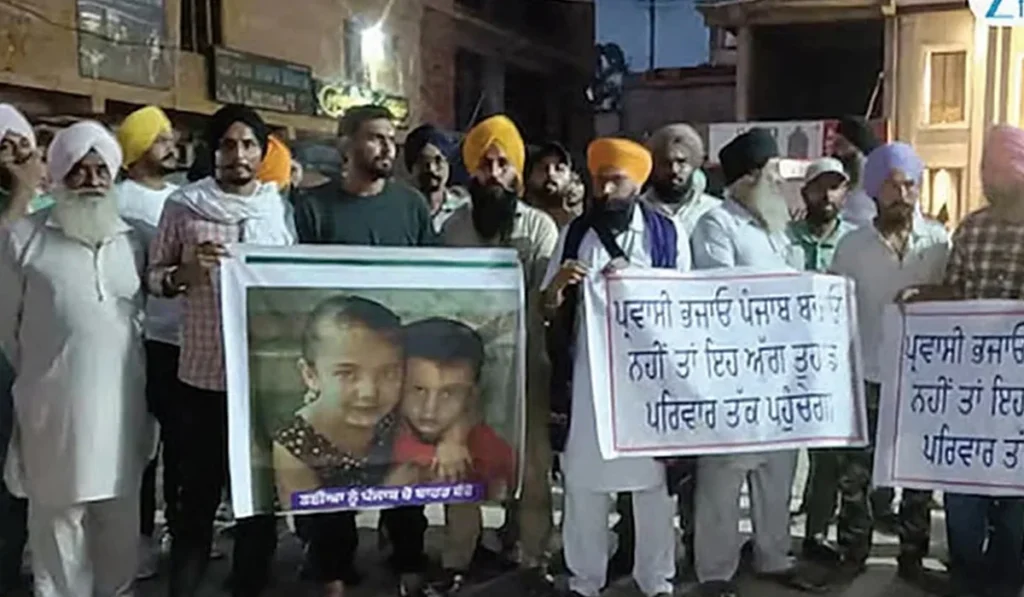
This year as well, in February, some youths reportedly targeted a migrant worker with a gunshot, though he survived. Statements by political, religious, and social leaders against migrant workers have also kept the atmosphere tense. People like Lakha Sidhana have gone as far as claiming that the Indian state is altering the Punjabi demographic identity through migrant workers. However, many doctors and experts consider such claims to be nothing more than rhetoric. In recent times, migrant-run fruit carts and golgappa stalls have also been targeted, and calls for boycotts have been made.
Those opposing migrant workers claim that Punjab has anywhere between 70 lakh and 1.5 crore migrant workers living in the state. But the truth is that no one has clear, verified numbers. The figures they cite appear far from reality. According to the 2011 Census, the number of migrant workers in Punjab was said to be around 13 lakh. A study by Punjab Agricultural University some years ago suggested it to be around 18 lakh. Some scholars estimate up to 25 lakh. But in no case does it reach 70 lakh to 1.5 crore. Many experts also believe a large portion of Punjab’s migrant labour force is seasonal: they come for work in specific seasons and then return to their home states.

According to Government of India reports, out of Bihar’s population (13.43 crore), about 60 lakh people work as labourers in other states; and out of Uttar Pradesh’s population (24 crore), about 83 lakh workers do labour work in other states. That means only about 5–6% of these states’ populations migrate for labour. The highest number of migrant workers are in Maharashtra (around 60 lakh), followed by Delhi, Tamil Nadu, and Gujarat; only after that does Punjab’s name appear. In other words, not all migrants are coming to Punjab.
If we look through a more rational lens, we see that Punjab has historically seen the arrival of many groups such as Aryans, Iranians, Duhani, Takk, Munda, Mughals, etc., who came with intentions of loot or rule. Many settled here through marriages with local women. These groups also contributed cultural and linguistic qualities to Punjabi language and culture. For example, Punjabi received a rich heritage; a new language, Urdu, was born here; and several letters of Gurmukhi are said to have come from languages spoken by other tribes. For instance, the Gurmukhi letter “ੜ” is claimed to be from Dravidian groups, and “ਮ” from the Munda community. Beyond this, there are many words from other communities and languages that now feel fully Punjabi, such as: knife, razor, table, chair, room, slipper, school, station, etc. In fact, the claim is that more than 80% of commonly spoken words in Punjabi are non-Punjabi in origin. Despite all this, Punjabi language, Punjabi culture, and Punjab did not get destroyed. If even foreigners did not damage Punjabi culture, then how will Biharis from the same country destroy it?

The first reality is that a person is most influenced by the environment around them. In the same way, migrant communities too are shaped by the culture in which they live. Migrant workers who come to Punjab cannot escape the influence of Punjabi culture and language. It is exactly like Punjabis who moved abroad and could not avoid being influenced by the lifestyle there. Their children often adopt Western lifestyles and language patterns. Punjabi literature produced in Western countries also reflects those societies more than Punjab’s villages. Similarly, Punjabi literature written there will inevitably carry the stamp of the place where it was written.
A second bitter truth is also hard to ignore: one community can dominate or heavily influence another only if it has strong economic power. Two examples are often given. First: the British ruled much of the world not because they were “the best nation,” but because wherever they went, they carried strong economic power. On the other hand, Indians who went abroad could not do that, because they went as a working class for livelihood, not with economic power. This suggests that labourers who have come to Punjab for bread and survival are unlikely to are unlikely to fundamentally alter Punjab’s culture.

Over time, these migrant workers are getting coloured in Punjabi culture as well. For example, the writer cites a Bihari worker from their village: a “bhaiyya” named Ram Lal came around 40 years ago speaking purely Bihari, but today he speaks good Punjabi. His children and grandchildren speak Punjabi so well that even many native Punjabi children do not pronounce it that cleanly. In reality, he was influenced not by “Punjabi culture” alone but by Sikh culture. He changed his name to Ram Singh, and named his son Gurdeep Singh, who is a a child who keeps uncut hair in accordance with Sikh tradition.
In fact, the real threat to Punjabi culture is not from outsiders, but from its own people. Punjabis have started removing their children from government schools and putting them into English-medium schools. In such schools, the mother tongue is not valued. Meanwhile, the children of a migrant like Nand Kishore from Bihar study “oorha-airha” (Punjabi alphabet) in government schools and write lines such as: “Guru Nanak Dev Ji was born in Rai Bhoi di Talwandi, district Sheikhupura, at Nankana Sahib.” On the other hand, today many Punjabis and their children seem obsessed with going abroad.

Critics argue that some opposition appears driven more by identity politics and fears of losing political influence than by genuine concern for cultural preservation. We know how migrant workers have achieved success through hard work. During the Green Revolution era, migrant workers began arriving in Punjab at scale and made an important contribution to agriculture. Today, many workers, through sheer effort, have moved from villages to cities and started their own work: some in factories, some running carts. This is what irritates wealthy farmers: those who once worked cheaply in their fields are becoming self-reliant in towns. Migrant workers often work in fields at cheaper rates than local labourers. There have also been reports suggesting that some rich farmers make migrant workers work like bonded labour.
As for robberies, snatching, and other crimes, we cannot blame the entire migrant community for it. A few individuals may be involved, but it is not right to label the whole community as criminal. These are hardworking, honest workers. That is why many families in cities and villages also employ them as domestic help. In reality, the reasons behind theft and robbery are economic: they are the product of a broken economic system, not “bad blood” in migrants. If we examine fairly, we find Punjabis are not behind in such crimes either. Spoilt sons of big families and unemployed youth are commonly seen involved in such incidents. Recent robberies and murders in Punjab also confirm this. Many Punjabis even commit robberies and smuggling abroad. So will we call the entire Punjabi community a community of looters?
If migrant workers from our own country work hard in another part of the same country and reach heights of success, what is wrong in that? And if that is wrong, then how is it right for Punjabis to go to foreign countries and work in high positions?
We must not forget that migrant workers have contributed significantly to Punjab’s prosperity. In today’s era, when we talk about travelling to neighbouring countries without visas, it cannot be called a good thought to stop workers of our own country from coming into Punjab.
Hardline Sikh groups use protests against migrant workers in the state to push their own agenda forward. On the other hand, political parties use attacks on migrant workers to gain votes in their own states.


Leave a Comment