
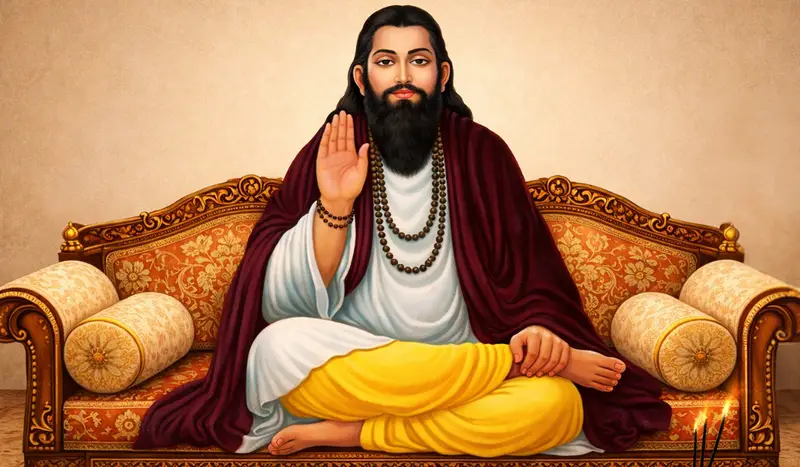

What does it mean when a cobbler’s prayer moves a stone idol, and a queen kneels at his feet? The life of Guru Ravidas answers that question in ways few histories dare to record.
A Scripture Without Borders
Sri Guru Granth Sahib stands as the word-guru of all humanity, not of any single community, nation, or creed. It was the fifth Sikh Guru, Sri Guru Arjan Dev Ji, who undertook the monumental task of compiling the Adi Granth Sahib. Working alongside the scribe Bhai Gurdas Ji, Guru Arjan Dev gathered the sacred compositions of the Gurus, the Bhagats, and devout Sikhs closely associated with the Guru’s house.
The criterion for inclusion was not birth, religion, caste, language, poverty, or wealth. It was the quality of devotion and the alignment of thought with Gurmat philosophy. The Bani of fifteen Bhagats found its place in this universal scripture. These were men and women born into Hindu and Muslim traditions, who had each raised their voice against the corruption eating through both faiths.
Bhagat Bani gave dignity to those who had been rejected from birth. It spread the message of shared humanity, kindled the spirit of self-respect, and sparked a revolution of thought against the inhuman treatment rooted in caste and religious identity. It urged people to abandon the instincts of the animal and build a society grounded in moral worth. The Bhagats did not merely preach. They named the rot and challenged it directly.
The World Guru Ravidas Walked Into
When Guru Ravidas was born, medieval India was locked in a particular kind of darkness. The population was absorbed in rituals, idol worship, and the veneration of lesser deities. Caste distinctions were not merely social habits. They were enforced as law.
Society was divided into four classes. Brahmins, who performed prayers and religious functions, occupied the highest station. Kshatriyas, the warrior class, ranked second. Vaishyas managed agriculture and trade. Shudras, at the bottom, were permitted only to labour in the homes and fields of those above them.
The consequences for Shudras who crossed these lines were severe. The 11th-century traveller Al-Biruni, in his account of India, recorded on page 125 that even Vaishyas were denied the right to utter the sacred syllable, Om. If a Vaishya was heard uttering it, his tongue was ordered cut out immediately. For Shudras, the act of devotion itself was classified as sin. They were not merely discouraged from worship. They were forbidden from it.
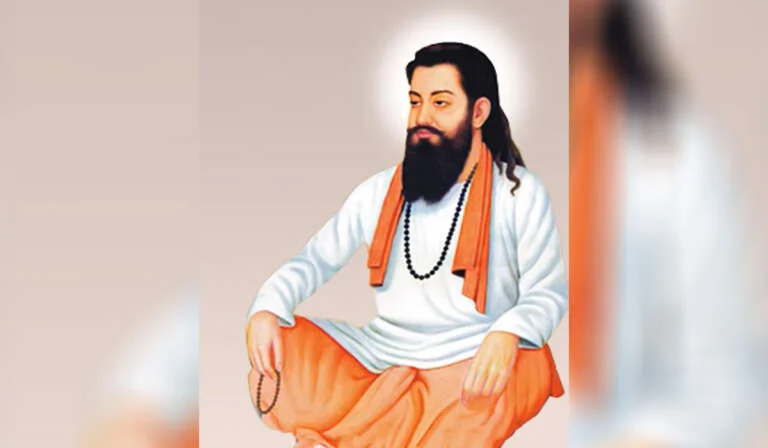
It was into this world, into a Shudra family, that Ravidas was born.
A Child Drawn Toward God
From his early years, Ravidas accompanied his mother to the gatherings of saints and holy men. The company of these figures left a permanent mark. By the age of nine, he was already given over to devotion in a way that alarmed his family.
His father, hoping to redirect him, put Ravidas to work in the ancestral trade of making shoes. The boy learned the craft and practised it all his life. But the pull toward God did not weaken. Saints who came to him received sandals stitched at little or no cost. He wrote of his caste without shame or apology, in direct and unhesitating verse:
Nagar jana meri jaat bikhyat chamaran. (Know, O townspeople, my caste is widely known as that of a cobbler.)
He said what others concealed. That, in itself, was a form of courage.
The Trial Before the King
As Ravidas grew in reputation and began to spread his message of devotion, opposition gathered. High-caste men brought a complaint before the local king. A Shudra, they said, was committing the offence of worshipping God. He must be stopped.
The king summoned Ravidas and put the charge to him plainly. Ravidas replied that devotion to God had nothing to do with birth. The king had no satisfactory answer to this. He devised a test instead. A statue of a deity was placed in the court. Brahmins and Ravidas were each called to draw the idol toward themselves through the power of their prayers.
The Brahmins performed their full round of rituals. The statue did not move.
Ravidas, who opposed displays of miracle working, nevertheless offered a humble petition to God. He acknowledged his own unworthiness, appealed to the honour of true devotion, and asked for a sign. According to accounts preserved in the writings of the 18th-century saint Paltu Sahib of Uttar Pradesh, the idol moved to the arms of Ravidas.
After that day, no one could formally deny a Shudra the right to worship. The ruling that had crushed generations was broken, not through political argument, but through the demonstrated reality of a cobbler’s faith.
Mirabai and the Diamond He Would Not Take
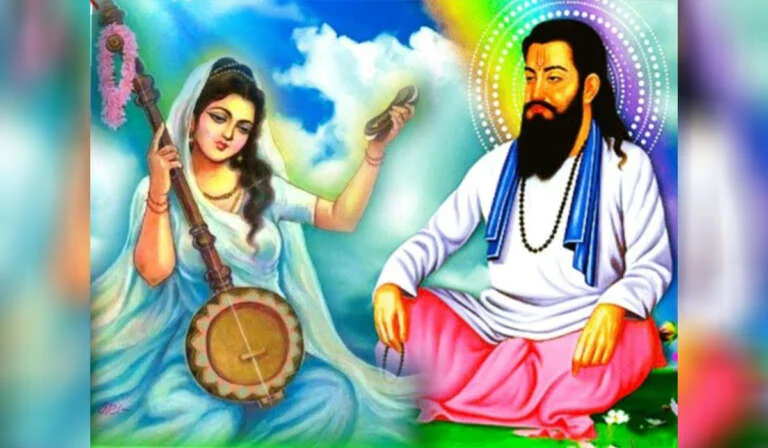
Among the most devoted followers of Ravidas were King Pipa and Mirabai, the poet-princess of Mewar. Mirabai herself confirmed her relationship to him in her own verse:
Guru Ravidas mile mohi poore dhur se kalam bhidi. (I met Guru Ravidas, my perfect Guru, destined from above.)
When people mocked Mirabai for following a cobbler, she brought a valuable diamond to Ravidas. She asked him to sell it, build a proper house, and live with some comfort. He looked at it and told her that everything he had ever received had come through the work of his hands, and that the diamond was of no use to him.
He advised her further. If the taunts of the world troubled her, she could worship in private. She left the diamond on the ground when she went. When she returned after some time, expecting to find that he had sold it and improved his condition, she found Ravidas still at his workbench, stitching shoes. The diamond lay exactly where she had placed it, untouched.
The Teaching and the Bani
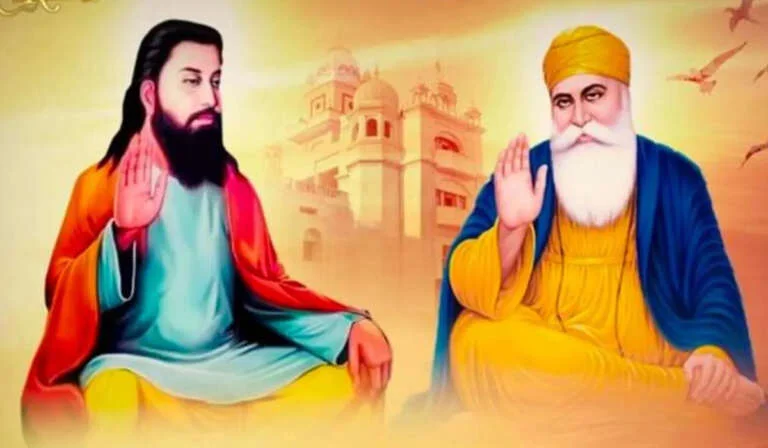
Guru Arjan Dev Ji, in his own verse, placed Ravidas alongside Kabir, Namdev, and Guru Nanak Dev Ji, noting that all four shared a single understanding of the divine.
Forty compositions of Ravidas were included in the Adi Granth Sahib, some of which were recorded in Raag Sorath and Raag Maru. A later collection, published in 1978 by Beni Prasad Sharma under the title Sant Guru Ravidas Bani, contains 177 compositions and 41 sakhis, the short narrative verses that carry moral instruction.
The teaching of Ravidas rested on several clear principles. He held that no worldly possession matches the worth of the divine name. He taught that a person ought to earn an honest living through labour, not beg from door to door. He warned that bad actions carry consequences that cannot be avoided. He praised the company of the spiritually sincere as the highest good, for it is in such company that God is remembered and the accumulated weight of wrongdoing dissolves.
On the question of religious practice, he was equally plain. He saw both Hindu and Muslim ritual as theatres of vanity. The idol in the temple and the mosque at prayer time were, in his view, no substitute for inner purification. He envisioned a city he called Begampura, a place without sorrow, without tax, without fear, without wrong:
Begampura shahar ko naau, dukh andohu nahi tihi thau. (Begampura is its name, a city where there is no pain, no anxiety.)
A Legacy That Outlasted Its Age
The Bani of Guru Ravidas, as preserved in Sri Guru Granth Sahib, created a sustained dialogue against the conditions of its time. It addressed inequality at every level: social, economic, political, and cultural. It spoke to people who had been treated as less than human for centuries and told them that, in God’s sight, they were equal to every other soul.
Guru Ravidas spent four years, nine months, and eleven days at Khuralgarh in what is now the Hoshiarpur district. A millstone associated with his life remains there. A fair is held at the site every year.
What this man accomplished, larger social reform movements had not managed to do. He changed the terms on which the oppressed understood themselves. That is a harder thing than any legislation, and a more lasting one.

Leave a Comment