


A World Bank President’s Candour, a Punjab BJP Chief’s Defence — and the Solutions Neither Offers
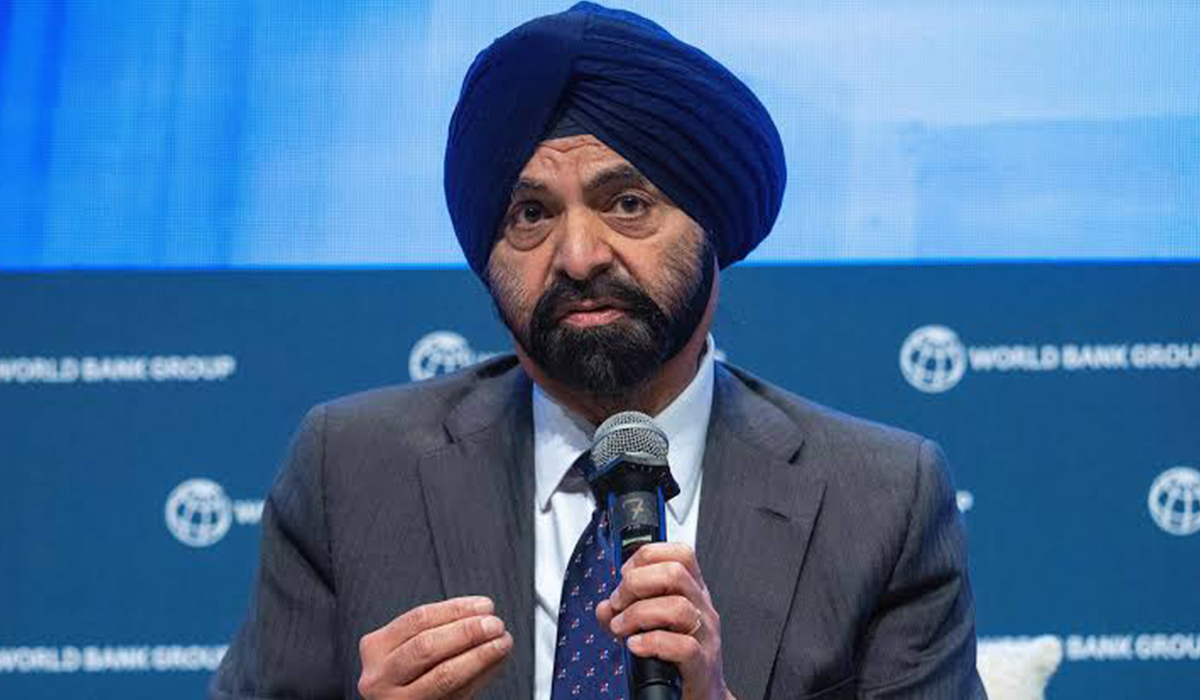
Ajay Banga’s recent remarks about young Punjabis squandering land-sale proceeds on drugs and conspicuous consumption have generated considerable heat. Born into a Punjabi Sikh family in Khadki, Maharashtra — his father, Lieutenant General Harbhajan Singh Banga, rose to senior command in the Indian Army, with the family’s ancestral roots in Jalandhar — Banga is a practising turbaned Sikh who became a naturalised US citizen in 2007 and now heads the World Bank Group as its 14th President. His words carry both institutional authority and the emotional charge of a man with deep roots in the very soil he is commenting upon. They have also, predictably, provoked a response (video).
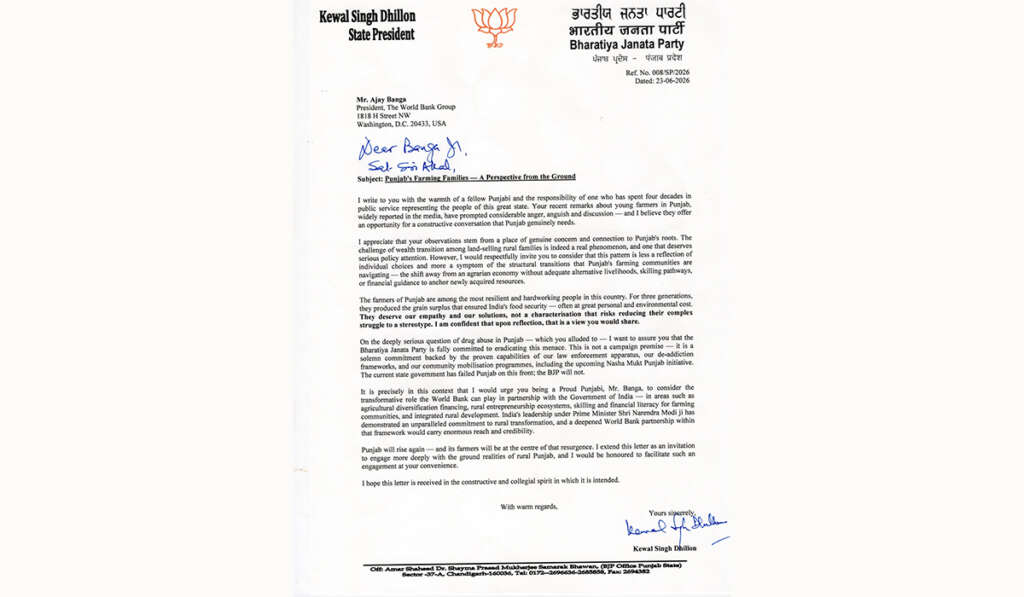
That response came today, on 23 June 2026, in the form of a formal letter from Kewal Singh Dhillon, State President of the BJP Punjab, addressed warmly — Dear Banga Ji, Sat Sri Akal — to the World Bank chief at 1818 H Street NW, Washington. Dhillon’s letter is courteous, measured, and makes several important points. It deserves to be read alongside Banga’s remarks, not merely as a rebuttal, but as the other half of a conversation that Punjab genuinely needs.
Two Honest Men, Two Partial Truths
Banga’s framing is essentially that of a capital allocator. Land is an asset. Its sale is a one-time capital event. Those who dissipate that capital on SUVs and substances rather than investing it in education or enterprise are, in his implicit reading, authors of their own misfortune. It is a boardroom lens applied to a broken social landscape — not wrong, but radically incomplete.
Dhillon’s response pushes back firmly and, in significant measure, justly. He reminds Banga that Punjab’s farmers have underwritten India’s food security for three generations — often at severe ecological and personal cost. The current distress, he argues, is not a moral failing of individuals but a symptom of structural transitions: an agrarian economy collapsing without safety nets, alternative livelihoods, or credible pathways for skilling and mobility. He invokes the BJP’s commitment to the Nasha Mukt Punjab initiative and holds the current AAP state government responsible for the drug menace’s persistence.
Both men are saying something true. Banga is right that, even within shared structural pressures, individual and community choices vary — and that some of those choices are self-destructive. Dhillon is right that those choices do not occur in a vacuum; they are shaped by decades of policy neglect, monoculture dependency, and the absence of dignified non-farm employment.
Where they converge — and this is the important point — is in their shared silence on what comes next.
The Silence That Matters
Punjab does not suffer from a shortage of diagnosis. Commission reports, expert commentary, political speeches — the shelves are full. What has been chronically absent is design: the patient, specific, institutionally grounded work of building frameworks that actually change behaviour and outcomes on the ground.
Banga, from his vantage at the World Bank, is uniquely placed to go beyond the cautionary tale. What would a realistic model of financial and legal counselling for a land-selling household in Mansa or Gurdaspur actually look like? How might development finance help seed rural enterprises capable of absorbing young workers exiting agriculture — rather than leaving them to choose between migration and addiction? These are not rhetorical questions. They are design problems, and the World Bank has the intellectual and financial architecture to help address them.
Dhillon, for his part, is right to reject stereotyping. But having correctly identified the problem as structural, the letter’s policy content remains at the level of aspiration. The invitation to the World Bank to play a “transformative role” in partnership with the Government of India is welcome — but what would that role concretely entail? Even three pilotable interventions in a single district would have given the letter an actionable edge.
What Punjab Actually Needs
Let us be direct about what a serious response to this crisis would require, from all sides:
First, a time-bound state–centre–multilateral compact on Punjab’s agricultural transition — with clear, monitorable milestones for crop diversification, groundwater management, and non-farm employment creation. Not another committee. A compact with named accountabilities.
Second, village-level financial and legal counselling infrastructure for families considering land sale — so that the decision is informed, the proceeds are channelled into productive assets where possible, and the long-term implications are understood before the transaction, not regretted after.
Third, an integrated drug strategy that treats addiction as a public health emergency connected to unemployment and social breakdown — not primarily as a law-and-order problem. This means treatment capacity, community support structures, and parallel employment pathways, not just enforcement drives.
Fourth, a credible, politically insulated monitoring framework to evaluate what is working, what is not, and to course-correct without waiting for the next election cycle.
None of these is a silver bullet. All of them require political will, sustained resources, and a willingness to be judged by outcomes rather than by rhetoric.
An Invitation, Not a Verdict
The most productive reading of this exchange is not as a contest between a globalised Punjabi banker and a state party president — one moralistic, the other defensive. It is as evidence that Punjab’s crisis has now reached a level of visibility where figures of genuine influence are being drawn into the conversation.
That is an opportunity.
Ajay Banga has the convening power and institutional resources to help shape how global development capital engages with Punjab’s rural transition. Kewal Singh Dhillon has the political responsibility to translate structural empathy into specific, time-bound programmes within his party and, should the opportunity arise, his government.
The 23-year-old from a marginal farming family in Sangrur is not waiting for the diagnosis to be perfected. He needs to know: should he sell the land or hold it? Is there a skill pathway that leads to a real job in the region, or is the IELTS exam still the only credible exit? What institutions exist to support his choices rather than simply judge them after the fact?
Punjab deserves leaders — in government, in global finance, and in civil society — who move from eloquent description to patient design. Who stay long enough to see those designs tested, refined, and if necessary honestly abandoned.
That is the conversation this moment calls for. Let it begin.

Leave a Comment