

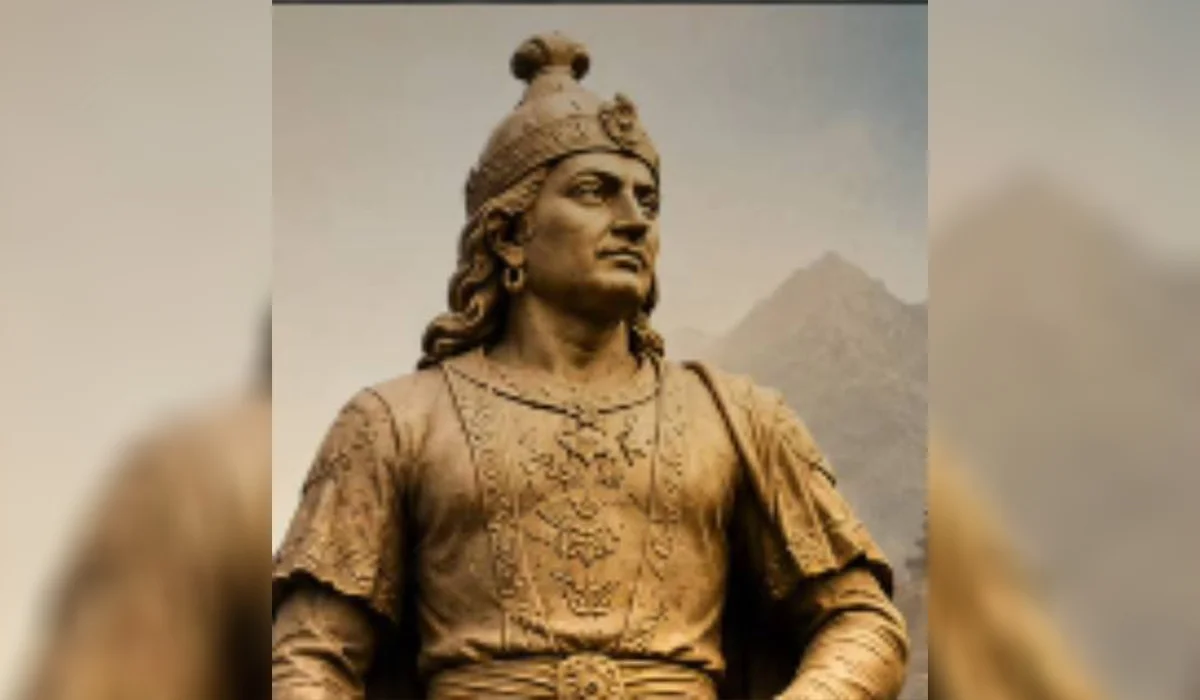

In the shared history of the Indian subcontinent and Central Asia, there have been a few exceptional rulers whose political frontiers crossed geographical boundaries and opened new chapters of civilisational exchange. Kanishka I (127–150 CE), the great emperor of the Kushan dynasty, stands among the brightest of them.
Kanishka was not merely an undefeated warrior and conqueror. He was also a farsighted administrator, a patron of international trade, a connoisseur of art, and one of the most important rulers responsible for giving Buddhism a global identity.
The geographical, administrative and economic heart of his vast and powerful empire was ancient Punjab. During the Kushan period, Punjab was no longer merely a frontier province. It emerged as a major centre of world civilisation, connecting East and West.
This article presents a detailed historical study of Kanishka’s reign, his multifaceted achievements, and the geographical and cultural role of ancient Punjab.
Origins of the Kushans
The history of the Kushans begins in the steppes of Central Asia. According to Chinese historical sources such as the Shiji and the Hanshu, the Kushans were originally one of the five branches of the Yuezhi tribal confederation.
During the second century BCE, attacks by nomadic groups on China’s frontier regions forced the Yuezhi to leave their homeland. Moving westward, they eventually settled in Bactria, corresponding broadly to northern Afghanistan, where they displaced the Greco-Bactrian rulers.
Among the five Yuezhi principalities in Bactria, the Guishuang branch gradually became the most powerful. This branch later came to be known in Indian history as the Kushans.
Foundation of the Empire and the Advance Towards Punjab
The real founder of the Kushan dynasty was Kujula Kadphises, who ruled approximately between 30 and 80 CE.
He crossed the Hindu Kush and established control over Kabul, Kandahar and other regions of Afghanistan. He also began expanding into the northwestern parts of Punjab and weakened the remaining Indo-Greek and Indo-Parthian rulers.
His successor, Vima Kadphises, who ruled approximately from 90 to 127 CE, proved to be another highly significant ruler. He crossed the Indus and extended Kushan authority over Punjab, Malwa and a substantial portion of northern India.
Vima Kadphises is also credited with issuing gold coins on a large scale in India, symbolising the growing economic strength of the Kushan realm. He was a devotee of Shiva, as indicated by representations of the trident and Nandi bull on his coins.
When Kanishka I ascended the throne in 127 CE, he inherited a kingdom whose foundations were already firmly established in Punjab.
Recognising Punjab’s fertile land, hardworking population and strategic location, Kanishka made it one of the principal administrative pillars of his great empire.
Geographical and Administrative Structure of Ancient Punjab
During the Kushan period, the geographical meaning of “Punjab” was far broader than the boundaries of the present-day Indian state.
This ancient Punjab broadly encompassed present-day Indian Punjab, Pakistani Punjab, Haryana, Himachal Pradesh, the plains of Jammu and Kashmir, and parts of what later became the North-West Frontier Province, now Khyber Pakhtunkhwa.
Kanishka’s vast empire, stretching from the Oxus region to Banaras, required an efficient administrative system. He therefore developed several important cities of ancient Punjab as administrative, educational and commercial centres.
Purushapura, modern Peshawar, was the principal administrative and military capital of Kanishka’s empire.
Situated close to the Khyber Pass, it occupied one of the most strategically important points connecting Central Asia with the Indian plains.
Kanishka constructed a massive Buddhist structure there, commonly known as the Kanishka Stupa or Chaitya, which is traditionally described as having reached an extraordinary height of around 400 feet.
Chinese pilgrims such as Faxian and Xuanzang later described the monument in their travel accounts as one of the great wonders of the ancient world.
Excavations associated with the site also yielded the famous Kanishka reliquary, bearing representations associated with Kanishka and the Buddha.
Taxila, near present-day Rawalpindi, was one of ancient Punjab’s greatest intellectual and educational centres.
It had already enjoyed prominence from the Mauryan period onward, but under the Kushans it experienced renewed prosperity. Urban complexes such as Sirkap and Sirsukh formed part of the larger historical development of the region.
Taxila became a major centre of Gandharan art, education and international trade.
Archaeological excavations at Sanghol, in present-day Fatehgarh Sahib district of Indian Punjab, demonstrate that Kushan influence extended deep into the Punjab plains.
Excavations have revealed the remains of a major Kushan-period stupa, numerous red-sandstone sculptures associated with the Mathura artistic tradition, coins and seals.
These finds indicate that Sanghol was an important commercial and administrative centre.
Sakala, identified with modern Sialkot in Pakistani Punjab, was also an important military and economic centre linking the central Punjab plains with northern hill regions and southern trade routes.
The Silk Route and Punjab’s Role
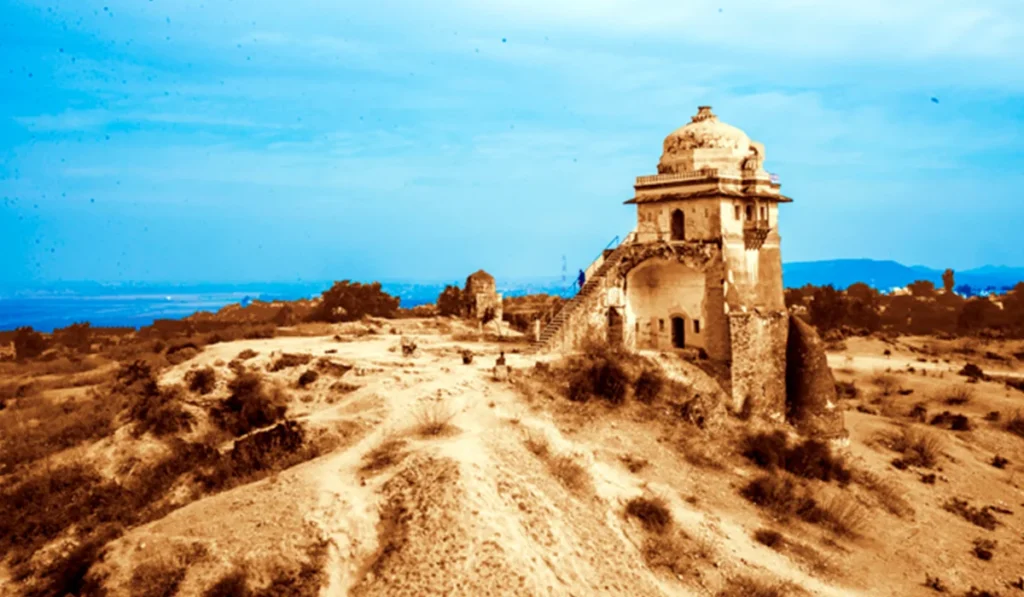
One of the greatest achievements of Kanishka’s reign was the consolidation of Kushan influence over important branches of the Silk Route.
This international trade network carried valuable Chinese silk through Central Asia towards the Roman world and Europe.
Ancient Punjab became one of the backbone regions of this international commercial system.
Kanishka strengthened trade routes from the Hindu Kush to the Punjab plains by deploying military forces to protect caravans.
Measures were taken to suppress banditry, while rest houses, wells and other facilities supported merchants along major routes.
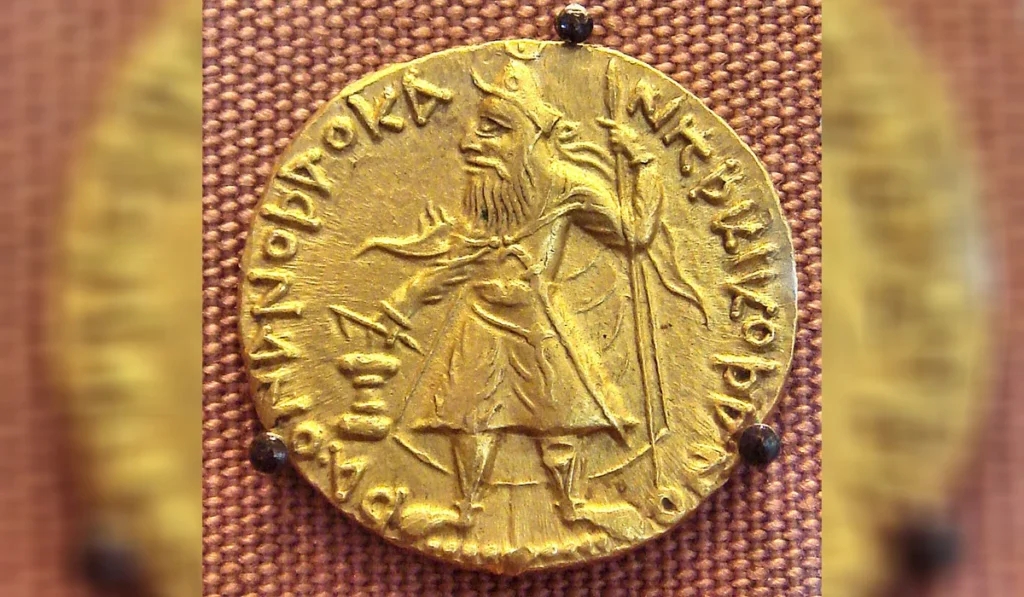
The Kushans issued large quantities of gold and copper coinage, which circulated widely across Central Asia and the broader commercial world.
The prosperity generated by Indo-Roman trade brought considerable quantities of Roman gold into the subcontinent, a trend noted with concern by the Roman writer Pliny.
Punjab’s fertile plains also served as one of the great agricultural bases of the Kushan Empire.
Improvements in irrigation, the use of wells and agricultural organisation contributed to the production of grain, cotton and other commodities, strengthening both farmers and merchants.
Military Campaigns, Expansion and Strategy
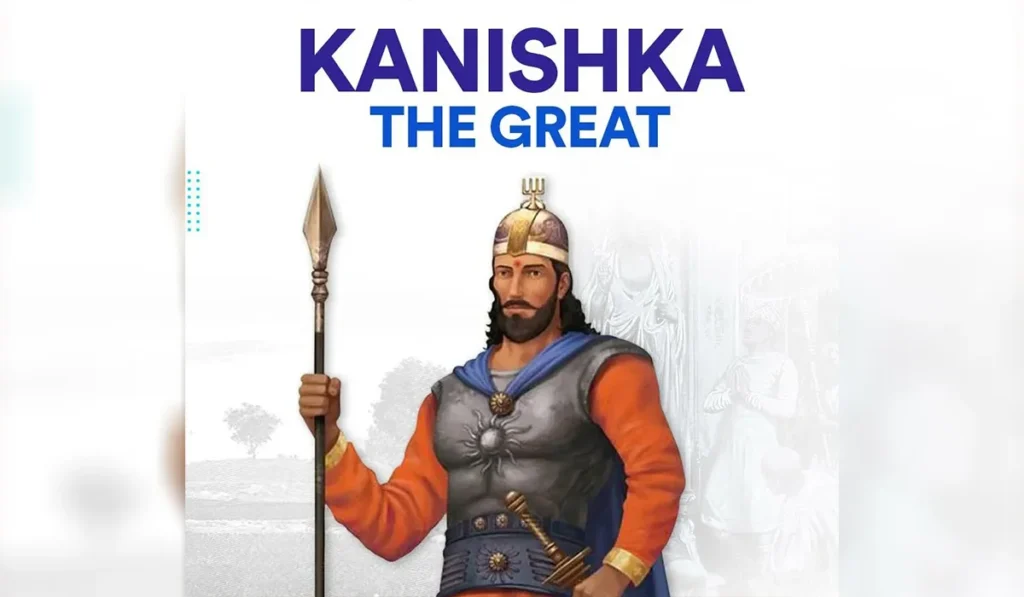
Kanishka was also a formidable military ruler.
His army included Central Asian cavalry, infantry drawn from the Indian regions, and war elephants.
Using Punjab as an important strategic base, he expanded his authority in several directions.
Moving eastward, Kushan influence extended into parts of central and northern India, including regions of present-day Uttar Pradesh and Bihar.
Traditional accounts associate his eastern campaigns with Pataliputra, present-day Patna, and with the acquisition of important Buddhist relics and scholars.
One prominent figure associated with Kanishka’s court was the Buddhist philosopher, poet and dramatist Ashvaghosha, who became one of the celebrated intellectual figures of the period.
Conflict with the Chinese Empire and the Conquest of Kashmir
Kushan interests in Central Asia brought the empire into conflict with Han China over control of Silk Route territories.
Historical traditions associate these struggles with the famous Chinese general Ban Chao and later developments involving regions such as Khotan, Yarkand and Kashgar.
According to later narratives, the Kushans initially suffered reverses but subsequently strengthened their position in the Tarim Basin.
Control over these strategic regions greatly enhanced Kushan influence in Asian trade and politics.
Kanishka was also closely associated with Kashmir.
Tradition credits him with founding a settlement called Kanishkapura, often identified with modern Kanispora.
Kashmir became an important centre of his religious and cultural activities.
To secure the western frontiers of his empire, Kanishka also confronted powers in the Iranian and Parthian sphere and strengthened Kushan control west of the Indus.
Religious and Cultural Revolution: A Golden Age of Buddhism
Kanishka is remembered as much for his religious and cultural contribution as for his conquests.
In Buddhist tradition, he is often compared with Emperor Ashoka and is sometimes described as a “second Ashoka.”
One of the most important religious events associated with his reign is the Fourth Buddhist Council.
Tradition places the council at Kundalvana in Kashmir, although alternative historical traditions have associated it with other locations, including parts of Punjab.
The council is traditionally said to have been presided over by Vasumitra, with Ashvaghosha also playing an important role.
It is linked with major doctrinal developments within Buddhism and with the strengthening of what later became known as the Mahayana tradition.
Under Mahayana Buddhism, devotion to the Buddha and Bodhisattvas acquired greater prominence, and visual representations of the Buddha became increasingly important.
The Kushan period also witnessed the growing use of Sanskrit in Buddhist intellectual traditions.
Texts and commentaries associated with the Mahavibhasha became especially significant in Buddhist scholasticism.
The Rise and Development of Gandhara Art
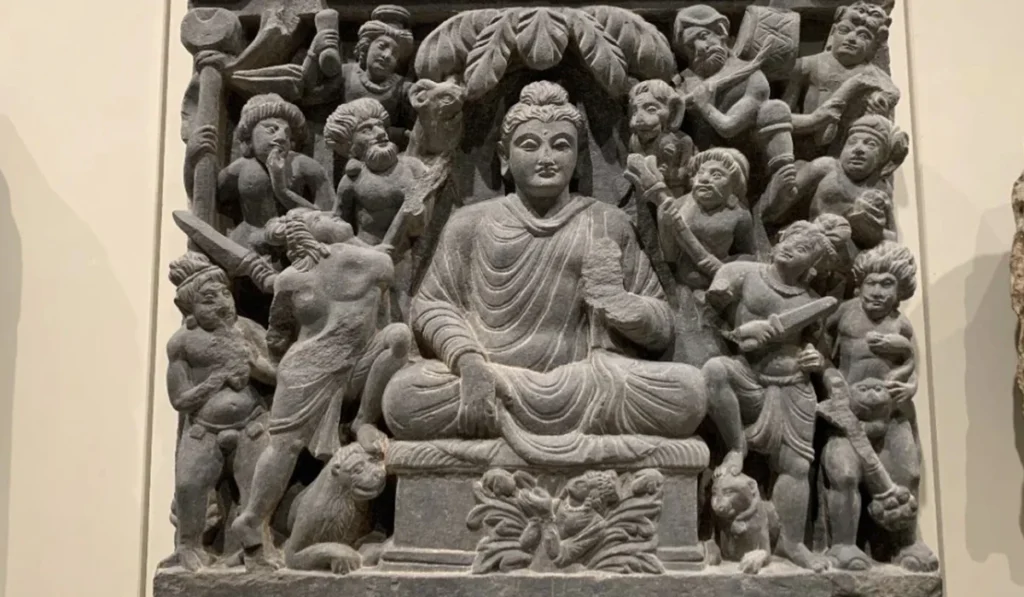
During Kanishka’s reign, a remarkable artistic tradition flourished in ancient Punjab and Gandhara.
This came to be known as Gandhara Art or Greco-Buddhist Art.
Its defining characteristic was the blending of Indian Buddhist themes with artistic techniques influenced by the Hellenistic world.
Buddhist figures were increasingly represented in human form, often with features such as wavy or curly hair, finely modelled robes and naturalistic bodily forms.
Taxila, Peshawar and other centres across Gandhara and northwestern Punjab became important centres of artistic production.
At the same time, the Mathura school of art also flourished further east.
Examples of Mathura-style sculpture have been found in significant numbers at Sanghol in Punjab.
Although Kanishka became a great patron of Buddhism, he was not a religiously exclusive ruler.
His coins provide striking evidence of religious diversity.
Alongside images associated with the Buddha, they also depict Greek deities such as Helios and Selene, Iranian and Zoroastrian divinities such as Mithra and Atar, and Indian deities associated with Shiva and other traditions.
This reflects the multicultural and religiously diverse character of the Kushan Empire.
Historical Sequence of Kushan Rulers
The Kushans exercised a major influence over the Indian subcontinent, especially northwestern India and Punjab, for several centuries.
The dynasty’s historical development can broadly be understood through its principal rulers.
Kujula Kadphises, ruling approximately from 30 to 80 CE, laid the foundations of Kushan power. He established control over Kabul and the northwestern frontier and issued extensive copper coinage.
Vima Kadphises, ruling approximately between 90 and 127 CE, significantly expanded Kushan power into India. He crossed the Indus, consolidated control over Punjab and became closely associated with the large-scale issue of gold coins. His coinage also reflects a strong association with Shiva.
The golden age of the dynasty came under Kanishka I, approximately 127–150 CE. His reign was associated with the expansion of Silk Route trade, Buddhist patronage, Gandharan cultural development and the prominence of Purushapura as a major imperial centre.
His successor Huvishka, who ruled approximately from the mid-second century onward, maintained much of the empire and was associated with cultural development in Kashmir and Mathura.
Vasudeva I, generally regarded as one of the last major Kushan rulers, symbolised the increasing Indianisation of the dynasty. After his reign, Kushan political power gradually fragmented.
Punjab Before and After the Kushan Age
Ancient Punjab had long served as one of the principal gateways of Indian history.
During the Mauryan period, especially under Emperor Ashoka, Punjab formed part of the imperial northwestern region often associated with Uttarapatha, with Taxila as a major administrative centre.
Ashoka promoted Buddhism and supported stupas and religious establishments, including monuments associated with Taxila.
The Kushan period, however, marked a significant shift.
Punjab was no longer merely a frontier of an empire. It became one of its central zones.
Under Ashoka, Buddhism was strongly associated with ethical principles of Dhamma. During the Kushan age, Buddhism increasingly developed through devotional practices, visual art and international networks of exchange.
By the middle of the third century CE, central Kushan power had weakened, and smaller regional powers, including groups such as the Yaudheyas and Arjunayanas, re-emerged.
During the fourth century, the Gupta Empire established varying degrees of influence over northwestern states, although the political relationship between the Gupta heartland and Punjab differed substantially from the direct imperial control once exercised by the Kushans.
By the late fifth and sixth centuries, invasions by the Hunas profoundly disrupted the northwestern region.
Huna rulers such as Toramana and Mihirakula became associated with major political upheaval across Punjab and northwestern India.
The instability of this period contributed to the decline of many Buddhist and urban centres that had flourished during the Kushan age.
The Lasting Impact of the Kushans on Punjab’s History, Society and Culture
The influence of Kanishka and the Kushan dynasty extended far beyond military conquest.
They left a lasting mark on the social and cultural fabric of Punjab.
The cosmopolitanism of the Kushan age connected Punjab directly with Chinese, Central Asian, Iranian, Greek-influenced and Roman commercial worlds.
Punjab was not simply an agricultural region. Its merchants, artisans, monks and travellers participated in a vast network of international exchange.
The intellectual environment associated with Kanishka’s age also produced or patronised major scholars.
Figures traditionally associated with his court include Ashvaghosha, Vasumitra and Nagarjuna.
Ashvaghosha’s Buddhacharita, a celebrated biography of the Buddha, remains a major work of Sanskrit literature.
Traditional accounts also associate the famous physician Charaka with the Kushan age and sometimes with Kanishka’s court. The Charaka Samhita became one of the foundational works of classical Indian medicine and Ayurveda.
Archaeological excavations across Punjab continue to reveal the depth of Kushan influence.
Besides Sanghol in Fatehgarh Sahib, Kushan-period coins, pottery and other remains have been discovered at places such as Sunet in Ludhiana, Ropar and other archaeological sites across the Punjab region.
These discoveries testify to the widespread economic and cultural presence of the Kushans.
Kanishka’s Immortal Legacy in the Pages of History
The reign of Emperor Kanishka represents one of the most remarkable and glorious periods in the history of the Indian subcontinent, particularly ancient Punjab.
It was an age in which the region emerged as an important power on the world stage.
Kanishka demonstrated that greatness in kingship did not depend only on military conquest. A truly significant ruler was also one who developed peace, art, education, religion and commerce across the territories under his authority.
Ancient Punjab was one of the great sources of strength and vitality for Kanishka’s empire.
His relatively inclusive religious policy, economic vision, support for international trade and patronage of artistic traditions such as Gandhara helped create a legacy that influenced generations for centuries.
Although the enormous stupas, palaces and urban centres of the Kushan Empire have largely been reduced to archaeological remains by the passage of time, the memory of Kanishka’s age survives through its art, coins, trade networks, religious traditions and historical monuments.
In the pages of history, Emperor Kanishka will always be remembered as one of the most powerful and farsighted rulers associated with ancient Punjab.


Leave a Comment