
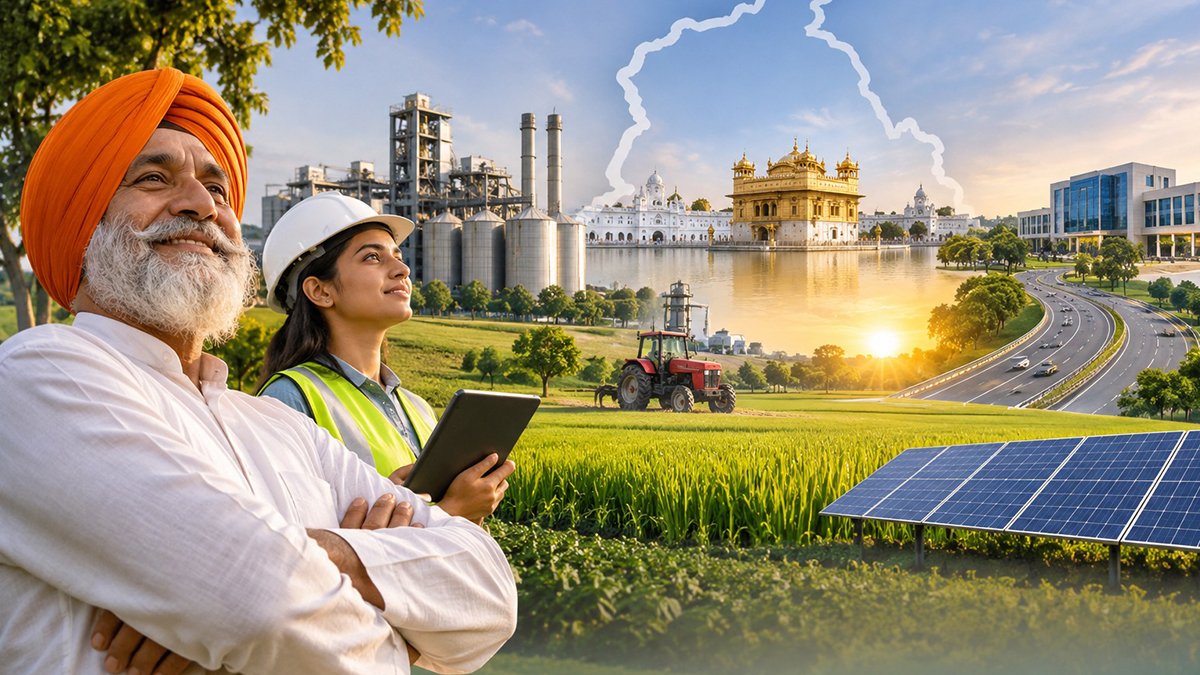

Punjab state of India has been focus of attention due to widely acknowledged as a model of economic development since 1966. It is now lagging behind and has slipped in its ranking of economic prosperity to number ten. It is important to understand that the development dynamics of a state in the federal system are very much linked to union government and its policies. Punjab states development model and its prosperity has been very much linked to the national priorities. It is well known that Punjab state has a 553 km long border with Pakistan and national security in the post-independence period was very much a concern of the state of India. It has set the priority to develop infrastructure for a fast movement of the army. The country has shortage of food supplies and was dependent on PL-480 US food aid. Therefore, these two concerns of the national priorities had given precedent to make joint efforts of both the Union government and the state government for a fast and durable economic development of the Punjab state. As the prosperity led by green revolution has been started reflecting in terms of upward mobility of rural population and that resulted into increased political participation, the traditional political balance came under stress. Green revolution due to decreasing returns to scale has started showing signs of agrarian crisis, the political leadership diverted it to unsettled issues that helped to convert secular moment to a religious one. During the decade of 1980s, there was a turmoil mainly led by religious sentiments and secular/non-partisan forces were relegated to background. A decade of turmoil decimated all well-functioning organs of the state and turned it from a developmental state with surplus on revenue account to a law and order state with deficit on its revenue account. Fiscal policy as an instrument of development has turned dysfunctional. Since then the union government has not shown interest to attend to the major challenges of Punjab state, but continue to draw benefits from Punjab in terms of both food and national securities.
In terms of evidence, the president rule in Punjab has given extraordinary powers to both bureaucracy and paramilitary forces to control the turmoil. This was the time when expenditure increased but revenue raising capacity deteriorated. As per NITI Aayog report, the fiscal deficits began rising noticeably after 1985–86. The fiscal deficit increased from ₹566 crore in 1985–86 to ₹1,242 crore in 1990–91, ₹3,904 crore in 2000–01, ₹23,092 crore in 2017–18 and ₹30, 465 crore in 2024-25 which is equivalent of 3.8% of the gross state domestic product (GSDP). Revenue deficit also increased from ₹544 crore in 1990–91 to ₹2,336 crore in 2000–01 and ₹14,785 crore in 2017–18. It was increased to ₹32, 570 crore in 2026-27, which is 3.9% of gross state domestic product.
Outstanding liabilities have increased at an alarming rate from ₹34 thousand crore in 2001-02 to ₹4.17 lakh crores in 2025-26. It comes out to be 46.4% of GSDP against the all state average 29.2%. Capital expenditure of the Punjab state was 1.23% of GSDP and 7.46% of the total expenditure of the state. In comparison to all state average, it was 3.2% of GSDP and 17.9% of total states expenditure in 2025-26. This is not only low but affected severely the Gross State Fixed Capital Formation (GSFCF) that stands at 16.5% against the national average of 31.9%. The deterioration of Punjab’s development experience lies in lack of investment in the capacity to produce output in the economy (GSFCF). This was caused by persistent revenue deficits, rising public debt and increasing expenditure commitments. The state’s fiscal stress is particularly concerning because a substantial proportion of its revenue is absorbed by interest payments, salaries, pensions and subsidies, leaving limited resources for capital investment and development.
Punjab’s fiscal crisis is therefore structural rather than merely cyclical.
Long term failure of the fiscal policy has deepened economic crisis of Punjab economy. The democratically elected governments over time could not address the structural factors that have caused slow growth of Punjab economy. It was precisely because of the fact that economic reforms since July 1991 has given mandate to the elected governments to facilitate private investment and clear institutional impediments in the functioning of the market economy. An effort was made to monetize public assets for fulfilling the additional revenue needs and reduce the burden of tax revenue for flourishing the private investment both domestic and foreign. Punjab’s locational factors such as long active international border with Pakistan and to some extent the internal factors went against attracting significant investment. Due to land locked territory, it is costly to transport goods to distant ports and often suspension of trade through Wagah Border deteriorated investment climate of Punjab. On the top of it, if there is any protest by the Punjabis, the Haryana state government on the behest of the Union government blocked main routes that prohibit transportation of goods produced in Punjab. These uncertainties have impacted hugely in terms of discouraging expansion of Punjabi investors their investment in Punjab and others not to enter for new investment.
In addition to this, the production structure of Punjab has caught in several dichotomies. One agriculture sector has been highly specialized and produces in bulk wheat and rice for primarily for the central pool. Its high productivity is well known, but less known is low value addition. In the post-economic reform era, there has been a rising cost and falling returns. This is well known deterioration of the terms of trade in agriculture. It is based on assured ground water irrigation and has taxed heavily on the water resources. This has led to falling water table of aquifer of Punjab, which is called environmental disaster. Solving this structural challenge needs the attention of both state and the union government.
The analysis of interlinkage among different sectors of Punjab economy shows that they are very weak. This implies that agriculture sector produce and residual requires to be converted in manufactured products. A right kind of industrial development that should have not only linkage with agriculture sector but make both agriculture and industrial on higher level productivity as well as value addition. Thus, this process of higher value addition requires continuous upgradation of technology, new innovations and skill formation of the labour. Infusion of technology, upgradation of supportive infrastructure and searching for alternative markets involves cost. Switching to a new regime of production needs investment through joint efforts of the state government and whole hearted support of the union government. Punjab also needs to change services sector to become capable to support a desired new production structure. Additional investment to ensure facilitative services sector needs restructuring the services sector of Punjab. It is well known that 21st century has been witnessing fourth industrial revolution technologies and to make use of them requires upgradation of the educational system and new investment by the state facilitating public and private sector for producing goods and services of international standards.
It is pertinent to point out that the economic reforms era requires a decentralization. Contrary to it, there is high degree of centralization of revenue collection, centrally sponsored schemes and deteriorating transfer of resources from the union to state has occurred over time. The union government as incentives to the investors have given tax concessions, subsidies and loan waiver to both domestic and foreign investors. They may be investing in a state or not. This has not only reduced the capacity of the state government to generate revenue resources but forced the state government to borrow from the commercial banking institutions. The burden of debt has been rising over time and interest liability has deteriorated the already available resources from the state exchequer. Until the flexible tax collection rights are not restored to the state, the revenue deficiencies are difficult to overcome.
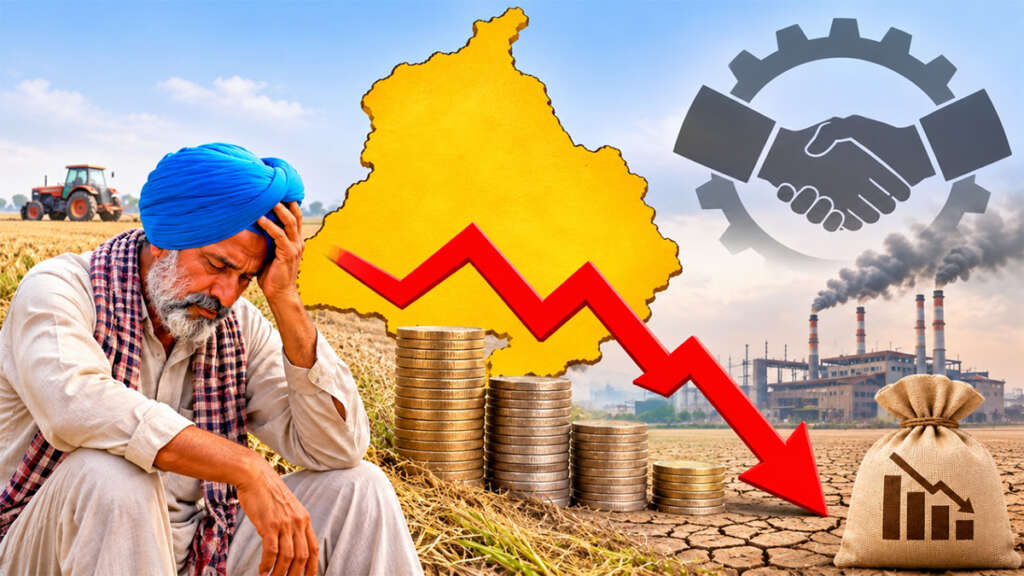
Given the vicious circle in which Punjab’s economy and policy has fallen, a push by both the state and the central governments is in order. The state government should make the first move to change the public policy that can address the challenges before Punjab’s economy. If Punjab elections in the past is any indication, the electorate of Punjab change its political leadership every five years. Therefore, Punjab have not voted in favour of the freebie/subsidy regime, instead, voted for change in public policy. Political leadership and bureaucracy are seems to be risk averse and avoid innovative and experimental policy decisions due to vested interests. People are impatient and this is indicative from agitations, including the more than a yearlong farmers’ protest at the outskirts of Delhi. The regular agitations in Punjab is an ample evidence of dissatisfaction of Punjabis from the performance of various governments.
There is ample scope in Punjab to rationalize universal subsidies to strategic subsidies to restructure the basic production structure and incentivize new investment. It can take initiatives to raise adequate its own revenue and free the fiscal policy for unleashing dynamics of development. Another doable step is to make policy institutions functional and decentralize resources and decision-making, while ensuring the participation of the stakeholders. Domain knowledge experts should be involved in specific areas but a holistic approach to policy making should be the ideal. Punjab has a formidable diaspora spread over to major advanced countries of the world. For envisioning the future engines of economic development, the expertise and innovative-investible resources of the diaspora can be the best bet.
Punjab has a legitimate right to ask the Centre for support in lieu of unique benefits, including food security and national security, for marching on its journey of development. The state can seek a special investment deficiency package. In lieu of the long-term low credit-deposit ratio that transmitted investible resources to other parts of the country, the state government can prepare a case for a moratorium on debt. The Punjab government can also claim a fair share from the ever increasing monetary proceeds of the Reserve Bank of India that are being solely transferred to the Union government. Punjab’s claim is mainly due to diaspora has been sending remittances to build exchange reserves to save the country from a balance of payment crisis.
The restoration of the development process is a win-win situation both for the nation and Punjab. It is legitimate for Punjab state to seek help from the union government specially to complement the efforts of the Punjab government for restructuring its economy for sustainable development. Sustained economic development has a capacity to reduce long held contradiction of Punjab economy and can promote durable peace. Peace has its own cost and devolution of financial resources from the nation’s kitty may be worth it.


Leave a Comment