
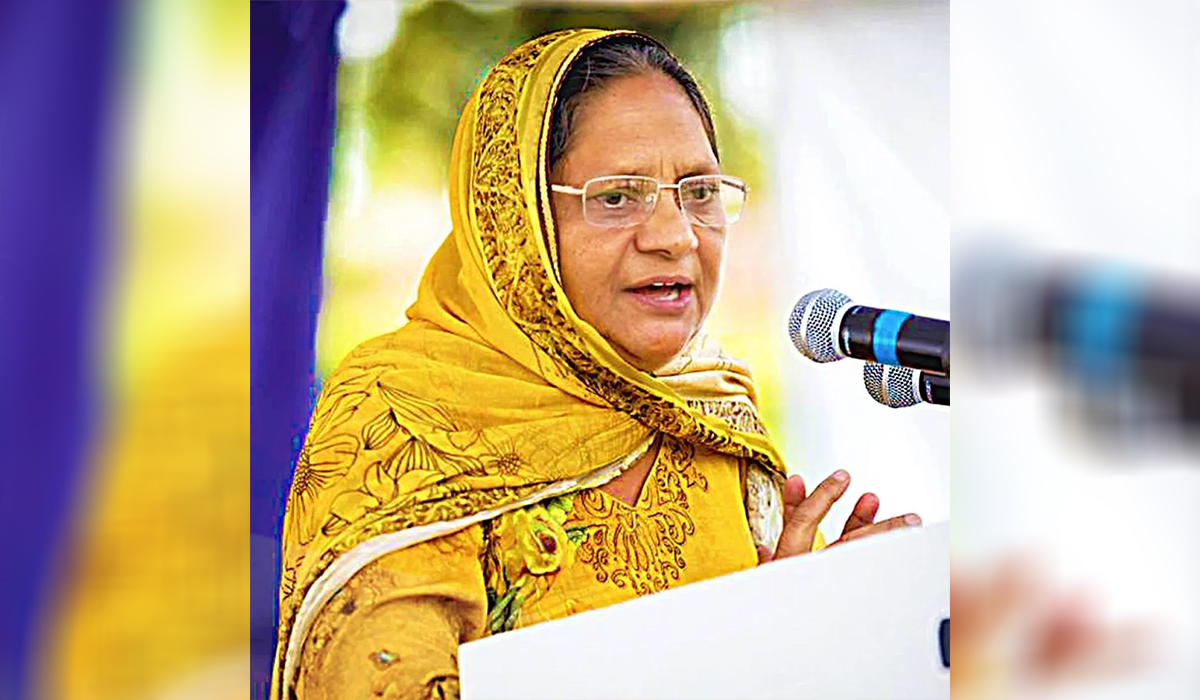

Interpreting a Statement that Puts all Political Parties in the Dock
I. What She Has Said
Ahead of a congregation called by the Jathedar of Sri Akal Takht Sahib at Harike Pattan on Tuesday, 14 July 2026 — the point where the Sutlej and the Beas converge, and the stretch of river where unclaimed bodies were once consigned to its waters — Paramjit Kaur Khalra has issued a statement in Punjabi, on X (formerly Twitter), appealing to Punjab, the wider Sikh Panth, and “people of the world who believe in human rights and justice” to unite in the search for truth.
Her statement recalls the June 1984 military action at Sri Darbar Sahib, the November 1984 Sikh massacre, and the years of unclaimed bodies, custodial torture and staged police encounters that followed, and holds that these still await accountability. She places responsibility for the massacre and its aftermath first with the Congress government of the day, then charges every government since with failing to deliver justice.
Her sharpest language, however, is reserved for Akali Dal-led governments, which she accuses of having rewarded implicated police officers — she names Sumedh Saini, Izhar Alam, Darbara Gill (Guru?), Umranangal and Mohammad Mustafa — with VIP treatment, legal cover and high office, while victims’ families were pushed to the margins, harassed and left to fight their own legal battles. She extends the charge to the present Aam Aadmi Party government, which she says has helped convicted men evade the law rather than face it, naming Khalra’s own convicted killers: DSP Jaspal Singh, Sub-Inspector Jasbir Singh, and Satnam Singh. She adds that the Bharatiya Janata Party government now stands accused, on the FBI’s evidence, of targeted killings on foreign soil.
To the Akal Takht, she addresses three specific requests: the constitution of a people’s commission to establish the true numbers of the disappeared, the unclaimed dead, and those killed in fake encounters through the 1980s and 1990s; a rightful place in the Central Sikh Museum for the unidentified bodies whose identity, she says, Khalra established through his own martyrdom; and financial assistance from the SGPC to victims’ families. She closes by insisting that no party or individual stand above accountability, that those responsible be named, stripped of honours and socially boycotted — and that this “third ghallughara” not be used to score political points by anyone.
II. What the Statement Withholds — and Why That Matters
The more instructive interpretation of this statement lies less in what it says than in what it carefully does not say.
Nowhere does Paramjit Kaur Khalra state, in the first person, that she will attend the Harike congregation, or that she will stay away. For the individual most identified with this cause — the widow whose sixteen-year legal battle produced the only convictions this case has ever yielded — that silence is not incidental. A statement of this length, addressed directly to the event’s convenor, could easily have carried a line of confirmation either way. Its absence should be reported as an open question, not filled in by assumption in either direction.
Equally, the statement contains no call to physically assemble at Harike in numbers. Her appeal is for unity of purpose — Punjab, the Panth, and rights-minded people everywhere “coming together to find the truth” — not an instruction to converge on the venue. Coverage that interprets this as a mobilisation call would be reading more into the text than the text supports.
The framing of the event itself is worth noting closely. Throughout, she describes it as something Punjab is preparing to do “at the call of the Jathedar” — never as something she is convening, co-hosting or organising. Every verb keeps her outside the apparatus doing the calling. Her three requests are addressed to the Jathedar and the SGPC in the language of a petitioner, not a partner: “we request that the Jathedar Sahib…” This is the posture of someone asking an institution to act, not someone standing inside that institution’s planning.
That posture becomes pointed once set against her substantive criticism of the SGPC’s own political lineage. Her statement does not spare the Akali Dal — the party whose governments have historically controlled the SGPC — naming five officers she says Akali governments protected with position and privilege. An appeal addressed to the Akal Takht that simultaneously indicts the political tradition most associated with its custodianship is not a statement of alignment. It is best interpreted, instead, as someone drawing a line between the institution she is petitioning and the political history she holds responsible — asking the Takht to rise above that history rather than assuming it will.
Her closing paragraph makes the underlying anxiety explicit. She warns against this “third ghallughara” being used to “fry political rotis” (ਸਿਆਸੀ ਰੋਟੀਆਂ ਸੇਕਣ) — a Punjabi idiom for turning a tragedy into partisan capital — and insists that accountability be sought from “the entire system,” not selectively. Read against her own text, this warning cannot be confined to Congress, AAP or the BJP alone; it sits in a statement that has just finished naming Akali-era officers by name and criticising Akali governments’ conduct. The plainest interpretation is that she is pre-emptively declining to let any faction — the Akali Dal and the SGPC leadership it has long shaped included — claim her cause, or Khalra’s memory, as a political asset arising from this congregation.
III. The Reporting Distinction Worth Preserving
None of this amounts to a public break with the Akal Takht Jathedar personally, nor should it be reported as one. The statement’s tone toward the Jathedar remains respectful and hopeful — she explicitly voices the Panth’s expectation that he will lead with the “fearlessness and impartiality” the Gurus established. What can fairly be seen as distancing here is distancing from the congregation’s entanglement with party politics — from any faction’s ability to claim the occasion — and not from the Jathedar, the Akal Takht, or the congregation itself as an act of remembrance.
What the statement does establish, on its own terms, is this: a petitioner’s appeal for truth and accountability, addressed upward to an institution she does not claim to speak for or organise alongside; a set of names — victims’ advocates and accused officers alike — placed on the public record without euphemism; and an explicit, textually grounded refusal to let this moment be annexed by any political party, past or present, including the one most closely tied to the SGPC’s own history.
For a case that has spent three decades being told in fragments — a press note here, a CBI finding there, a Supreme Court order upholding five convictions out of nine men named — the precision of what this statement says, and the deliberateness of what it leaves unsaid, deserve to be reported with the same care she appears to have taken in writing it.

Leave a Comment