
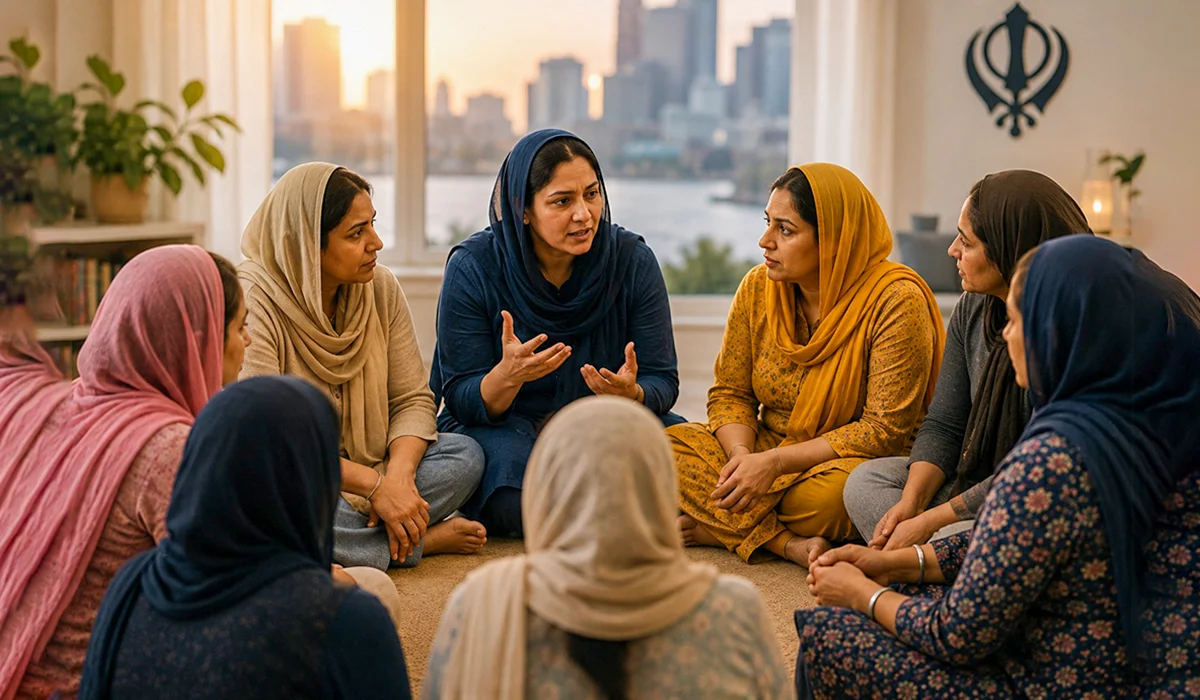

Amid domestic violence, the challenges of migrant life, language barriers and questions of gender equality, Sikh women living abroad are reshaping the meaning of community
Punjab’s migration story is often told through numbers: how many students leave for foreign countries every year, how many people obtain permanent residency, how much money is sent back to Punjab from abroad, and how many members of Punjabi families have settled in Canada, the United Kingdom, the United States, Australia or New Zealand. These questions form a significant part of the larger picture of migration.
The signs of this transformation are clearly visible across Punjab’s villages and cities. In some places, new houses have been built; elsewhere, homes remain locked. In many families, one part of the household continues to live in Punjab while another lives thousands of kilometres away in another country.
But migration is not simply about people moving from one country to another. Family relationships, language, traditions, expectations, beliefs and power dynamics within the home also travel across borders.
After arriving in a new country, however, all these things do not necessarily change at the same pace. A woman may study abroad, secure a good job and become financially independent, yet she may still be expected to perform the same traditional roles within the family that her parents or in-laws were accustomed to in Punjab.
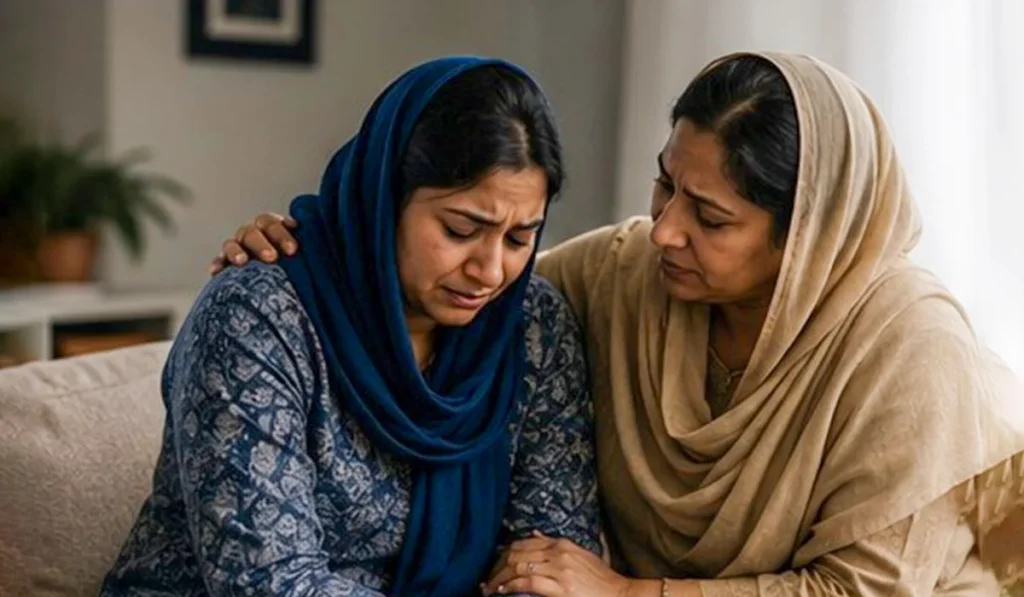
For many women, the situation becomes even more difficult when violence, control or abuse enters a marriage or family relationship. In such circumstances, the challenge is not merely gaining access to the police, a lawyer or a shelter home. A woman may also have to contend with language barriers, financial constraints, concerns about her children, immigration status, family pressure and the fear of losing her social support system in a foreign country.
It is against this backdrop that support networks being created by Sikh women overseas point to an important social transformation.
Organisations in the United Kingdom, Canada, the United States and New Zealand are working on issues including domestic violence, the challenges faced by migrant women, gender equality, counselling, legal assistance and community education.
These organisations do not all operate in the same way, nor do they represent the entire Sikh community. Their presence, however, highlights an important shift: Sikh women abroad are no longer simply members of the community. They are also creating new institutions and support systems designed around the community’s changing needs.
A Diaspora Large Enough to Build Its Own Institutions
The size of the Sikh diaspora is important to understanding this transformation. According to the 2021 Census of England and Wales, 525,865 people identified their religion as Sikh, compared with 430,020 in 2011. This represented a 22.3 per cent increase in the Sikh population over a decade. Women accounted for 49.9 per cent of this population.
Another census statistic offers an interesting picture of family structures. Around 29.9 per cent of Sikhs in England and Wales lived in multi-family or multi-generational households, compared with 11.1 per cent of the overall population.
It would not be appropriate to link this figure directly to domestic abuse. Multi-generational households are not, in themselves, an indication of a problem. The statistic does, however, show that for a significant section of Britain’s Sikh community, extended families and multiple generations living together continue to be important features of family life.
Language is another crucial dimension. According to the 2021 Census, among Sikhs aged three and above, 36.6 per cent reported Punjabi as their main language, while English was the main language for 62.1 per cent.
The generational difference becomes more apparent here. Many first-generation migrants feel more comfortable communicating in Punjabi, while younger Sikhs who were born or raised abroad may find it easier to discuss personal and sensitive issues in English.
For organisations working with women, however, this is about more than language alone. When a woman is experiencing domestic abuse or another crisis, being able to speak in the language in which she feels safest can be crucial. This is why several organisations provide assistance in Punjabi alongside the local language.
When the Problem Goes Beyond Husband and Wife
A 2024 report by Sikh Women’s Aid, Gender, Power & Abuse, draws attention to the seriousness of the issue. In research involving 675 Sikh Punjabi women, 61.48 per cent of respondents reported experiencing domestic abuse, while 58.13 per cent said they had never formally reported it to the authorities.
The report also identified emotional abuse and controlling behaviour as prominent forms of domestic abuse. Among women who reported experiencing domestic abuse, more than 60 per cent said they had experienced abuse from more than one person. The report also refers to family members such as mothers-in-law and sisters-in-law as secondary perpetrators in some cases.
It would not be appropriate to present these figures as representative of the entire Sikh community, since they reflect the experiences of the women who participated in the research. They do, however, raise an important question: when abuse is no longer confined to a relationship between husband and wife but becomes embedded within a wider family structure, how much harder does it become for a woman to seek help?
Sometimes a woman may fear not only her husband but also the possibility of losing her children, bringing perceived shame upon her parents, becoming the subject of community gossip, losing financial support, or jeopardising her immigration status.
Simply telling such a woman to “leave the house” can therefore overlook the complexity of her circumstances. For many migrant women, leaving home may mean beginning an entirely new struggle in a foreign country, involving housing, money, childcare, legal rights and the rebuilding of a social support system.
Why Culturally Informed Support Matters
In such circumstances, some women may find it easier to approach an organisation that understands their cultural background. This does not mean that mainstream government or social services are unnecessary. Rather, the first barrier to seeking help can sometimes be trust.
Sikh Women’s Aid describes itself as a women-centred, “by-and-for” organisation, providing culturally sensitive and trauma-informed support to Sikh Punjabi women and girls. Its research has highlighted issues ranging from domestic and sexual abuse to religious or spiritual abuse.
An important distinction needs to be made here: religion and culture cannot be equated with abuse committed by an individual or a family.
The problem arises when family control, patriarchal expectations, notions of honour and enforced silence are justified through religious or cultural language.
Discussing these issues is not about maligning a community. It is about trying to understand the problems that exist within it. And such conversations can often be most effective when led by people who understand the community’s language, history and social context.
A Support Network That Began at a Gurdwara in New Zealand

New Zealand’s Sikh Women’s Association offers an interesting example of this transformation. Started by migrant women in 2002, the initiative grew from informal women’s gatherings at the Otahuhu Sikh Temple into services addressing domestic violence, family crises and the needs of migrant women. Its head, Jit Kaur, has said that the killing of an Indian mother and her child in South Auckland inspired them to begin working in this direction.
The organisation’s services include counselling, crisis support, advocacy, family mediation, home visits, and help in understanding government and legal systems. Assistance in Punjabi and Hindi can be particularly important for women who are unfamiliar with the systems of a new country.
This highlights one of the major paradoxes of migration. A woman may be living in a country where several legal and social support systems exist, but if she does not know how to access them, those facilities may have little practical meaning for her.
Another Model of Support in the United States
In the United States, Sikh Family Center also provides support in Punjabi and English. Through its helpline and community peer counselling, it assists people facing domestic violence or family crises.
One small but important aspect of this work is that safety is considered even at the level of a phone call. If a woman’s phone is monitored by her partner or another family member, a returned call or voicemail can itself create difficulties for her. The way support is delivered, therefore, becomes part of the safety plan.
The organisation’s work is not limited to women experiencing abuse. Family members who want to support a woman but do not know how to respond in such circumstances can also seek guidance.
This helps shift the understanding of domestic violence from being merely a private family matter to being a wider community concern.
In Canada, the Conversation Moves Beyond Crisis
Canada’s Sikh population adds another dimension to this story. According to the 2021 Census, 771,790 people in Canada identified as Sikh. Of these, 300,435 lived in Ontario and 290,870 in British Columbia. A significant part of Canada’s Sikh population is linked to migration, with 53.8 per cent of Sikhs identifying as immigrants.
In such a large and established community, the conversation cannot remain limited to providing help only after a crisis has occurred.
This is why initiatives such as the Sikh Feminist Research Institute (SAFAR) promote research and discussion around Sikh women, gender equality, history, identity and social justice.
This shift matters because equality is not created only through support provided after a crisis. It is also shaped when a community begins asking itself who defines what it means to be a “good wife”, a “good daughter-in-law”, a “good daughter” or a “good Sikh woman”, and how much space those definitions leave for a woman’s own choices, freedom and decision-making.
The Mother-in-Law and Daughter-in-Law Relationship Cannot Be Reduced to a Stereotype
When research on domestic abuse refers to family members such as mothers-in-law or sisters-in-law, the discussion often quickly gets reduced to the familiar idea of a “mother-in-law versus daughter-in-law conflict”.
But the issue is far more complex.
In a patriarchal family structure, women do not always possess equal power. That does not mean, however, that they have no power within the household.
Sometimes the rules imposed on one generation are passed on to the next. A woman who was once told how to behave as a “good daughter-in-law” may later expect the same behaviour from the daughter-in-law who enters her own household.
The issue therefore cannot be understood simply as a problem involving one woman or one family relationship. It is important to examine the wider social structure in which obedience is equated with respect, while asserting one’s rights may be labelled rude, rebellious or destructive to the family.
This is not a problem unique to Sikh or Punjabi society. But in communities where family honour, kinship networks and social opinion carry considerable weight, discussing such issues openly becomes even more important.
The Next Generation Is Changing the Questions
A younger generation raised abroad is taking this discussion in another direction.
For first-generation migrants, major priorities often included establishing themselves in a new country, finding employment, buying a home, educating their children and building gurdwaras and community institutions.
The next generation has inherited those institutions, but its questions are different.
It is asking what equality within a family really means. Can a woman make different choices for her own life and still remain connected to her Punjabi and Sikh identity? Can a daughter disagree with her family and still remain part of it? And does preserving tradition necessarily mean preserving every old family expectation unchanged?
These questions are not confined to the diaspora. Thousands of families in Punjab whose daughters or daughters-in-law now live abroad are also connected to the same debates.
There Is a Lesson Here for Punjab Too
Punjab often looks at its diaspora through the lens of remittances, investment, foreign education and employment opportunities.
But women’s organisations being built abroad can also bring another kind of experience back to Punjab: the understanding that community support need not remain limited to relatives and personal acquaintances.
Multilingual counselling, legal support, independent safe spaces for women, awareness about domestic violence and the possibility of seeking help beyond family pressure are all issues that can become part of the conversation in Punjab as well.
Most importantly, a strong community cannot mean keeping every problem confined within the four walls of a family.
If a woman needs help to escape violence or abuse, supporting her does not weaken the family. It is a step towards building a safer society.
In this sense, Sikh women living far from Punjab are becoming examples of an interesting transformation. They are not dismantling older forms of Punjabi community life. Instead, they are adding another dimension to them.
Alongside the gurdwara, langar and community gatherings, counselling, legal assistance, women’s support and social justice are increasingly being recognised as community responsibilities too.
Perhaps the next chapter of Punjabi migration will not only be about how many people left Punjab.
It may also be about how they transformed their communities after leaving, and how significant a role women played in that transformation.


Leave a Comment