


The Historical Roots of Punjab’s Opioid Crisis, and a Roadmap Out of It
I. A Court Perfumed with Poppy
Long before Chitta became a byword for Punjab’s ruin, opium — amal, as it was known in the durbars and the dhaabs alike — was a fixture of Punjabi life, sanctioned by custom and dispensed by the powerful. Almost every princely house of the region had its tale of indulgence and excess. Maharaja Ranjit Singh himself, the celebrated Lion of Punjab, was no stranger to intemperance; his favoured concoction blended corn-spirit with meat juice, musk, herbs, and opium, and his courtiers were expected to keep pace with him at the drinking bouts that followed a day of campaigning. Among the Rajput and Sikh aristocracy more broadly, amal carried an almost devotional status, consumed before battle as both stimulant and anaesthetic against fear.
This royal sanction filtered downward through the agrarian economy in a manner that was neither accidental nor incidental. Large landowners cultivated the poppy on their most fertile plots and dispensed small quantities of opium to labourers engaged in the punishing work of harvest and canal-digging — a wage-in-kind that dulled fatigue, suppressed appetite through long shifts, and, not coincidentally, deepened dependence on the very landlord who supplied it. Opium in this period was less a vice than an instrument: of labour discipline, of hospitality, of statecraft.
II. The Company’s Monopoly and the Making of a Habit
Colonial rule transformed a regional indulgence into an instrument of imperial revenue. The East India Company had folded opium into its trading ledger as early as 1683, and by 1773 the Governor of Bengal had assumed an outright monopoly over its manufacture in Bengal, Bihar and Orissa, a system of agency and contract that persisted for well over a century. At its height, close to a million and a half peasant households across North India were bound into poppy cultivation for the Company’s opium department, a labour-intensive crop grown not for local welfare but for the China trade and the imperial exchequer.
Punjab’s own tryst with the crop deepened under this regime. Cultivation for revenue normalised opium as a legitimate cash crop and, by extension, as a permissible domestic intoxicant — sanctioned, taxed, and licensed rather than criminalised. The habit that had begun in the durbar and the harvest field now had the further imprimatur of the colonial state’s own commercial interest, embedding opium use across class lines by the time of Independence.
III. From Husk to Synthetic: The Post-Green Revolution Turn
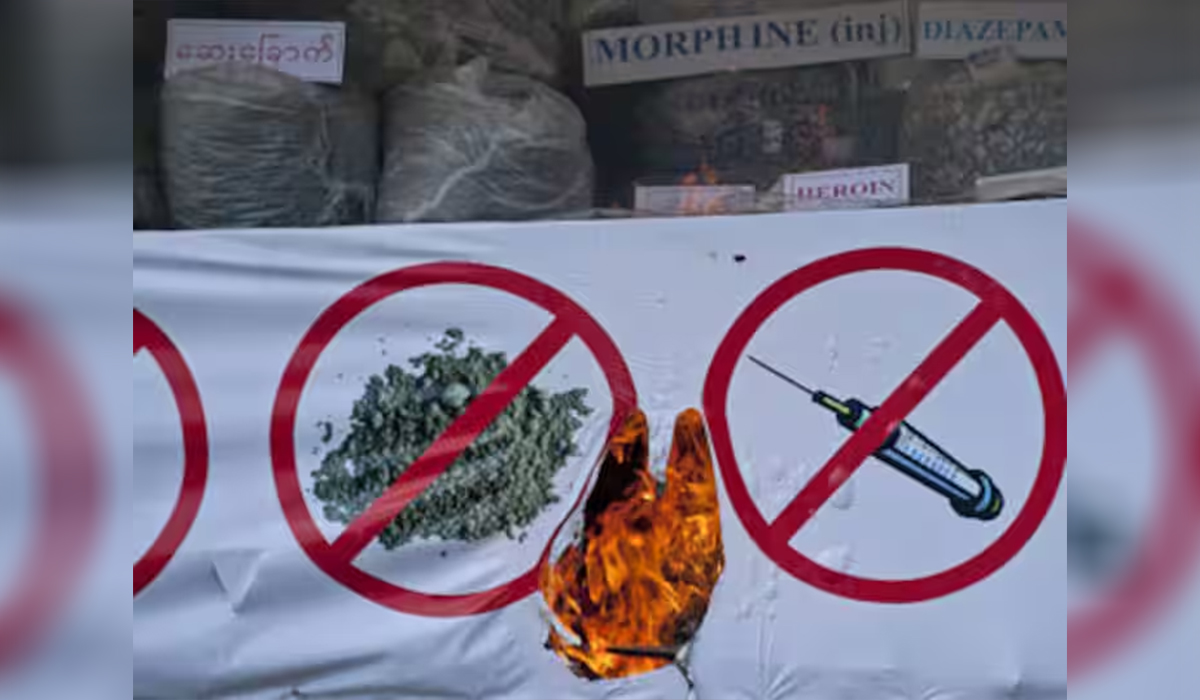
The transformation from traditional amal and bhukki (poppy husk) to Chitta — the street name for adulterated heroin — did not happen overnight, nor was it inevitable. Three developments converged to accomplish it. First, the Green Revolution reshaped Punjab’s agrarian economy around cash and credit, eroding the older patron-labourer relationship in which opium had been dispensed as an in-kind wage, even as the underlying culture of tolerance for the substance persisted. Second, prohibition-era legislation — chiefly the Narcotic Drugs and Psychotropic Substances Act of 1985 — squeezed the supply of natural opium and poppy husk without extinguishing demand, creating exactly the vacuum that traffickers are best placed to fill. Third, and most consequentially, Punjab’s location along the 553-kilometre border with Pakistan, astride the historic smuggling corridors from Afghanistan, made it the natural entry point for cheap, high-potency synthetic heroin once the Golden Crescent’s production surged.
The economics were brutal in their logic: natural opium is bulky, seasonal and increasingly hard to procure legally, whereas heroin is concentrated, portable, and vastly more profitable per gram for the trafficker. What reached the Punjabi user was rarely pure heroin, but a cheaply adulterated cocktail — hence Chitta, ‘the white one’ — cut with everything from paracetamol to rat poison, multiplying the toll of overdose deaths. Where the labourer of an earlier era received opium as a controlled, socially mediated dose from a known landlord, today’s addict procures an unregulated, unpredictable substance from an anonymous supply chain stretching back across an international border.
IV. The Present Reckoning
The scale of the crisis, and of the state’s response to it, is now well documented. Since the Punjab government launched its Yudh Nashian Virudh (War Against Drugs) campaign on 1 March 2025, the state police have registered over 51,500 FIRs and arrested more than 68,000 traffickers and peddlers, attaching drug-linked assets worth in excess of ₹319 crore, with the National Narcotic Drugs and Psychotropic Substances Act conviction rate reported at a notable 89 per cent. Chitta seizures have repeatedly broken annual records, running well above 1,500 kilograms in a single nine-month stretch. In parallel, the state has extended immunity under Section 64A of the NDPS Act — the provision shielding genuine addicts who come forward for treatment from prosecution — to over 10,600 individuals, channelling them into government-run de-addiction and rehabilitation centres rather than jail.
Yet the Supreme Court, in strictures delivered earlier this year, was unsparing: enforcement has too often confined itself to small peddlers while the larger trafficking networks and their financiers continue to operate with relative impunity, and the human cost — measured in overdose deaths in villages such as those repeatedly reported from Kapurthala, Tarn Taran and Ferozepur — remains alarming. The paradox that opium cultivation itself persists, periodically unearthed in Fazilka and along the border belt even as heroin floods in from across it, is a reminder that this is a crisis of both supply and of an unresolved cultural relationship with intoxication that predates Partition by a century and more.
V. A Roadmap Out of the Crisis
A durable solution to Punjab’s opioid emergency must rest on more than periodic crackdowns, however creditable their arrest and seizure statistics. Six measures deserve priority.
First, target the financiers and the money trail, not merely the street-level peddler. Asset attachment under the NDPS Act, as under the Prevention of Money Laundering Act, must be pursued as aggressively against the syndicate’s backers as against the courier, since it is the return on capital that sustains the trade.
Second, secure the border in genuine coordination with the Border Security Force, with sustained investment in drone-detection and counter-drone capability, given the now-routine use of aerial drops from across the International Border to ferry heroin and weapons into the border districts.
Third, scale up de-addiction and rehabilitation infrastructure well beyond current capacity, with outpatient opioid substitution therapy (buprenorphine-naloxone) clinics in every block, since the Section 64A immunity route only functions if treatment capacity exists to absorb those who come forward.
Fourth, invest in the rural economy itself. The addiction crisis is inseparable from agrarian distress, indebtedness and youth unemployment; skilling and livelihood programmes, sincerely implemented, address a root cause that policing alone cannot touch.
Fifth, revisit the licit-opium debate honestly rather than dismissing it. Voices within Punjab, including farmer leaders, have periodically argued for a regulated, medically supervised supply of traditional afeem and bhukki to registered addicts as a bridge away from Chitta, on the reasoning that a controlled natural substitute is safer than an unregulated synthetic one. Whatever view the state takes, the argument deserves an evidence-based hearing rather than reflexive rejection, given the historical precedent of controlled dispensation that Punjab itself once practised.
Sixth, sustain political will beyond electoral cycles. Punjab’s war against drugs has been declared more than once by more than one government; its credibility now depends on continuity of enforcement, transparent reporting of outcomes — including relapse and re-offence rates, not merely arrest counts — and cross-party consensus that treats the addict as a patient rather than a criminal, whichever party sits in Chandigarh.
VI. Conclusion
The journey from the durbar’s ceremonial cup of amal to a village funeral for a young man felled by adulterated Chitta is, at its core, the story of how an indulgence once dispensed and controlled by the powerful became, when that control collapsed, a predator preying on the powerless. Punjab has fought this battle before, under other names and other governments; what it has never quite achieved is combining the discipline of enforcement with the patience of rehabilitation and the honesty to examine its own historical relationship with the poppy. Yudh Nashian Virudh has produced results that merit acknowledgement, but a war against drugs is not won by seizure figures alone. It is won, if it is ever to be won, in the de-addiction centre, the border outpost, and the family that keeps its son or daughter home rather than losing them to the fields their ancestors once tilled for a different master.


Leave a Comment