
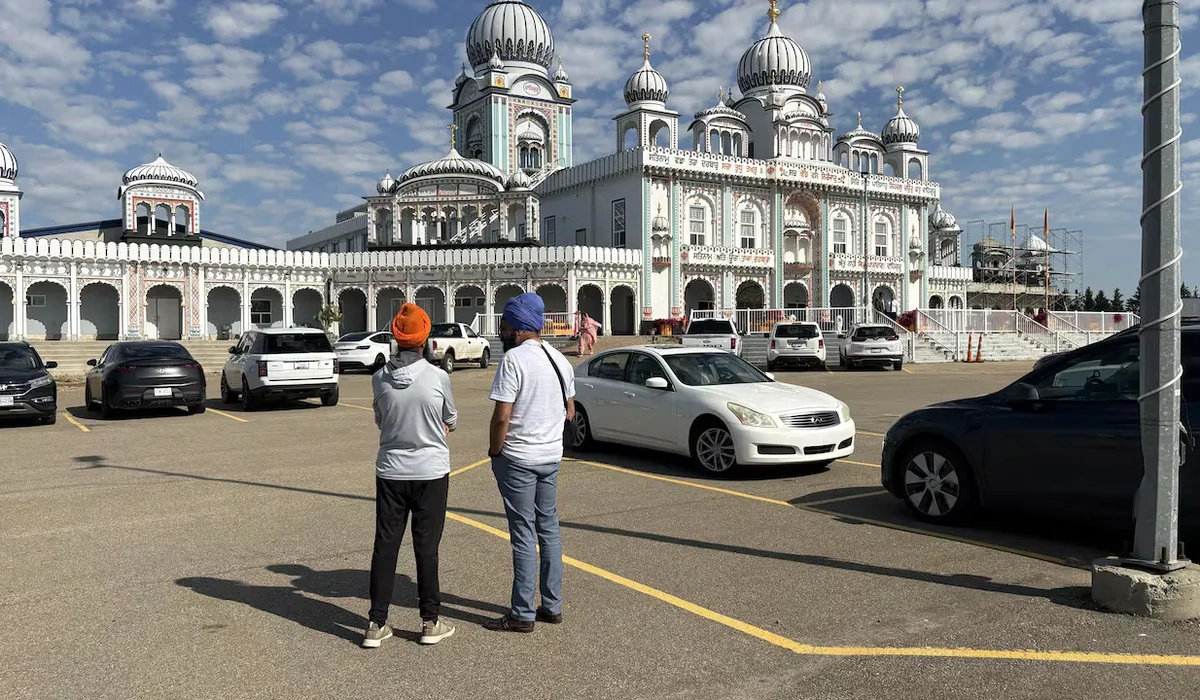

When a parolee walks into Nanaksar before the sangat has finished morning prayers, the gap between statute and sanctuary becomes impossible to ignore
At 5:08 a.m. on Friday, the hour when a gurdwara is at its most defenceless, its congregation absorbed in Nitnem rather than vigilance, a 27-year-old man walked into Nanaksar Gurdwara Gursikh Temple in northeast Edmonton carrying a screwdriver and tried to force his way into the prayer room. He did not succeed. A 75-year-old priest and a 51-year-old volunteer, both recovering from what police describe as non-life-threatening wounds, paid the price of intervening. The suspect himself was injured and hospitalised alongside them. Congregants restrained him; police arrived; the Hate Crimes Unit has since joined the investigation, though no motive has yet been established.
I set the chronology down plainly, as I was trained to as a district officer, because in the first hours the chronology is the only thing not yet colonised by narrative. This one, barely a day old as I write, was colonised within hours. Early reports claimed Sri Guru Granth Sahib Ji had itself been targeted, perhaps desecrated. Gurdwara officials have since told CBC, on the record, that no sacred text was damaged. That clarification deserves stating as plainly as the chronology, because a false report of sacrilege, once released into the diaspora’s bloodstream, does not fully retract even when corrected — it leaves antibodies behind that shape how the next incident, real or rumoured, gets read.
The man who wasn’t supposed to be there
The detail that ought to trouble the public more than any theory of motive is the mundane one: the suspect had been released from federal custody the day before, mid-sentence for aggravated assault and assaulting a peace officer, and had already failed to report to his designated halfway house. Whatever else this attack turns out to be (and I will not pre-judge the Hate Crimes Unit’s pending findings), it is, at minimum, a system that lost track of a documented violent offender within twenty-four hours of releasing him. That failure would have found a victim somewhere. On Friday it found a gurdwara.
It is entirely possible — and Canadian authorities will need to establish this with more rigour than a first press briefing allows — that Nanaksar was less a chosen target than a target of convenience: unlocked doors, a predictable early-morning crowd, a building without the security of a courthouse or a consulate. If that is what the investigation shows, it does not make the attack less serious. It makes it more damning of how lightly protected these institutions remain, everywhere in the diaspora, at the one hour they are fullest and least guarded.
Ottawa’s condolence, and the sentence it left out
The Prime Minister’s office moved quickly, which is more than can be said of the halfway house. Mark Carney posted the following on social media Friday afternoon, in full:
“The attack at the Nanaksar Gurdwara in Edmonton this morning is appalling. My thoughts are with the two people who were injured and the wider community that is shaken by this terrible event. No one should ever feel unsafe in their place of worship. I want to thank the Edmonton Police Service for their swift response.”
It is a decent sentence, and I do not begrudge him it. But read against the chronology above — a violent offender released Thursday, unaccounted for by Friday dawn, inside a gurdwara’s prayer room within twenty-four hours — it is also an admission dressed as a condolence. Alberta Premier Danielle Smith went further, tying the attack directly to bail and parole reform; Edmonton’s police chief would only say hate-crime provisions remain on the table pending motive. Three levels of government, three diagnoses, within hours of each other. None of them yet an answer.
The wider weather, whatever this incident turns out to be
I raise the broader Canadian context not because I have evidence this attack was ideologically motivated — the record does not establish that — but because the World Sikh Organisation’s own statement, issued within hours, invoked “rising anti-Sikh hate” as the frame through which it wanted this incident read. That framing did not arrive from nowhere. Canada’s Sikh community has spent three years, since the killing of Hardeep Singh Nijjar in Surrey in June 2023 and the diplomatic rupture that followed, watching gurdwaras, temple boards, and Sikhs across the Khalistan spectrum absorbed into a geopolitical argument between Ottawa and New Delhi most of them did not choose to be combatants in. Whatever this attacker’s motive proves to be, he walked into a community already primed to read an attack on a gurdwara as something larger than an attack on a gurdwara. That is pattern recognition earned the hard way, not paranoia — the vulnerability a diaspora caught in someone else’s geopolitical narrative carries, regardless of where any individual gurdwara or worshipper stands on the Khalistan question.
The collapsing of a community into a slogan
And here I want to say something that does not fit comfortably into either camp’s talking points, because it needs saying anyway: the entire Sikh community in Canada — several hundred thousand people, the overwhelming majority of whom have never signed a petition or attended a rally for a separate state — keeps getting flattened into one word, Khalistani, by three quite different quarters. First, from the white-nationalist fringe in Canada, for whom “Khalistani” is simply the latest slur to hang on a turbaned face. Sikh community leaders and some Canadian security analysts have alleged a second source — pro-Pakistan lobbying voices finding it convenient to amplify the Khalistan frame rather than let Sikhs be seen as simply Sikh — though I should be honest that this claim is asserted more often than documented, and I do not want to launder an allegation into a fact merely by repeating it well. Third, from ultra-right-wing handles and obscure YouTube channels back home in India, who take the noise made by a genuinely small minority of separatist sympathisers and treat it as representative of the entire diaspora — as if every gurdwara, every langar hall, and every ordinary Sikh professional in Toronto or Surrey or Edmonton were secretly signed up to the same cause, when in fact most of them have spent their lives building careers and families, not an insidious movement.
I should also be fair to the other side of this, though not more fair than the facts warrant. What gets called the Khalistan question is not, and has never been, a mass sentiment among diaspora Sikhs — nor is it any broader movement speaking for the Sikh Panth as a whole, or for Punjab in general. It is something kept simmering by a genuinely microscopic minority, for reasons that look, on the evidence, more personal and parochial than ideological. Sikhs For Justice’s referendum campaigns are real and publicly organised — I would characterise them as mischievous exercises serving that narrow minority’s own interests rather than any authentic expression of the diaspora’s mood, and I say that as someone with no wish to be mistaken for a sympathiser of that project. The 2023 vandalism at Indian consulates in Toronto, Vancouver, and San Francisco also happened. None of this justifies stabbing worshippers with a screwdriver, and none of it licenses the three narrative machines above in generalising from a small, self-interested fringe to an entire diaspora. But pretending that fringe does not exist at all would be exchanging one distortion for another.
None of these three flattening tendencies, notice, agree with each other about anything else. The Canadian racist and the Indian television anchor would be astonished to learn they are doing the same rhetorical work. But the effect is cumulative: a community defined by its loudest fraction rather than the quiet majority who go to Nanaksar at 5 a.m. for prayer, not politics — Zora Grewal’s own words, that this temple is “not involved in any politics,” ought to be the epigraph for every one of these narratives, and is heeded by few. Friday’s attacker, notably, appears from the reporting to have had nothing to do with any of this — no ideology established, a history of undifferentiated violence, not political grievance. That has not stopped, and will not stop, the narrative machines from fitting him into a pre-built frame regardless of what the Hate Crimes Unit finds.
Why “sacrilege law” is the wrong tool for this morning
I have spent a fair amount of ink over the past year on the Jaagat Jot Sri Guru Granth Sahib Satkar Rules, and on Punjab’s unfinished argument with itself over sacrilege legislation. I return to that work today only to say, plainly, that none of it would have stopped what happened in Edmonton. Sacrilege law, however carefully drafted, is a Punjab statute answering a Punjab problem: the desecration of the Panth’s holiest object by an identifiable act, prosecutable inside a jurisdiction whose legislature has the power to write the law. It has no purchase in Alberta. It could not have staffed a volunteer roster, installed a door lock, or flagged a parolee’s missed check-in four thousand miles from Chandigarh.
What Edmonton exposes is a gap no sacrilege law was ever built to close: the physical security of the Guru Granth Sahib‘s dwelling place in jurisdictions where the Panth has no legislative standing, and must instead rely on the diligence of local police, the vigilance of volunteer sevadars, and — as happened Friday, and has happened before, and will happen again — on ordinary worshippers willing to place their own bodies between an intruder and the Guru. That the two men who did exactly that, aged 75 and 51, are expected to recover, is the one mercy in this account. It should not have had to depend on their courage in the first place.
The doors of Nanaksar reopened for a scheduled wedding the same day. It is how gurdwaras have always answered an assault on their sanctity — not with a statute, but by continuing to open the doors. That, in the end, is the resilience of this community, and it has a name of its own in the Punjabi we grew up speaking: Chardi Kala — the discipline of rising, undefeated in spirit, precisely at the moment the world hands you every reason not to. Nanaksar rose to it before the blood on its threshold had even dried.

Leave a Comment