

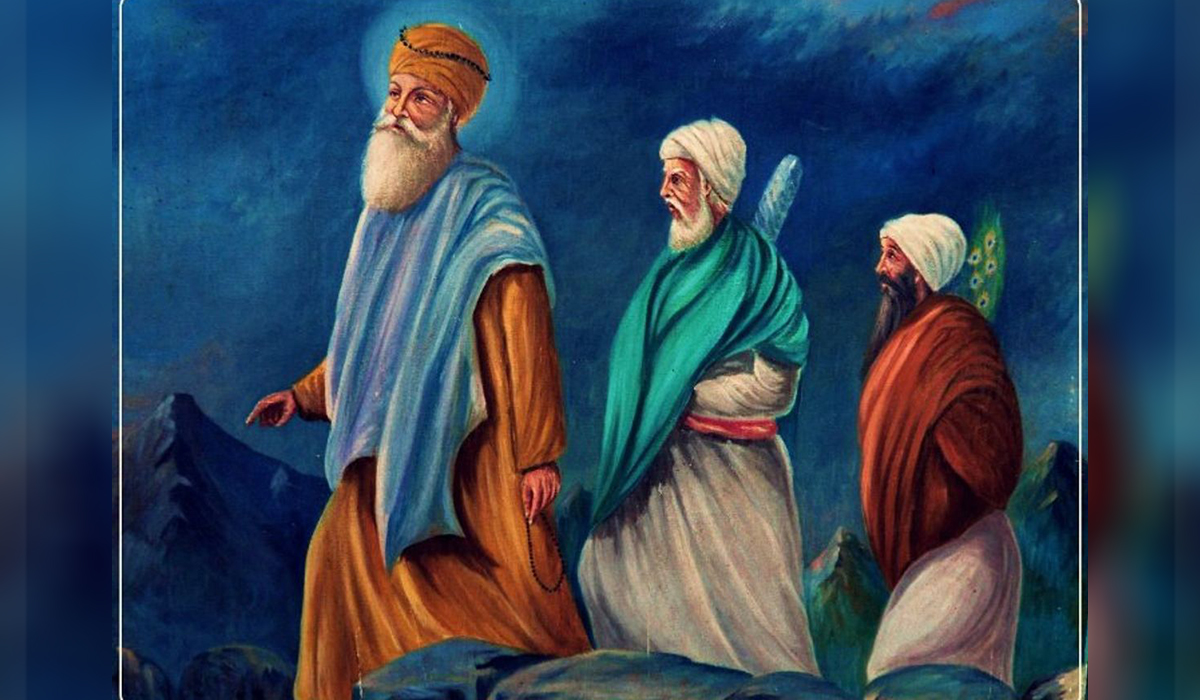

During one of his journeys, Guru Nanak reached Pakpattan Sharif. This ancient city in the Punjab province was renowned as the spiritual center of the Chishti Sufi sect. The shrine of the thirteenth-century saint Baba Fariduddin Ganjshakar is still present here today. Constantly engrossed in the pursuit of knowledge, Guru Nanak met a great learned saint, Sheikh Farid, in Pakpattan. Sheikh Farid believed that severe penance was the only path to attain salvation, for which it is necessary for a person to go far away from the world.
Guru Nanak conversed with him and the essence of what he said afterwards was in these two lines –
Ghar hi bheetari sabu kichhu hai
Baahari dhoodhat bharamu gavai
The details of Guru Nanak’s life and the detailed explanation of his teachings are found in four major Janamsakhis. One of these is Miharban’s Janamsakhi. Famous writer Khushwant Singh considered this to be the most authentic. Interpreting the Guru’s teaching, Miharban’s Janamsakhi says that if the mind is concentrated and pure, then God can be found even while living at home.
This episode encapsulates the entire irony of Guru Nanak’s long journeys. In his lifetime, he undertook at least four extremely long journeys during which he walked about 28,000 kilometers. In Sikh tradition, these journeys are called Guru Nanak’s Udasis. After walking thousands of miles for many years, he told Sheikh Farid that there is no need to go so far from home to find God. In this very irony lies the essence of Guru Nanak’s journeys.
Guru Nanak was born in 1469 AD in Talwandi (present-day Nankana Sahib, Pakistan). At that time, India was not an integrated political entity. The Sultan of Delhi did not have effective control over the entire subcontinent. Many regional sultanates, Rajput states, and local chieftains were running power in their respective areas. North India was ruled by the Lodi dynasty and Bahlul Lodi (1451–1489) sat on the throne of Delhi. Punjab was also under the Delhi Sultanate, although the actual administration here was largely in the hands of local Afghan chieftains and subedars. He was born in such an India where power was trying to centralize on one hand and continuously scattering on the other.
He also saw the reign of Sikandar Lodi (1489–1517) and then Ibrahim Lodi (1517–1526). In the final phase of his life, in the year 1526, Babur laid the foundation of Mughal power by defeating Ibrahim Lodi in Panipat. Thus, Guru Nanak saw the transition of power from the Afghan Lodi rule to the Mughal rule right before his eyes.
From childhood, Guru Nanak was an introverted boy who lived in his own tune. For many days, he did not even like to speak to anyone. He would often wander in the forests and look at the mysteries of nature with great engrossment – the coming of spring, when life seemed to suddenly awaken with the buzzing of bees and the flight of butterflies all around; that scorching heat of summer, which scorched all vegetation; and then the rainy season, which like some magic breathed life back into the dry earth and turned the whole world green. The distinct world of the birds and animals of the forest also attracted him a lot.
This mystery of nature gradually descended within the child Nanak. He started thinking who is the maker of this vast creation, who is its sustainer and ultimately who is its destroyer? And along with these questions, another question started taking birth in his mind – can that Creator be reached only through the rituals of being a Hindu or a Muslim?
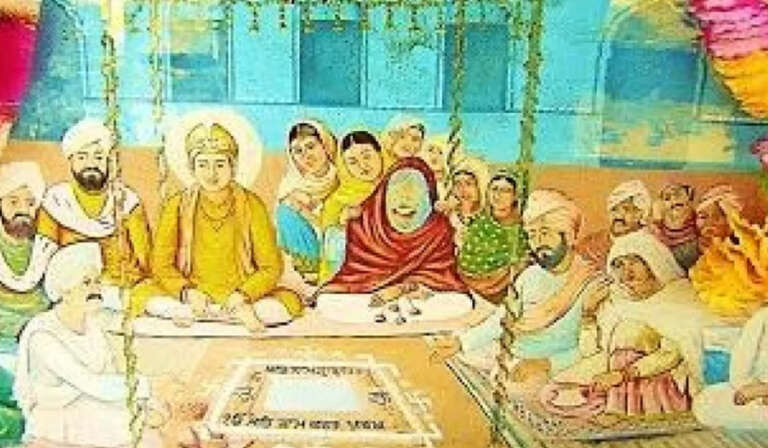
At the age of about sixteen, Guru ji came from his ancestral village to Sultanpur Lodhi where he worked for some fourteen-fifteen years in the granary of Daulat Khan, the local representative of the Lodhi rule. During this period, he got married, after which his two sons were also born.
A Muslim servant of the family named Mardana had also come along with him to Sultanpur Lodhi. Going forward, this very Mardana became his closest companion. In the Janamsakhi, he has been described as belonging to the Mirasi and musician community. He used to play the rabab and sing Guru Nanak’s verses along with him.
Nawab Daulat Khan Lodi was very impressed by Guru Nanak’s honesty. The work of the store and accounts was entrusted to him, but Guru Nanak neither accepted anyone’s bribe, nor adopted the corrupt traditions of his predecessors. The people of Sultanpur Lodhi also never tired of praising his honesty and simplicity.
All day long, Guru Nanak had to write accounts. Making a ledger of income and expenses, adding and subtracting at the end of the day, and seeing whether all the accounts tally correctly or not. Many times he had to stay bent over the ledger in the light of a lamp until late at night. According to an anecdote told in Miharban’s Janamsakhi, one night he suddenly became agitated with his own life. He threw the pen and ledgers to one side and asked himself, “Why have I gotten trapped in these hassles? Forgetting my Creator, why am I entangled in these petty accounts? Does my whole life have to pass like this, writing accounts day and night?”
He realized that if he had to stay awake lighting a lamp at night, then he should stay awake for some work which has a real meaning. Being of a spiritual tendency since childhood, he used to look at his surroundings with the eyes of a conscious philosopher. Gradually he became detached from the ordinary things of life and the world. His mind also drifted away from his wife, children, his property and the people around him. He had understood very well that one of the biggest ironies of society is caste discrimination, but an equally deep problem is the enmity and division flourishing among humans in the name of religion.
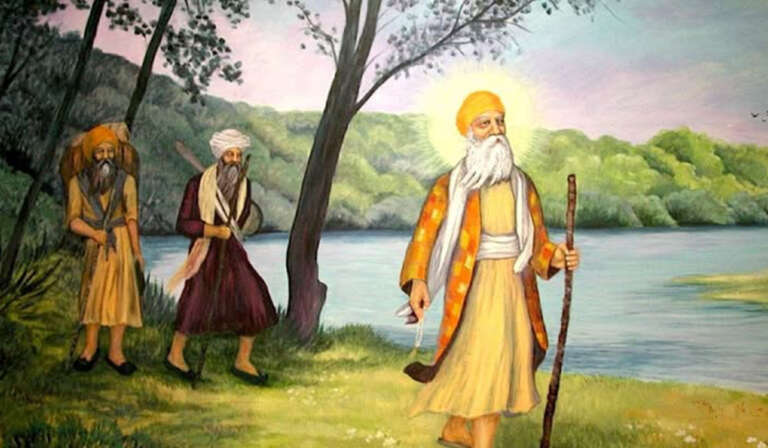
If historians and his biographers are to be believed, one day during 1499 to 1501 AD, he decided that to fully understand the creation made by the Creator and the religious-communal hypocrisy being run in His name, and to bring it before the common people, he would have to set out on long journeys. Taking Mardana along, he set off in the direction of Delhi. This was the beginning of the unimaginable journeys of his life. As mentioned above, these journeys were named Udasi. The root of this word is considered to be the Guru’s detached and neutral state of mind. Through these Udasis, he wanted to reach among all the pilgrimages, cities, ascetics, pundits, Sufis, and common people of the country to enrich his world of experience, which would give proper guidance to his pursuit of truth.
Regarding his first Udasi, an incident is mentioned in Miharban’s Janamsakhi. Guru Nanak and Mardana were traveling. They saw a flock of swans flying in the sky. Guru Nanak was so captivated seeing those birds that he ran towards them. Mardana also followed behind him. The swans landed in the field below and let Guru Nanak come near them.
Guru Nanak kept looking closely at those birds for a long time – their long necks, shining eyes, and bodies with silver-like white wings. Then a question arose in his mind, these birds cross the sky and go so far. Have they ever even looked towards their Creator? He kept thinking why such beautiful birds keep wandering from Khorasan to Hindustan and from Hindustan back to Khorasan.
Then he blessed those swans and moved forward on his journey. This small anecdote is perhaps the most beautiful beginning of Guru Nanak’s entire Udasi. He had not set out to conquer the world. He had set out to see it well.
Although there is a difference of opinion among scholars regarding the exact duration and the number of Guru Nanak’s Udasis, according to the official website of the Shiromani Gurdwara Parbandhak Committee, he undertook a total of four Udasis which took place during the years 1500 to 1521.
Some modern scholars also name his travels within the Punjab province between 1523–1524 as his fifth Udasi, but the general consensus has been formed on four Udasis only. These four Udasis were undertaken towards four different directions. The first Udasi was undertaken towards the East between 1500 and 1506, the second towards the South between 1506 and 1513, the third towards the North between 1514 and 1518, and the fourth towards the West between 1519 and 1521.
Since Guru Nanak himself did not leave any written description of his journeys, over time various events and characters must have kept getting added during the documentation of these Udasis.
In the first and longest Udasi undertaken in the Eastern direction, Guru Nanak traveled towards the East passing through North India. Under this, places like Kurukshetra, Haridwar, Delhi, Mathura-Vrindavan, Ayodhya, Kashi, Gaya, Patna, Bengal, Kamrup, and Jagannath Puri are mentioned.
This Udasi started with the journey to Delhi. It is not known for sure how long Guru Nanak stayed in Delhi. From there he moved towards Haridwar, situated on the banks of the Ganges. It seems that a major religious festival was going on at that time and a huge crowd had gathered to bathe in the holy river.
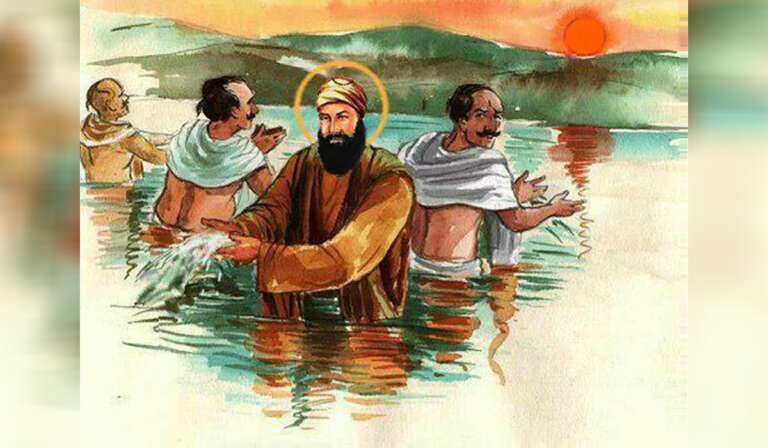
Guru Nanak and Mardana stayed in Haridwar for some time to attend the Baisakhi fair. On the day of Baisakhi, a huge crowd of people had gathered to take a bath in the Ganges. Guru Nanak saw that people, facing towards the East direction, were filling water in their palms and tossing it towards the Sun. Guru Nanak also stepped into the river and, filling water, started throwing it towards the West direction.
Surprised, the pilgrims started saying, “Who is this throwing water towards the West? He must either be a madman or a Muslim!”
They went to Guru Nanak and asked him why he was offering water in the wrong direction. Guru Nanak conversely asked them why they themselves were throwing water towards the Sun in the East direction.
“We are offering it to our dead ancestors,” they replied.
“Where are your dead ancestors?”
“In heaven with the gods.”
“How far is the abode of the gods from here?”
“Forty-nine crore kos.”
“Does your water reach there?”
“It absolutely reaches!”
“Then why are you people throwing water towards the West?” Guru Nanak replied, “My home and my lands are near Lahore. It has rained everywhere there, but it has not rained in my fields. Therefore, I am giving water to my fields.”
The people said, “O devotee of God, how on earth can you deliver water from here to your fields near Lahore?”
Guru Nanak said, “If you can deliver water from here to the abode of the gods forty-nine crore kos away, then why can’t I deliver it to Lahore, which is only two-four hundred kos away from here?”
Following this incident told in Miharban’s Janamsakhi, a large number of Hindu pilgrims gathered in Haridwar became disciples of Guru Nanak. Even after the Baisakhi fair ended, he stayed there for some time and kept preaching to the people.
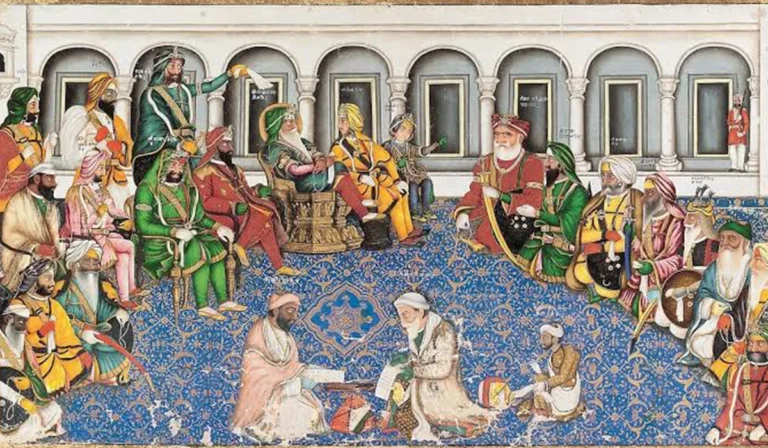
From Haridwar, Guru Nanak and Mardana proceeded towards Prayag, where in modern Allahabad the confluence of the Yamuna and Saraswati with the Ganges is believed to be. From Prayag, the Guru went to Banaras, which was then a major center of Hindu learning and orthodox religious tradition. In the Adi Granth, there is a mention of Guru Nanak’s many meetings with the pundits. These pundits used to reproach him for his unconventional beliefs and ask him questions to test his knowledge about the holy scriptures.
The historicity of the story can be debated. But its ideological power is indisputable. Guru Nanak is not doing this to mock ritualism. He is asking what is the meaning of the action? Should an action be considered meaningful just because it has been done for centuries? This question is at the center of his entire journey of thought. He is not merely an opponent of tradition. He is an opponent of blind tradition. For him, the value of religion does not lie in how many times we repeat a mantra, but rather in what changes within us after that mantra.
This incident represents a thread present in all the Udasis of Guru Nanak – Guru Nanak does not accept any hypocrisy spread in the name of religion and God and tests them on the whetstone of logic. His dialogues with religious leaders and saints-sages are present in all the Janamsakhis and give voice to his clear vision and people-oriented ideology.

Leave a Comment