

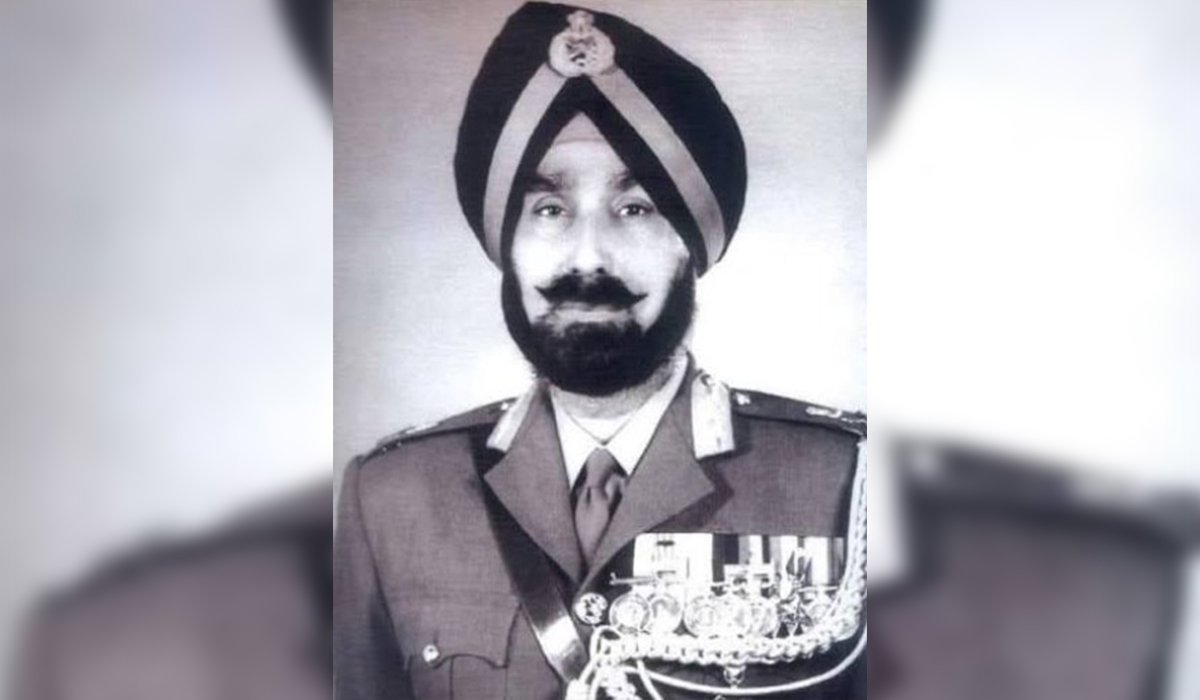

Lieutenant General Harbaksh Singh is one of those great generals of the Indian Army who changed the course of the country’s history. He is respected as the “Defender of Punjab” for the exceptional courage, foresight and determination he displayed while leading the Western Command during the 1965 India-Pakistan War.
Early Life, Birth and Education
General Harbaksh Singh was born on 1 October 1913 in village Badrukhan of the princely state of Jind, in Sangrur district, Punjab, into a prosperous Madhar Jat family. It is considered to be the maternal village of Maharaja Ranjit Singh. His father, Dr Harnam Singh, was the first doctor of the village and had served with the Jind Infantry during the First World War. Harbaksh Singh was the youngest of seven siblings. He studied at Ranbir High School in Sangrur and later graduated from Government College, Lahore.
Military Journey and Regiment
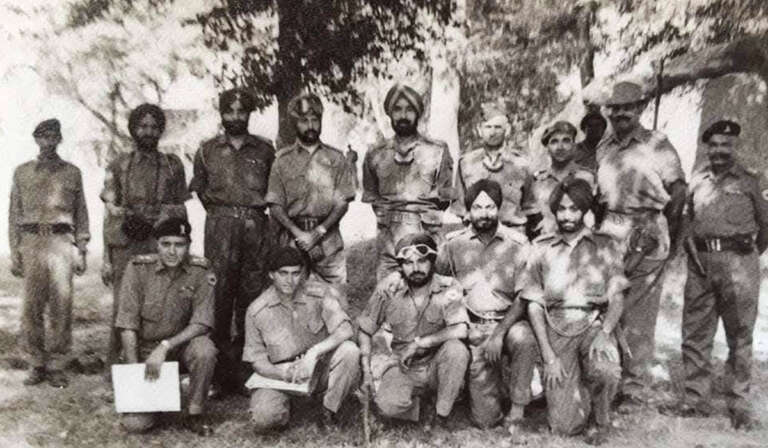
Harbaksh Singh joined the first batch of the Indian Military Academy (IMA), Dehradun, in 1933 and was commissioned into the Indian Army on 15 July 1935. Initially, he was attached to the British Army regiment ‘Argyll and Sutherland Highlanders’, during which he took part in the Mohmand campaign in the North-West Frontier Province (NWFP). In 1936, he joined the 5th Battalion of the 11th Sikh Regiment at Aurangabad.
During the Second World War, while fighting the enemy in the Malayan campaign, he was seriously wounded and, after the fall of Singapore, was taken prisoner of war (POW) by the Japanese Army. During captivity, he suffered severe hardships such as beriberi and malnutrition, but remained steadfast in his principles until the end. After being released in 1945, he returned to India.
Lieutenant General Harbaksh Singh breathed his last in New Delhi on 14 November 1999 at the age of 86. At the time of his final journey, the nation bid him farewell with full military honours.
15 Unique and Overlooked Facts
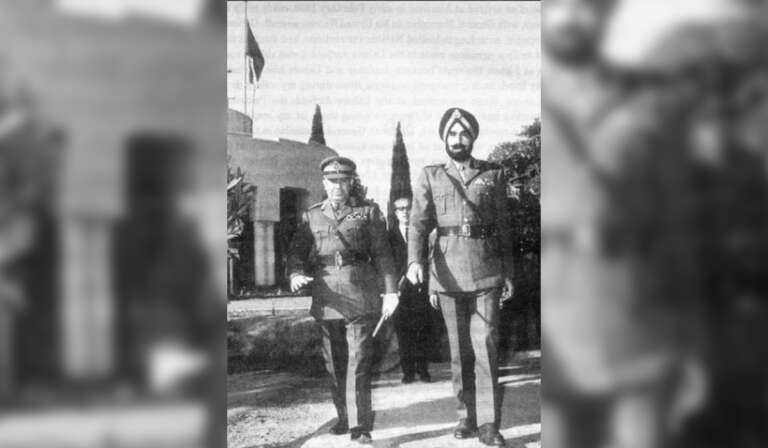
- Refusing the Order to Retreat: During the 1965 war, when Pakistan’s First Armoured Division attacked the Khemkaran sector with American Patton tanks, Army Chief General J.N. Chaudhuri, sitting in Delhi, panicked. He verbally ordered Lieutenant General Harbaksh Singh to pull back 11 Corps and move it to the defensive line along the Beas River.
According to General Harbaksh Singh, such a withdrawal would have meant handing over key areas of Punjab such as Amritsar, Gurdaspur and Tarn Taran, as well as Sri Darbar Sahib, to the enemy without a fight. At this historic moment, General Harbaksh Singh showed courage and clearly refused to obey the order of his superior, saying that if the order was to be implemented, it should first be sent in writing. This decision not only saved Punjab, but also changed the course of the war and gave India a glorious victory. - Creation of ‘Patton Nagar’: In the Battle of Asal Uttar near Khemkaran, he had canal embankments breached and fields flooded, causing Pakistan’s supposedly invincible American ‘Patton tanks’ to get stuck in the mud. The Indian Army destroyed or captured around 100 Pakistani tanks, because of which the place came to be known as “Patton Nagar”.
- Historic Victory at Haji Pir Pass: Under his leadership, Major Ranjit Singh Dayal’s unit hoisted the Tricolour at Haji Pir Pass on 28 August 1965, completely defeating Pakistan’s ‘Operation Gibraltar’.
- Establishment of Meghdoot Force: During the 1965 war, acting on Major Megh Singh’s proposal and without waiting for formal government approval, Harbaksh Singh authorised the creation of the ‘Meghdoot Force’ to carry out guerrilla attacks across enemy lines. This unit later became the Indian Army’s famous ‘9 Para’ (Special Forces).
- Attack Towards Lahore-Sialkot: When Pakistan launched an attack in the Chhamb sector under ‘Operation Grand Slam’ with the plan of cutting Kashmir off from India, Harbaksh Singh devised a strategy to open a counter-front by crossing the international border towards Lahore (Ichhogil Canal) and Sialkot, forcing Pakistan to pull back troops from Kashmir.
- Reducing His Own Rank: In 1947, when the commanding officer of 1 Sikh Battalion, Lieutenant Colonel Dewan Ranjit Rai, was killed in action, Colonel Harbaksh Singh voluntarily removed one star from his uniform and assumed the rank of Lieutenant Colonel in order to take direct command of the front.
- Defence of Srinagar: In November 1947 at Shalateng, he carried out such a strategic encirclement of tribal raiders who had reached within just 4 miles that more than 470 enemy fighters were killed and Srinagar airfield was saved from being lost.
- Awarded the Vir Chakra: In 1948, while commanding 163 Infantry Brigade, he crossed the Nastachun Pass in six days and captured Tithwal. For this bravery, he was awarded the Vir Chakra, the third-highest gallantry award.
- Honoured with Padma Awards: For defending the country in the 1965 war, he was awarded the Padma Vibhushan, India’s second-highest civilian honour, by the Government of India in 1966. Before this, he had also been honoured with the Padma Bhushan.
- First Indian Officer: In 1959, he became the first Indian/foreign military officer to go on attachment with the First Division of the German Army.
- Period as ADC: Former Punjab Chief Minister Captain Amarinder Singh, from the Sikh Regiment, served as Harbaksh Singh’s ADC during the 1965 war.
- Parade on Horseback: Due to his Japanese captivity, he had become physically so weak that he could not march on foot. When he became second-in-command of 4 Sikh, he was perhaps the only infantry officer to conduct parade on the parade ground while mounted on a horse.
- Command of IV Corps: During the Chinese attack of 1962, when there was chaos on the battlefield, he was immediately called from Shimla and given command of IV Corps at Tezpur in order to raise the morale of the Army.
- Presence at the Forward Front: During the 1965 war, he would personally go and stand among soldiers at the forward positions in Khemkaran, Burki and Dograi, which infused fresh enthusiasm among the troops.
- Author of Authentic Books: He wrote books to bring out the true facts of war and military strategies, including War Despatches: Indo-Pak Conflict 1965 and his autobiography In the Line of Duty: A Soldier Remembers.
General Harbaksh Singh was not merely an officer, but a commander of iron resolve whose courageous leadership proudly safeguarded the honour of Punjab and the whole of India in 1965.
Leave a Comment