
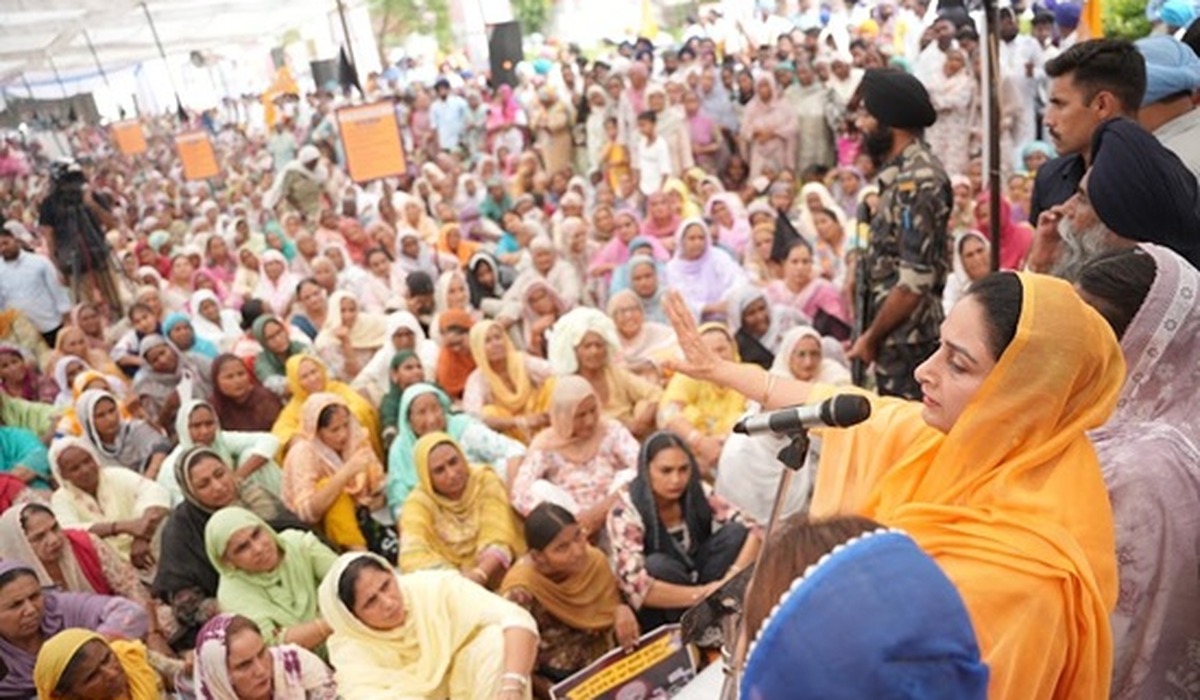

In the ongoing debate against drugs in Punjab, women, especially mothers, are constantly being appealed to play a crucial role. But for many women, the problem of drugs is not an issue outside the home. This problem can exist inside the house as well. The impact of a husband’s or son’s drug addiction can manifest in the form of depletion of household finances, selling of belongings, repeated demands for money, domestic tension, intimidation, and in some cases, violence.
Therefore, the question of women’s role in Punjab’s anti-drug campaign cannot merely be when and how they should stand up against drug peddlers. If women are expected to fight against drugs in Punjab, who will protect them when the addiction has already entered their own homes?
This question gained further prominence during the Shiromani Akali Dal women wing’s ‘Mawan-Dhiyan Insaaf’ (Mothers-Daughters Justice) program in Mohali on September 26. Shiromani Akali Dal leader and Member of Parliament from Bathinda, Harsimrat Kaur Badal, appealed to the women of Punjab to launch an anti-drug campaign on the lines of the farmers’ protest. She also spoke about setting up ‘Thikri Pehras’ (community night watches) to stop the sale of drugs in villages.
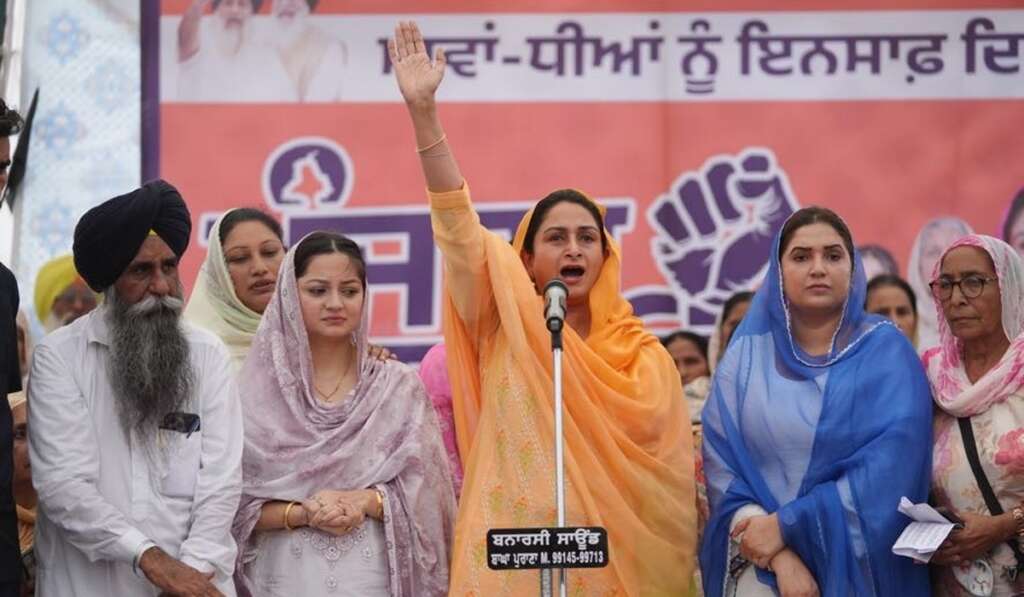
Badal’s statements were part of a political campaign, and she questioned the Aam Aadmi Party government’s performance in tackling drug smuggling. These allegations are political claims and cannot be independently verified based solely on her statement.
But beyond this appeal, a larger question arises: what about the women who are already battling the problem of addiction in their own homes?
Punjab’s drug problem is also a household problem
There has been a significant increase in the number of people reaching government de-addiction centers for treatment in Punjab.
According to state government data, admissions to government de-addiction centers rose from 9,577 in 2024 to 25,290 in 2025. This is an increase of over 164 percent. By July 2026, more than 14,000 people had been admitted to government de-addiction centers. Admissions to government rehabilitation centers also increased from 2,644 in 2024 to 8,574 in 2025. Behind these statistics are not just the individuals consuming drugs. Behind them are families.
A person admitted to a de-addiction center might be the earning member of the house, the husband of a mother of children, or the son of elderly parents. Therefore, treatment does not just change one person’s life. It impacts the entire family. However, family members living with addiction are often not viewed in the same way as the person consuming drugs.
Rural women are already telling what is happening inside homes
A report by The Indian Express in May 2026 on Punjab’s first Drug and Socio-Economic Census brought an unseen aspect of this problem to the fore.
According to the report, teachers working on the survey stated that rural women shared information about their husbands’ excessive alcohol consumption and, in some cases, the domestic violence committed by them.
A survey worker from a border village in Fazilka told the newspaper that some women had provided information about domestic violence linked to their husbands’ drinking habits. The report also revealed allegations that in certain situations during the survey, workers were instructed not to record alcohol addiction as drug abuse.
It is important to understand a crucial difference here. Alcohol is a legally sold substance, but dependence on it can also cause health and family problems.
The State Program Officer of Punjab’s De-addiction Program, Dr. Jagdish Bhola, had told The Indian Express that alcohol is also a drug, and people with alcohol dependence are treated in de-addiction centers. Punjab State Women Commission Chairperson Raj Lali Gill also told the newspaper that the commission receives cases where alcohol is linked to domestic violence and divorce.
This matter points to a fundamental problem in the public debate on drugs: only what gets recorded is what becomes visible.
Recent data does not confirm an overall increase in domestic violence
It is necessary to clarify an important fact here. The National Family Health Survey-6 (NFHS-6), 2023-24 data for Punjab does not reflect an overall increase in spousal violence in the state.
According to the survey, the proportion of spousal violence among married women aged 18 to 49 in Punjab decreased from 11.6 percent in NFHS-5 to 8.7 percent in NFHS-6. This means that about 9 out of every 100 women in this age group reported experiencing violence from their husbands.
Therefore, the claim of an overall “increase” in domestic violence in Punjab does not align with these statistics. But this also does not mean that the problem has ended — especially for women living in homes bearing the brunt of addiction.
A Chandigarh study showed a strong link between drugs and violence
In a community-based study published in August 2026, 279 women from an urban settlement in Chandigarh were interviewed. In the study, 30.1 percent of women reported facing domestic violence over the past year.
Among women whose husbands had a history of drug use, 77.7 percent reported domestic violence, whereas this proportion was 5.9 percent among women whose husbands had no such background of addiction.
The study highlighted the husband’s history of drug use as the strongest factor associated with domestic violence. However, it is also necessary to read these statistics with caution.
This study was based solely on 279 women from a specific urban settlement in Chandigarh. It cannot be considered the domestic violence rate for the entire Punjab. Nor does it mean that every person who consumes drugs is violent. But this study points to a strong correlation between addiction and domestic violence within that group.
Violence is not the only price women pay
For a woman living in a family with a drug problem, the difficulty does not always start with physical violence. Sometimes it begins with money.
A large part of the husband’s earnings can be spent on alcohol or other drugs. Household savings can get depleted. The woman may have to take loans for rations, children’s education, or medical treatment. Jewelry or other household items might be sold.
Alongside taking responsibility for the children, she might try to convince her husband or son for treatment. Sometimes, the same woman takes the addicted family member to the hospital or de-addiction center, talks to relatives, and runs the household. This is a type of unpaid labor that typically remains invisible in the state’s addiction statistics. And when the drug consumer becomes violent or aggressive, this very caregiving woman can also become the target of violence.
Women are not the police, the treatment system, or the government
Here, the question of a women-led campaign needs to be viewed from another angle. Women can organize, report suspected drug sales, demand action from the administration, and motivate families to recognize the drug problem and seek treatment. But expecting women to set up ‘Thikri Pehras’ or patrol villages cannot replace the police, treatment, and rehabilitation systems.
A mother confronting a drug peddler could put herself in danger. A wife confronting a husband who has become violent under the influence of drugs can also fall into danger. A situation of conflict can also arise for a woman trying to stop household items from being sold. The community’s role can be important, but the government’s responsibility of law enforcement cannot be shifted onto women.
How to protect the woman when addiction is inside the home?
First and foremost, safety.
If a family member is becoming violent or aggressive under the influence of drugs, the woman should not be expected to confront him herself or stop him from doing drugs. If there is immediate danger, moving the woman and children to a safe place and seeking emergency help should be the priority. According to the Punjab Police, the 112 emergency number and the 1091 women’s helpline are available.
But just a helpline is not enough. Women living in families with drug problems may need protection from domestic violence and legal aid, alongside counseling and mental health support. Where necessary, safe shelters, financial and employment assistance for them, and support for children affected by violence or addiction should also be available.
Along with this, affordable and accessible treatment for the addicted family member and a provision for confidentially reporting threats or violence are also essential.
The question should not merely be whether the woman complained about drugs or not. It should also be asked: did she remain safe after making the complaint?
Rising treatment statistics in Punjab raise another question
The increase in admissions to government de-addiction and rehabilitation centers could be an indication that more people are accessing treatment, the reach of government facilities has expanded, or the social stigma attached to addiction has reduced to some extent. It cannot be determined from admission figures alone what the main reason for the increase is.
But one thing is clear. Along with the individuals reaching out for treatment, their families also need to be looked after.
If 25,290 people were admitted to government de-addiction centers in 2025, the number of wives, mothers, children, siblings, and parents affected by them could be far greater. They may need help despite not consuming drugs themselves.
Women’s Commission also spoke about the impact on families
The issue of the impact of drugs on women is not only being raised by political parties.
During a visit to Punjab in August 2026, National Commission for Women Chairperson Vijaya Rahatkar also spoke about the emotional, social, and economic impact of drugs on women and families, emphasizing prevention and rehabilitation.
This perspective is important because it allows the drug problem to be viewed beyond just a law and order issue. For a woman whose family income or safety is being affected due to her husband’s addiction, this is simultaneously an issue of health, economics, family, and women’s rights.
What should be the demands of a women-led anti-drug campaign?
If women are to be given a major role against drugs in Punjab, the campaign should not be limited to just monitoring streets or informing on drug peddlers. The women’s demand could be that every family affected by addiction gets correct information about treatment and rehabilitation, and that there is a provision for confidential reporting and support for domestic violence in villages.
Along with the treatment of the addicted individual, there should be counseling facilities for the caregiving family members as well. If the family’s income is affected by addiction, the woman’s financial security should also be made a part of the policy.
Alcohol dependence should also be addressed as a health and social problem, because merely being a legally sold substance does not eliminate the harm it causes to families.
Women’s groups at the village level can be prepared as support and referral networks so that every woman does not have to personally confront drug peddlers or violent family members.
Women of Punjab can be part of the solution, but the entire burden cannot fall on them
Harsimrat Kaur Badal’s appeal for a women’s anti-drug campaign on the lines of the farmers’ protest has brought the question into public debate of what role women should play in Punjab’s anti-drug efforts.
But alongside this, another question must be asked: whose responsibility is the safety of the women suffering the consequences of addiction?
Recent data from Punjab indicates that there has been an overall decrease in the reported rate of spousal violence. At the same time, a specific study in Chandigarh revealed a strong correlation between a husband’s drug use and domestic violence. On the other hand, thousands of people are reaching de-addiction and rehabilitation centers.
These statistics do not say that addiction and violence are the same problem. But they certainly indicate that it is difficult to view both issues completely separately. For many women, the drug problem is not news of a drug seizure, arrest, or a political rally.
It is the dwindling of kitchen funds. It is a piece of household jewelry or item being sold without asking. It is a child seeing one of their parents coming home in an intoxicated state. It is the dilemma of that woman who wants to speak up but does not know what will happen afterward. And sometimes, it is also violence. If Punjab wants to mobilize women against drugs, one thing must be ensured: women should not have to stand alone in this fight.


Leave a Comment