
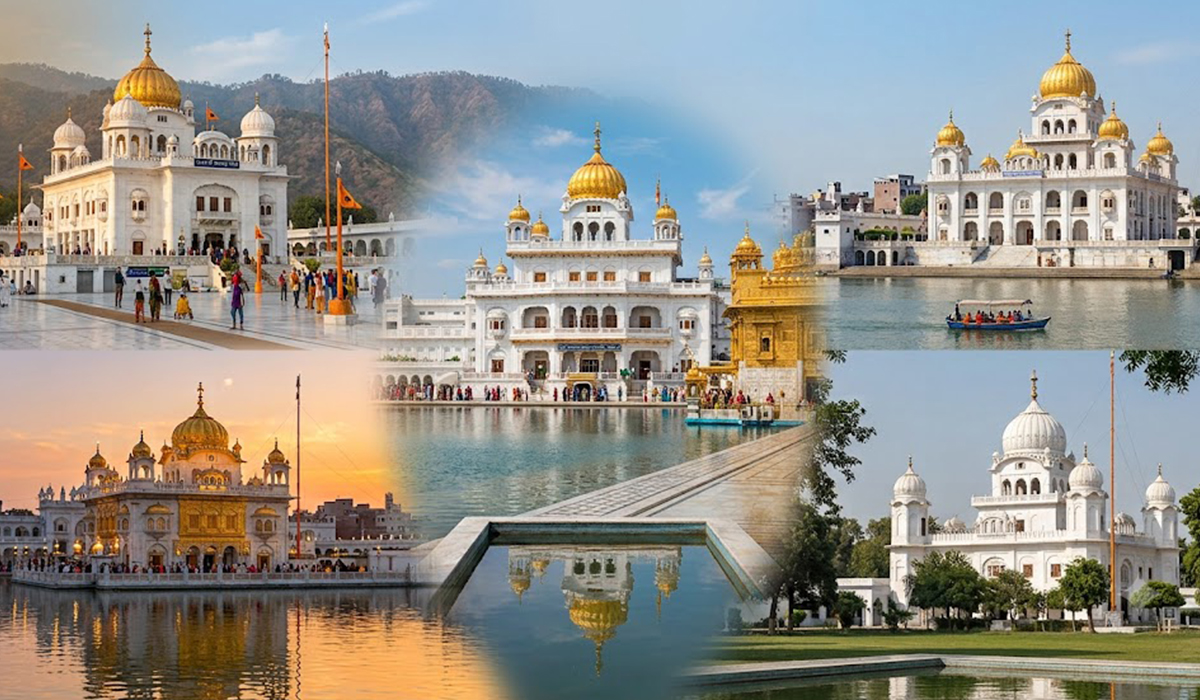

The Persian word ‘Takht’ means a throne, that is, the seat of power, but in Sikh history, this word took on a completely different and deeper meaning. These are the sacred places where spirituality and socio-political responsibility, namely Piri and Miri, meet one another. Today, the Sikh religion recognizes its five Takhts as the centers of supreme religious and communal authority. These five Takhts are:
The Five Takhts:
⚬ Sri Akal Takht Sahib, Amritsar
⚬ Takht Sri Kesgarh Sahib, Sri Anandpur Sahib
⚬ Takht Sri Patna Sahib, Patna
⚬ Takht Sri Hazur Sahib, Nanded
⚬ Takht Sri Damdama Sahib, Talwandi Sabo
These five Takhts were not established at the same time. Their history evolved gradually over a century. In fact, the history of the five Takhts encompasses the long journey of Sikh history; this journey includes crucial phases from Guru Hargobind Sahib to Guru Gobind Singh Ji, and then the acceptance of Sri Guru Granth Sahib Ji as the eternal Guru.
Situated opposite the Harmandir Sahib in Amritsar, the Akal Takht is considered the oldest and supreme among the five. It was established by the sixth Guru, Guru Hargobind Sahib Ji, in 1606. This was the time when, after the martyrdom of Guru Arjan Dev, a new historical question arose before the Sikh community: would religion remain a path to individual salvation, or would it also serve as a basis for communal resistance against injustice? Guru Hargobind Sahib Ji’s answer was—both. Through the concept of Miri and Piri, he intertwined spiritual and worldly responsibilities.
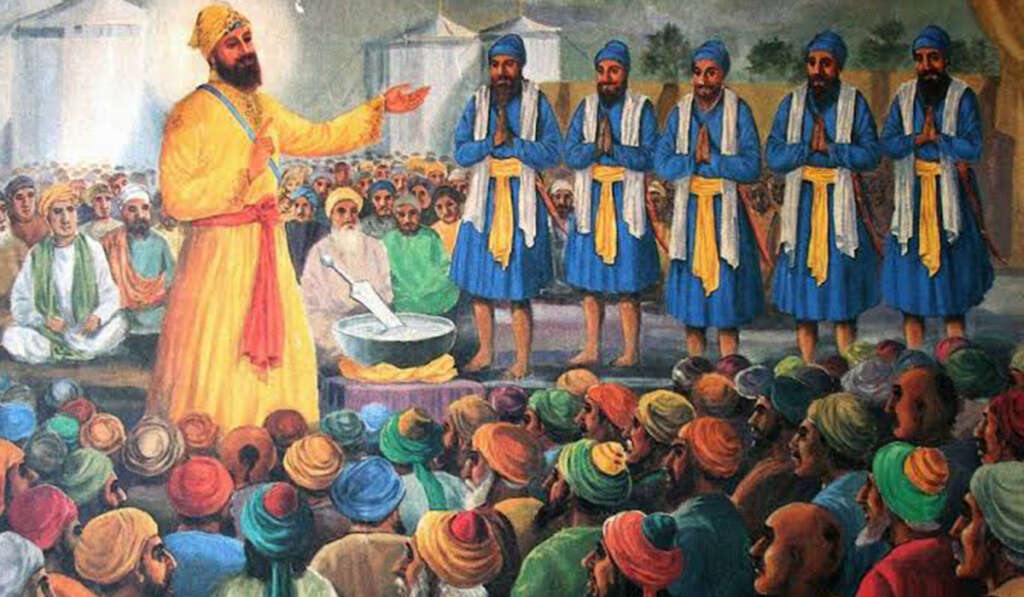
If Sri Akal Takht Sahib is the symbol of the evolution of Sikh spirituality and Panthic (communal) responsibility, then Takht Sri Kesgarh Sahib, Sri Anandpur Sahib is the historical center of the manifestation of the Khalsa consciousness. In the year 1699, on the occasion of Vaisakhi, Guru Gobind Singh Ji held a historic gathering at Anandpur Sahib. On this occasion, the Guru demanded a head from the congregation. One by one, Daya Ram, Dharam Das, Himmat Rai, Mohkam Chand, and Sahib Chand stepped forward. Sri Guru Gobind Singh Ji created the Khalsa Panth at Anandpur Sahib and created the great history of the formation of the Khalsa by administering Amrit to the Panj Piare (the Five Beloved Ones).
Takht Sri Harmandir Ji Patna Sahib serves as a reminder that Sikh history was never confined solely to Punjab. It was here, on December 22, 1666, that the tenth master, Sri Guru Gobind Singh Ji, was born (Prakash). Earlier, Sri Guru Nanak Dev Ji, and later Sri Guru Tegh Bahadur Ji, were also associated with this region. At that time, Patna was an important city in eastern India, and the local congregation played a vital role in the expansion of the Sikh tradition. Numerous memories of Guru Gobind Singh Ji’s childhood are associated with this land. The uniqueness of this Takht is that the image of young Gobind Rai is seen here before the heroic and warrior form of Sikh history emerges. This very child went on to become the tenth master who created the Khalsa Panth. Therefore, Patna Sahib is an important center of the initial phase of Guru Gobind Singh Ji’s life journey.
Situated nearly fifteen hundred kilometers away from Punjab in Nanded, Maharashtra, Takht Sachkhand Sri Hazur Sahib is connected to the most emotional chapter of Sikh history. It was here in 1708 that Sri Guru Gobind Singh Ji spent his final time. At this historical juncture, he established Sri Guru Granth Sahib Ji as the eternal Guru. In this sense, Hazur Sahib is the symbol of the end of one era and the beginning of another in Sikh history. It was also here that the Guru met Madho Das Bairagi, who later became Banda Singh Bahadur. Thus, Nanded is not just the final stage of the Guru’s life, but also an important link in the political and social struggle that subsequently influenced the history of Punjab.
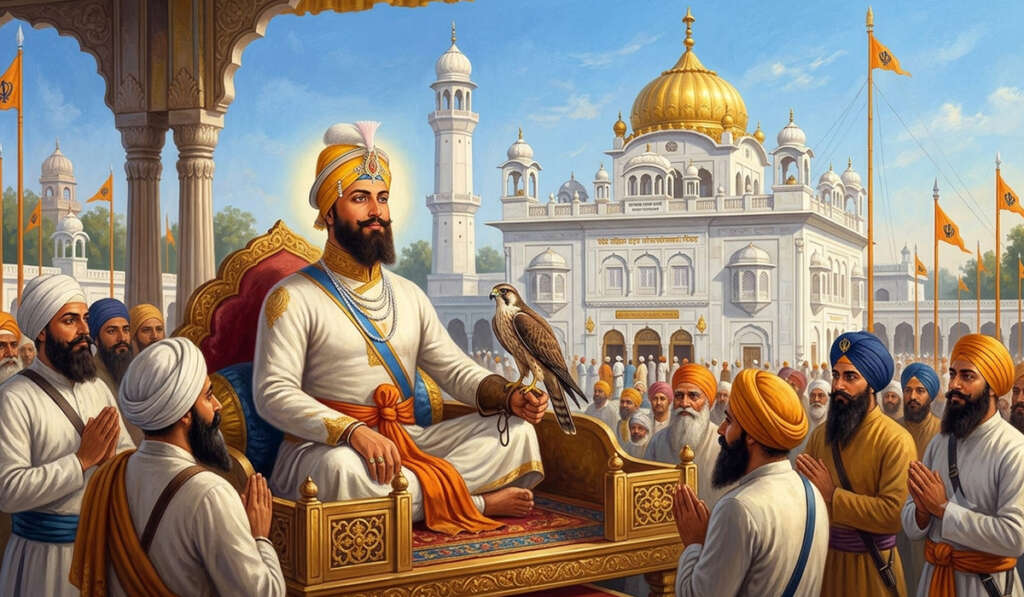
Takht Sri Damdama Sahib in Talwandi Sabo is the last of the five Takhts to be recognized. Guru Gobind Singh Ji stayed here for about nine months during 1705–06. After continuous wars and struggles, this place became a center of rest, study, and literary work for him. That is why Damdama Sahib is also called ‘Guru Ki Kashi’. According to Sikh tradition, it was here that Guru Gobind Singh Ji, with the assistance of Bhai Mani Singh Ji, finalized the compilation (Bir) of Sri Guru Granth Sahib Ji and included the Bani (hymns) of Guru Tegh Bahadur Ji in it. On November 18, 1966, the Shiromani Gurdwara Parbandhak Committee (SGPC) recognized Damdama Sahib as the fifth Takht.
The significance of the five Takhts is that they are not mere buildings, but living historical centers that embody Sikh history, meditation, struggle, and Panthic consciousness.



Leave a Comment