
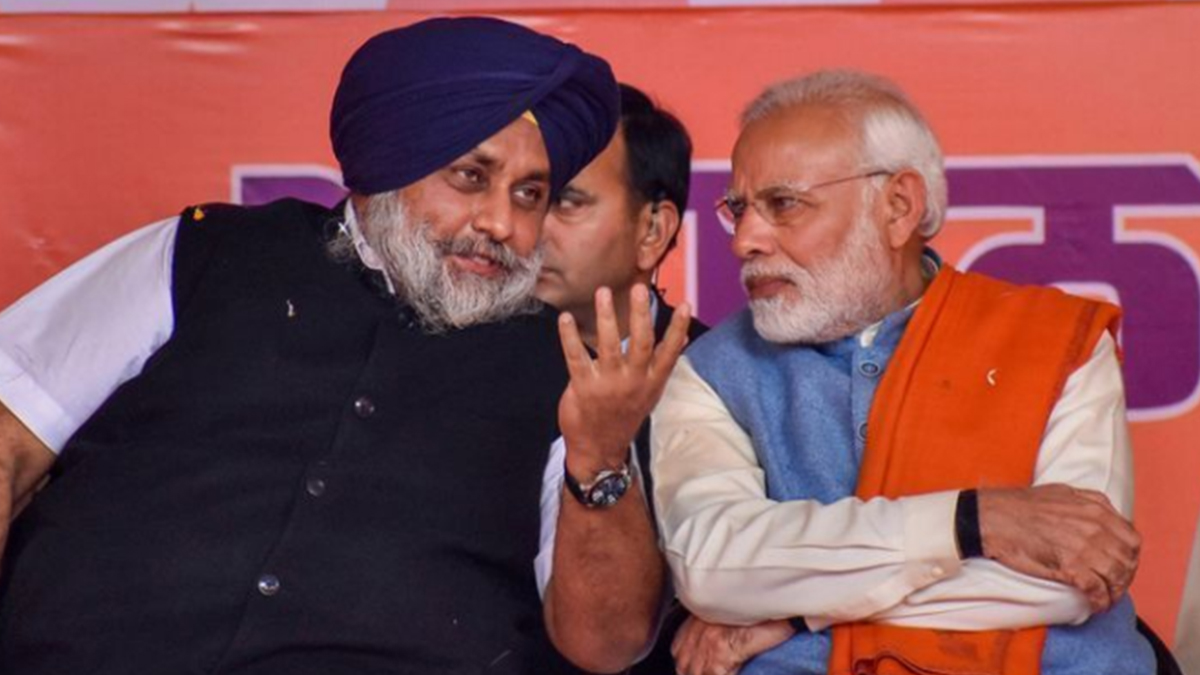

Six years after the farm laws broke a 24-year partnership, Punjab’s oldest regional party and India’s most powerful national party are walking back to the altar. But the bride and the groom have quietly swapped places, and the guests are not sure the wedding will last.
In rural Punjab they say that a quarrel between relatives lasts only until the next viah in the family. Politics, it seems, follows the same rule. With the 2027 Assembly elections barely three months away, Amit Shah declaring at every opportunity that Punjab will have an “NDA government”, and the BJP top brass expected in Amritsar on November 24, Guru Nanak’s Gurpurab, to formally unveil the tie-up, the Shiromani Akali Dal (Badal) and the BJP are set to renew a rishta that both had declared dead in September 2020, when Harsimrat Kaur Badal resigned from the Modi cabinet and the Akalis walked out of the NDA over the farm laws.
At first glance, the Akalis and the BJP are the strangest of bedfellows. One is the votary of a strong, centralised, Hindu-dominated state with an old soft corner for the trader and the big businessman. The other has, for a century, been the spokesman of the Sikh Panth, of federalism and of the peasant. The Anandpur Sahib Resolution and “One Nation, One Everything” do not sit easily on the same stage. Yet, time and again, pragmatism has trumped ideology.
On another level, the alliance makes perfect sense. The rural, Jatt Sikh vote of the Akalis and the urban, Hindu trader vote of the BJP fit into each other like the traditional bond of the village Jatt and the mandi Shahukar . This was never a love marriage. It was an arranged one, fixed by the vichola of electoral arithmetic. And it was this arithmetic that unlocked the doors of power for both, thrice, under Parkash Singh Badal, before the strains of the kisan andolan broke the bond apart.
To understand whether the reunion will work, one has to understand the long, chequered history of this relationship.
For the first two decades after Partition, the Akalis and the Jan Sangh, the BJP’s earlier avatar, stood on opposite sides of the most emotive fault line in Punjab: the Punjabi Suba. While Master Tara Singh and Sant Fateh Singh led morchas for a Punjabi-speaking state, Jan Sangh and Arya Samaj leaders exhorted Punjabi Hindus to declare Hindi as their mother tongue in the censuses of 1951 and 1961. It was a wound inflicted on the Punjabi language by its own speakers, and Sikh memory has never quite forgotten it.
Once the Suba was carved out in 1966, the old enemies discovered a common enemy: the Congress. In 1967, Gurnam Singh headed Punjab’s first non-Congress government, a khichdi of Akalis, Jan Sangh and the communists. It barely survived eight months before Lachhman Singh Gill’s defection, propped up by the Congress, brought it down. The experiment was repeated in 1969, and in 1970 a young Parkash Singh Badal became Chief Minister for the first time with Jan Sangh support, only for the Jan Sangh to walk out over the jurisdiction of the newly founded Guru Nanak Dev University. The post-Emergency Janata wave of 1977 brought another Badal government with the Janata Party, of which the Jan Sangh was a constituent. Indira Gandhi dismissed it in 1980.
The tumultuous 1980s, the Dharam Yudh Morcha, Operation Bluestar and the dark decade of militancy, put the two on opposite sides of the barricades once again. L.K. Advani would later write that he had pressed for army action in the Golden Temple.
A few trends stand out from this phase:
- The alliances were short-lived experiments, born of anti-Congressism rather than any shared vision.
- They could not survive their own contradictions, whether over language, universities or religion.
- The Jan Sangh and the BJP were largely a peripheral national force, with little presence in Punjab beyond a few cities.
- The Akali Dal, after the Punjabi Suba of 1966, became a formidable, mass-based party of the countryside.
- Above all, these were years of the overall hegemony of the Congress.
These were marriages of one monsoon season. They bloomed with the rains of antiCongressism and withered with the first summer.
The end of militancy opened a new chapter. A battered Punjab yearned for peace, and Parkash Singh Badal, ever the moderate, read the mood better than anyone. At the Moga conference in February 1996, the Akali Dal reinvented itself from a Sikh party into a Punjabi party with the slogan of Punjab, Punjabi, Punjabiyat. That same year, when few parties would touch the BJP, the Akalis stood by Atal Bihari Vajpayee’s 13-day government. It was an investment that would pay handsome dividends.
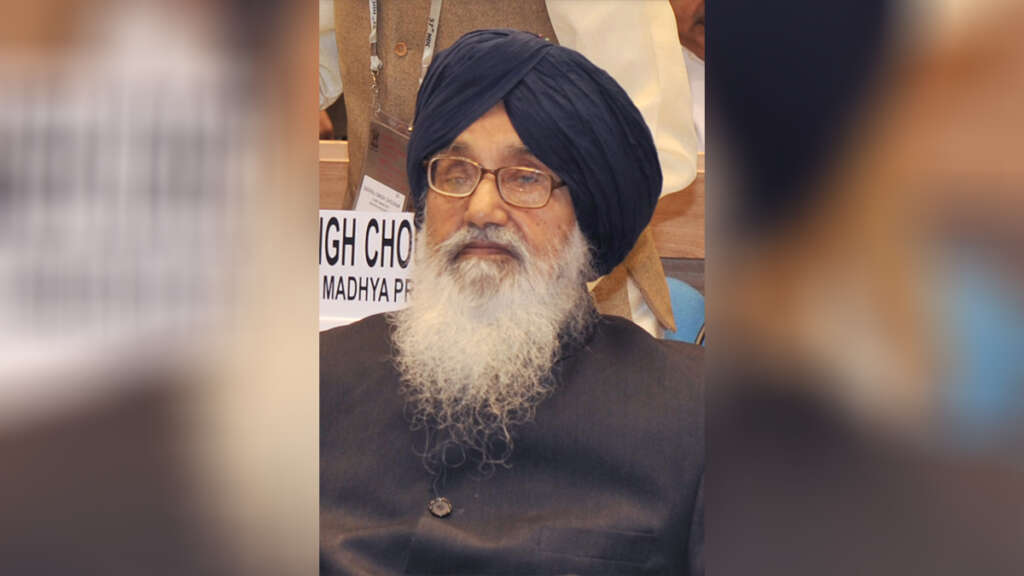
The BJP, for its part, put its controversial agenda, the Ram Janmabhoomi, Article 370 and the Uniform Civil Code, on the back burner during these years to appeal to allies. The alliance was sold on the plank of Hindu-Sikh unity, a balm for a society still healing from the wounds of the 1980s. The results were spectacular. In 1997 the alliance won 93 of the 117 seats. It returned in 2007, and in 2012 it did what no government in Punjab had done since 1966: it won a second consecutive term. Narendra Modi would later call Badal the “Nelson Mandela of India”.
The trends of this phase were very different:
- It was the age of coalitions in India, and the NDA was a broad church of regional parties.
- The BJP was rising steadily as a national force.
- The Akali Dal (Badal) enjoyed near-hegemony in state politics.
- The BJP remained firmly in a subordinate role, contesting just 23 Assembly and three Lok Sabha seats. Any BJP leader who tried to assert himself, be it Navjot Sidhu or Anil Joshi, was quietly cut down to size.
- The Akali Dal itself was consolidating into a family enterprise of the Badals.
- The Akali elite dealt directly with the BJP’s Delhi leadership, Vajpayee, Advani and later Arun Jaitley, bypassing the state unit altogether.
In those years the Punjab BJP was like a baraati at a Punjabi wedding: it got a good seat and plenty of pakoras, but no say in the menu.
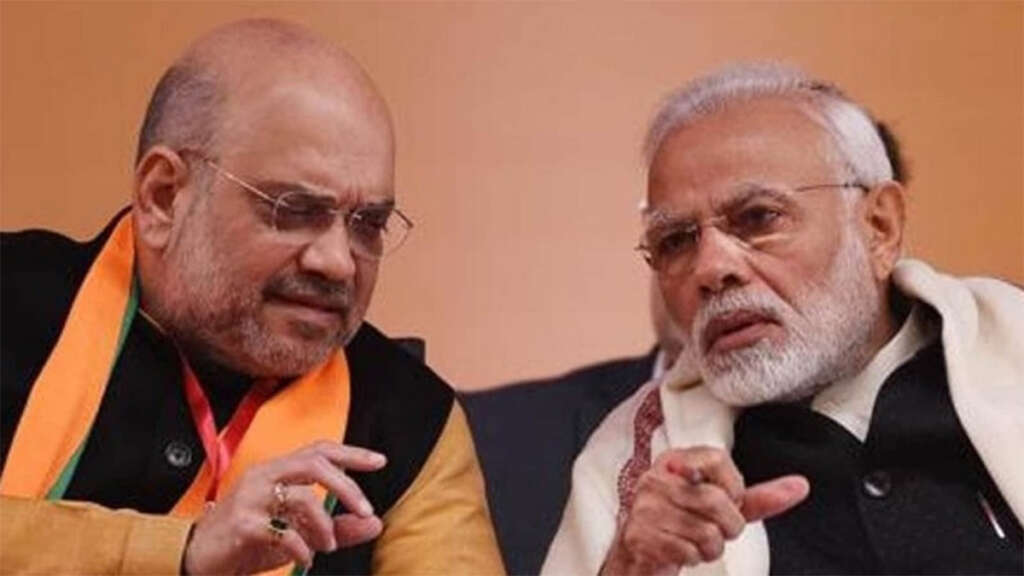
2014 changed everything. The arrival of Narendra Modi and Amit Shah brought a new, aggressive and unapologetic Hindutva to the centre stage. A BJP that won majorities on its own no longer needed the crutches of its allies, and one by one the old partners, the Shiv Sena, the TDP, the Akalis, found themselves on the margins.An aggressive BJP under Amit Shah attempted an expansion of BJP’s footprint in the state before the 2017 elections.
The Akalis, meanwhile, failed to assert themselves on their core issues. They supported the abrogation of Article 370 and initially defended the farm ordinances, even as the Bargari sacrilege and the pardon to the Dera chief eroded their Panthic credibility. When the farmers rose in revolt, the Akalis jumped ship too late to save themselves. The party that once held 75 seats was reduced to 15 in 2017 and just 3 in 2022. In the 2024 Lok Sabha elections it won only Bathinda and polled 13.42 per cent.
The BJP, freed from the Akali leash, went on a shopping spree in the Congress mandi, picking up Captain Amarinder Singh, Sunil Jakhar, Manpreet Badal, Ravneet Bittu, Rana Gurmit Sodhi and Kewal Singh Dhillon, who in May 2026 replaced Jakhar as state president. They also added a few Akalis like Manjinder Sirsa, Amarpal Boni, Ravikaran Kahlon etc .Its vote share jumped from about 6.6 per cent in 2022 to 18.56 per cent in 2024, and it led in 23 Assembly segments.
The trends of this phase are clear:
- The emergence of a new, assertive Hindutva leadership under Modi and Shah.
- The hegemony of the BJP in national politics.
- The decline of the Akali Dal as a regional force after Bargari and the farm laws.
- The fracture of the Akali vote between the Badal Akali Dal, the rebels of the Punar Surjit faction, Simranjit Mann and the neo-Panthics of Amritpal Singh. • The rise of a more assertive BJP, trying to make inroads into the Sikh and farmer vote.
- The yearning of the Akali Dal to ally with BJP.
- and the opening up of Punjab politics, with AAP sweeping 92 seats in 2022.
The chhota bhra has grown taller than the vadda bhra. BJP general secretary Tarun Chugh has said as much: it is now time for the BJP to play big brother.
The simple answer is that neither counts for much on its own. In 2024 the BJP and the Akalis together polled nearly 32 per cent of the vote, well ahead of the Congress (26.3 per cent) and AAP (26 per cent). Separately, they won one seat between them.
The by-elections and local body polls have hammered the point home. In the Tarn Taran bypoll of November 2025, a seat in the Panthic heartland, AAP polled 42,649 votes, the Akalis 30,558, Amritpal’s Waris Punjab De 19,620, the Congress 15,078, and the BJP a mere 6,239, losing its deposit. In the zila parishad and panchayat samiti elections a month later, AAP won 1,531 samiti zones, the Congress 612, the Akalis 445 and the BJP just 73.
The limitations of each are mirror images of the other. The BJP has failed to struck root in the villages. Despite courting former Congress and Akali leaders, seeking Dera support, trying OBC and Dalit planks BJP has largely hit a stonewall in the state due to a limited social base, credible leadership and a thin organisational base.Even Captain Amarinder Singh admits that building the party on its own strength would take “two to three elections”. The Akalis, on the other hand, have virtually vanished from the cities, where the Hindu voter has drifted to the BJP, the Congress and AAP. And there is the memory of past synergy. The workers of both parties have shared stages, langars and campaigns for a quarter of a century, especially in the mandi towns of Malwa and the cities of Doaba.
There is also a national calculation. Fresh from victories in Bihar and West Bengal, the BJP is eyeing Punjab, one of the last big states to elude it. A Sikh-majority border state without a Sikh ally sits awkwardly with its national narrative.
The courtship has been carefully choreographed. Sukhbir Badal met Prime Minister Modi in August, after which the Akalis backed the Centre on women’s reservation and the proposed increase in Assembly seats. The timing also looks inviting. In June, the Akal Takht declared Chief Minister Bhagwant Mann “Guru Dokhi” and “Khalsa Panth Virodhi” over a controversial video, and the AAP government is fighting fires on drugs, gangsters and finances. And the Akalis have been putting their own house in order. Prem Singh Chandumajra and Bibi Jagir Kaur have walked back from the rebel Punar Surjit faction to the Badal fold, while the BJP has nudged Sukhbir to bring back other estranged leaders as well. It is a ghar wapsi before the viah.
Arithmetic, however, is not chemistry. In politics, two plus two rarely equals four. It can be three, and sometimes, if the mood is right, five. Several hurdles lie in the way.
First, there is deep pessimism among BJP workers. Union minister Ravneet Bittu has said the BJP cannot share the Akalis’ burden of drugs and sacrilege. Old-timers fear being sidelined twice over: once by the Akalis, and again by the turncoats, Captain, Rana Sodhi and the rest, who are already queuing up for tickets. In many seats there are two or three BJP aspirants. In Ludhiana and Jalandhar there are four or five.
Second, there is the seat-sharing rusna-manauna. The old formula of 94 seats for the Akalis and 23 for the BJP is dead. Reports of the BJP’s demand have swung between 40 and 55 seats. The party argues that its booth-level machine entitles it to near parity, and it wants the semi-urban seats where it outpolled the Akalis in 2024. The Akalis, for their part, insist on contesting over 60 seats and remaining the senior partner. Whatever the final figure, for the Akalis accepting a lesser role is a karela that must be swallowed with a smile.
Third, Sikh youth are simply not connecting with the Akali Dal (Badal). Sukhbir’s “Vibe Punjab Di” outreach to Gen Z may be trendy, but a generation facing youth unemployment of 22.3 per cent, against 15.9 per cent nationally, wants jobs, not vibes.
Fourth, the BJP itself is no longer invincible. The Gen Z agitation of the “Cockroach Janta Party” over the NEET paper leaks forced the resignation of Union Education Minister Dharmendra Pradhan and dented the Modi aura among young voters. In Punjab, the BJP still carries the stigma of being anti-farmer and anti-Sikh. AAP and the Congress have already sharpened their knives. Bhagwant Mann has been telling village gatherings that the BJP will take the Akalis back only on the condition that they accept the three farm laws, and the Congress calls the reunion an “unholy alliance” of two parties fighting for survival. Expect the reunion to be branded a farm-law wala gathbandhan.
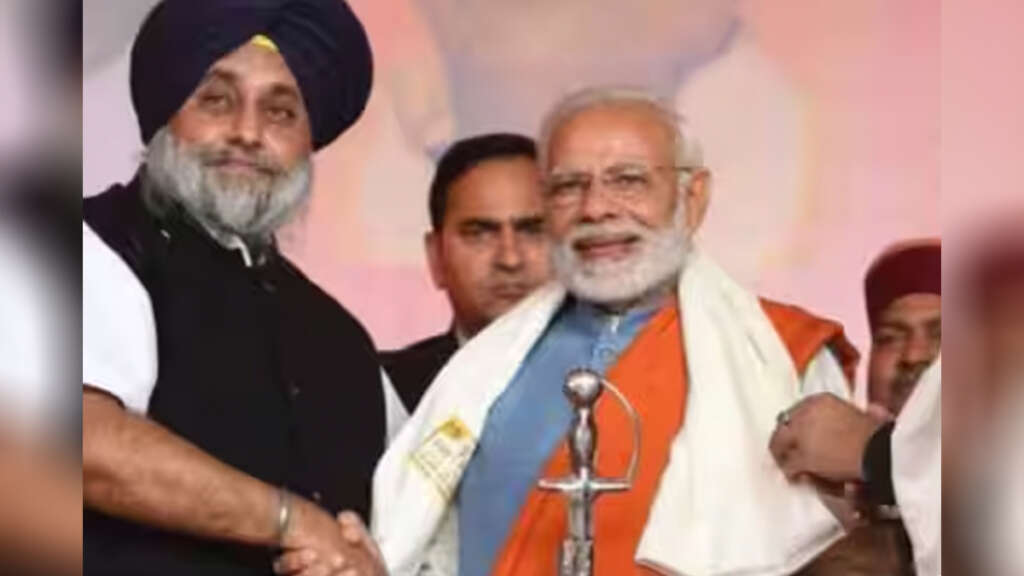
Fifth, there is a new reality. In 1996 it was the BJP that needed the Akalis. Today it is the Akali Dal, facing an existential crisis, that is more desperate for the alliance, and the BJP knows it. On November 19, even as the two sides were giving final touches to the deal, the BJP inducted Akali national vice-president Surinder Singh Chauhan, state secretary Jaswinder Kaur Sohal and a clutch of youth Akali leaders, and state president Kewal Dhillon called it merely “a trailer”. Barely 18 months ago, at Talwandi Sabo, Sukhbir Badal blamed the BJP for conspiring with the Jathedars to weaken his party. Such a U-turn will not be lost on the Panthic voter, who already views the Badals with suspicion. Giani Harpreet Singh’s Punar Surjit has already announced that it will oppose any BJP-Akali deal as “anti-Sikh”.
Finally, there is the question of leadership. Who will be the face of the alliance? The BJP is unlikely to accept Sukhbir as an undisputed Chief Minister, and the Akalis will not campaign for a BJP Chief Minister. Will the Hindu voter who backed Modi in 2024 vote for an Akali candidate in an Assembly poll? Will the Jatt Sikh who blames the BJP for the farm laws press the button for a lotus? The transfer of votes, not the signing of the deal, will decide its fate.
National politics offers two lessons. The TDP walked out of the NDA in 2018, returned in 2024 and swept Andhra Pradesh. The Shiv Sena began as the senior partner in Maharashtra and ended up split, swallowed and subordinate. The Akalis must decide which story they are writing, for the big brother’s jaffi can be warm, but it can also be suffocating.
In 1996, the BJP needed the Akalis to enter Punjab. In 2027, the Akalis need the BJP to remain relevant in Punjab. That reversal, more than any seat-sharing formula, is the real story of this alliance.
Whether this becomes a sanjha chulha that warms both homes, or merely a shared tent for one cold winter night, is for Punjab’s voters to decide.
The writer teaches history at SGGS College, sector 26 Chandigarh.He also edits the magazine Punjab Thinks.

Leave a Comment