
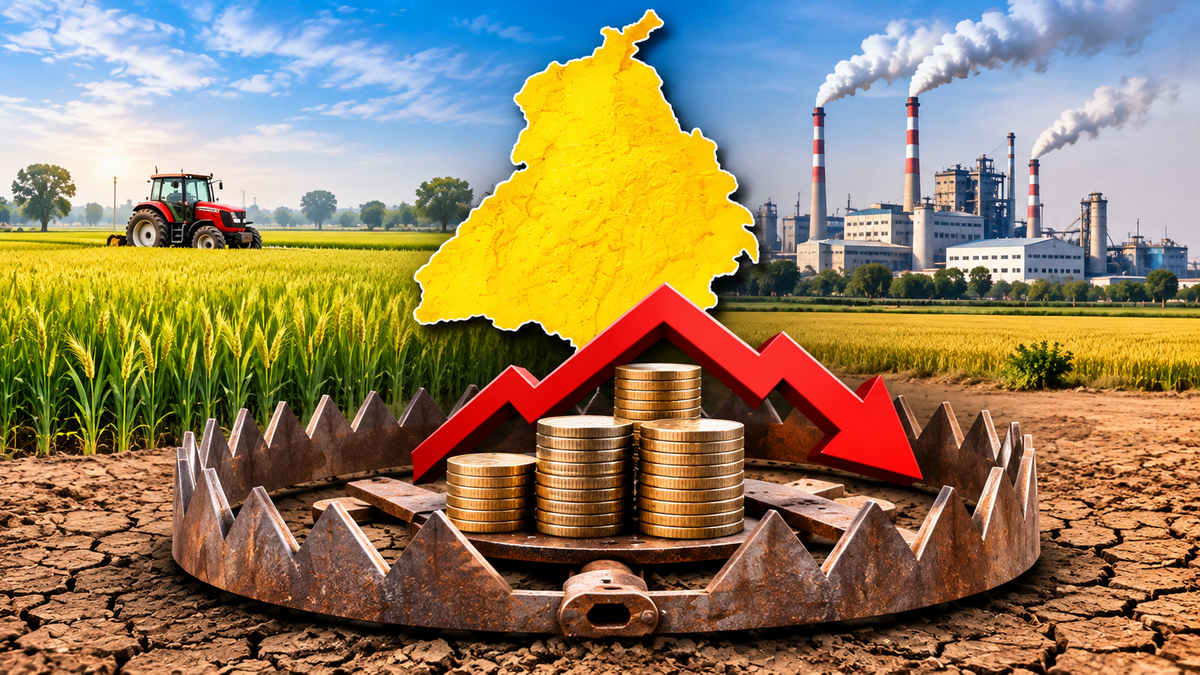

Based on per capita income (USD 1146 to USD 4515), India currently falls in the lower middle-income group. However, some major state economies, namely Karnataka, Telangana, Tamil Nadu, and Gujarat, have become upper middle-income economies crossing the threshold of per capita income of USD 4516, while Maharashtra and Haryana narrowly missed the mark. A glance at the GSDP growth and the per capita income of the past few decades shows that Punjab has been consistently losing ground vis-à-vis other major states in India. Punjab’s per capita income at INR 8318 was the highest among all the major states in India in FY 91. However, over the years, as other states raced ahead, Punjab’s per capita income in FY 24 at INR 205374 now ranks 11th among the major states in India. Neighbouring Himachal Pradesh surpassed the per capita income of Punjab for the first time in FY04 and has consistently clocked a higher per capita income than Punjab since FY 12.
Is Punjab caught in what is often referred to as a middle-income trap? This occurs when an economy grows rapidly to a comfortable middle-income level but cannot make the structural transition to high-value, high-productivity sectors. This term was first coined by Indermit Singh Gill, former Chief Economist of the World Bank and Homi Kharas in 2007 in a paper titled “An East Asian Renaissance: Ideas for Economic Growth.”
The middle-income trap, although used in the context of a sovereign nation, it can be used to analyse Punjab’s economic trajectory over the last few decades. During the height of the green revolution, Punjab’s GSDP growth averaged ~5.0% (mid-1960s to mid-1990), higher than the national average of ~3.5%. However, post 1991 liberalization, while the national growth engine shifted towards services, technology, and high value/export-oriented manufacturing, Punjab remained dependent on its government-subsidized agricultural model. Consequently, while Punjab’s GSDP grew at an average of ~5.5% during FY 91-FY 25, national GDP growth accelerated to an average of ~6.6%.
The phenomena of middle-income trap in Punjab can be attributed to three factors. First, Punjab’s agricultural success has become a noose around its neck. The state is unable to come out of wheat-paddy” monoculture as central government’s Minimum Support Price coupled with state government power subsidies make it financially irrational for farmers to go for agricultural diversification notwithstanding depletion of groundwater and degradation of the soil. Second, Punjab has failed to attract high-value manufacturing or high-tech services. Although it has a thriving MSMEs (micro, small, and medium enterprises) in sectors such as textiles, garments, sewing machines, bicycle parts, sports goods, etc., these are mostly low-tech, low-margin operations. Third, due to deep fiscal constraints, Punjab’s debt-to-GSDP ratio has reached 45.66% as per FY27 budget estimate (BE) – one of the highest in the country. Committed expenditure, which includes salaries, pension, and interest payments, accounts for nearly 61% of total revenue expenditure and 72% of all revenue receipts as per FY27BE. When these mandatory obligations are combined with power subsidy commitments, nearly 84% of the state’s revenue receipts are consumed before funding general administrative, developmental, or capital infrastructure projects. Capital expenditure, therefore, is quite low, which in turn is restraining the long-term growth multipliers of the state’s economy.
Once the low-income economy driven by cheap labour and capital accumulation reaches middle-income status, these advantages vanish, argue Gill and Kharas, and to avoid getting stuck in such economies, (i) must shift their focus from low-value and low-cost to higher value-added goods and services, (ii) nurture a society that supports education, innovation, and rewards talent rather than protecting entrenched legacy economic activities/businesses, and (iii) replace outdated economic arrangements with policies that promote market competition and creative destruction. Can Punjab do this and break out of the middle-income trap?
In the evolving scenario, it is almost clear that Punjab cannot find its way out of the middle-income trap via low-value/low-margin agriculture. The idea of crop diversification to transform Punjab agriculture is not new. The state government commissioned the Johl Committee Report on crop diversification in 1986, yet the state remains heavily locked into the same wheat-paddy crop cycle. A landlocked geography and high land costs are a disincentive for heavy manufacturing industries to choose Punjab. The requirement of sizeable land parcels makes setting up large manufacturing units in Punjab often cost-prohibitive compared to other states.
Despite these challenges, Punjab can pursue industrialization, but doing so would require overcoming deep structural bottlenecks such as cross-subsidized power architecture, non-availability of large land parcels, absence of plug-and-play industrial corridors, and over-reliance on migrant workers. It would also require an approach that does not attempt to emulate the industrial model of coastal states, such as Gujarat, Tamil Nadu, and even neighbouring Haryana and Himachal Pradesh. On the contrary, the way forward for Punjab is to leverage its massive textile footprint, expand agri-adjacent sectors, aggressively focus on IT hubs, and offer regulatory transparency. To overcome land and logistics constraints, the focus will be on footloose industries such as pharmaceuticals, electronics system design & manufacturing, medical devices, and bio-plastics, where value is derived from lightweight raw materials in combination with superior human capital, precision, and technology.
Since light manufacturing requires precision skills (CNC operators, cleanroom technicians, quality assurance chemists, etc.), Punjab will have to transform its industrial training institutes away from traditional skill sets and focus on industrial training that is geared toward automation, electronics assembly, industrial robotics maintenance, and automated chemical processing, etc. The New Industrial and Business Development Policy (IBDP) 2026, in combination with the Skill Development Mission of Punjab, outlines the blueprint for this shift. Even the fiscal incentives of the new policy are superior to those of the neighbouring states. Yet, given the fiscal health of the state, investors will remain in a wait-and-watch mode and first assess how the fiscal incentives play out before committing their investment. Since fiscal correction is nowhere in sight, Punjab, although seems to be getting its non-agricultural policy focus right, its transformation to an industrial/services-driven economy and breaking out of the middle-income trap is not going to be easy.
Sunil Kumar Sinha
Author is a Professor of Economics at Institute of Development and Communications (IDC), Chandigarh. Views expressed are personal.
Leave a Comment