
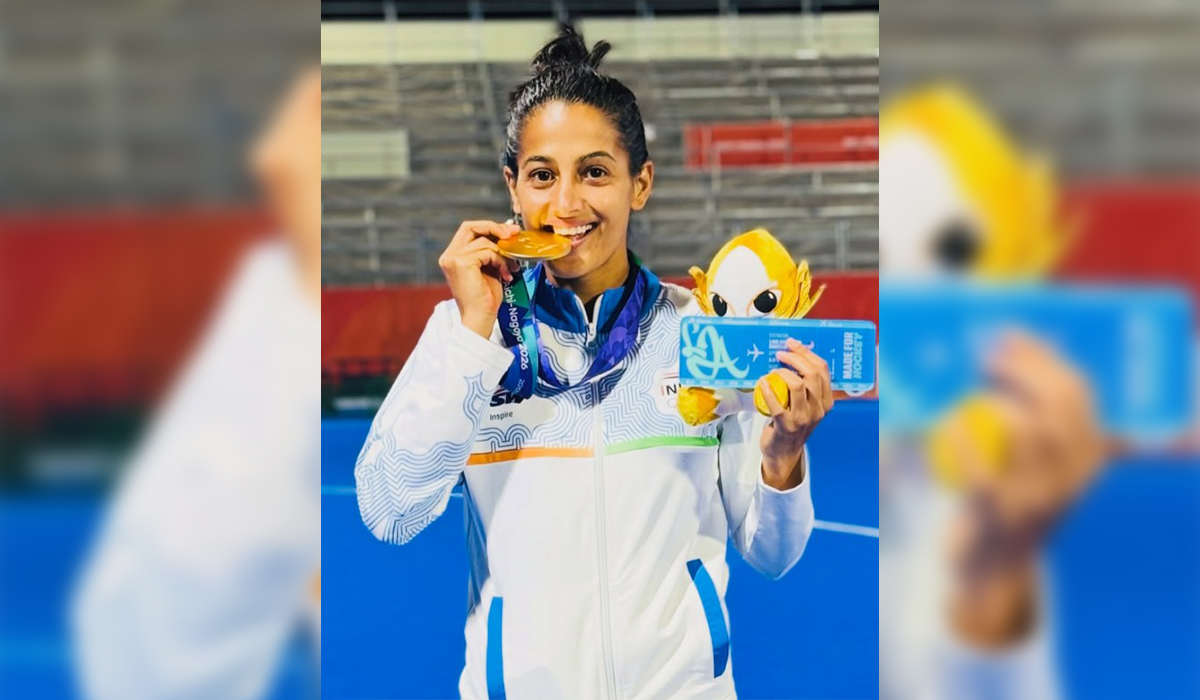

For Baljeet Kaur of Kakka Kandiala village in Tarn Taran, the hockey journey did not begin at a large stadium or a national camp. It started from a simple curiosity—watching her relative go out to play hockey every morning.
Today, 25-year-old Baljeet Kaur is a part of the Indian women’s hockey team that made history after 44 years by winning the gold medal at the Asian Games held in Japan. India defeated China 1-0 in the final on October 2. Baljeet was the only female player from Punjab in this gold medal-winning team.
But the story of reaching this milestone is not just about a match or a medal. It is the story of the journey of a daughter from a rural family, wherein the family had to face financial hardships to keep her sport going.
A story that began after seeing a relative play hockey
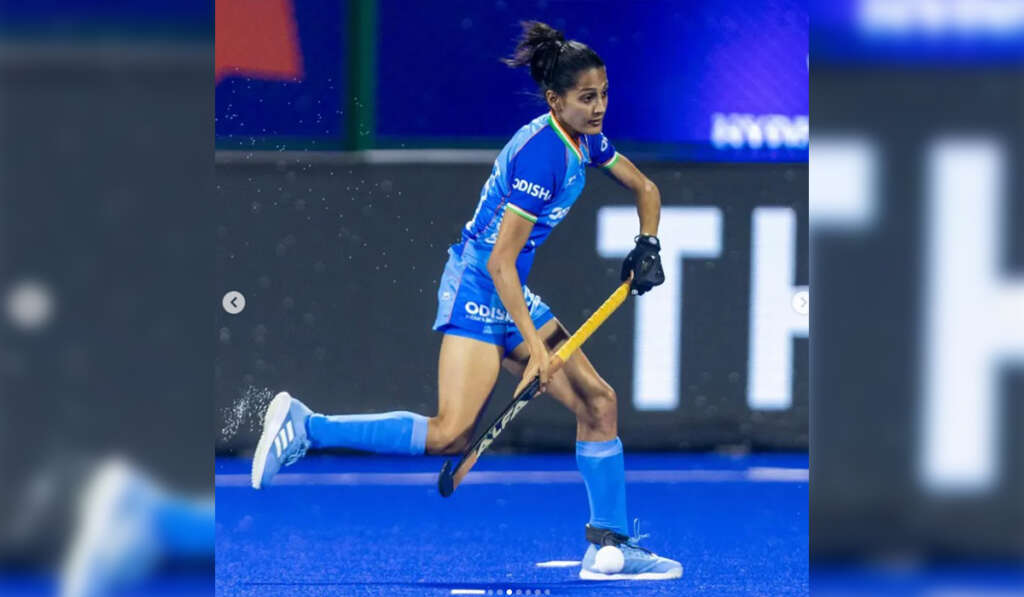
According to Hockey India, Baljeet started playing hockey in 2012 while studying in the seventh grade.
A relative of hers used to go out to play hockey in the morning. Baljeet would ask her where she went so early. When she found out that she went to the ground to practice hockey, Baljeet also developed an interest in the sport. This very interest gradually led her towards playing hockey seriously.
To get better training and competitive opportunities, she moved to a school in Tarn Taran. In 2017, she was selected for the Junior National Camp, which was a crucial milestone in her sporting journey.
When even almonds and chickpeas for hockey were difficult to afford
Baljeet’s family was not financially strong. Her father, Lakhwinder Singh, worked as a labourer.
In a sport like hockey, skill alone is not enough. Along with equipment, a player also needs a good diet. This was not always easy for Baljeet either.
Recently, in a conversation with The Tribune, she shared that her coach used to advise the players to eat chickpeas and almonds daily. But sometimes, she did not have the money to buy them. At such times, she would ask for some chickpeas and almonds from other players so that she could complete her diet.
She also mentioned that her father’s income was not much, but he never asked her to quit hockey.
Asking her father for money was not easy for Baljeet either. She knew that arranging money was difficult for the family. Yet, her father encouraged her to continue playing.
The hockey that was once questioned became the family’s joy

Baljeet’s elder brother, Dalsher Singh, who now drives a taxi, also recalled the family’s worries during her early journey.
At one point, he used to ask his father why so much money was being spent on Baljeet’s hockey. At that time, it was not clear to them where hockey would take Baljeet.
Today, that very question has turned into pride.
Even before Baljeet won the gold medal at the Asian Games, the family had started preparations to welcome her. She had asked her brother to arrange for a dhol to be played upon her return home.
From the village to the national team
Baljeet gradually made her place from the junior level to senior hockey.
According to Hockey India records, she currently plays in the midfield and made her debut for the Indian senior team in 2022. Prior to this, she was a part of India’s silver medal-winning team at the 2018 Youth Olympics and also played in the 2021 Junior World Cup.
The 2026 Asian Games were her first Asian Games.
India defeated China 1-0 in the women’s hockey final. In the opening minutes of the match, Baljeet combined with Ishika to create a chance in the Chinese circle. Later, she also received a green card and was off the field for two minutes. Lalremsiami scored the goal for India in the 10th minute, while goalkeeper Savita played a crucial role in the victory by saving a penalty stroke.
With this victory, India won the Asian Games gold medal in women’s hockey for the first time since 1982.
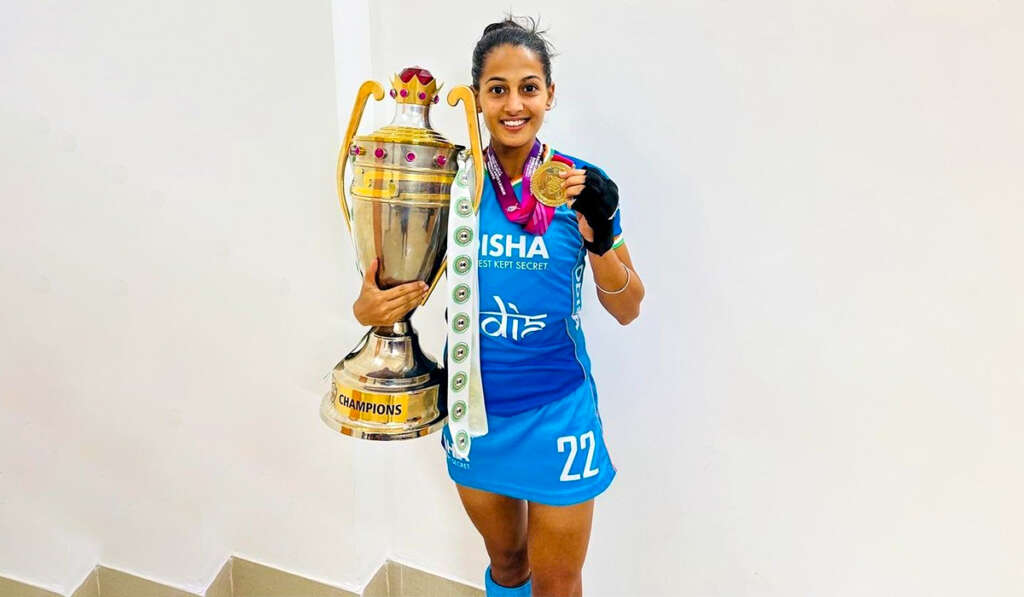
“Not going to Delhi, must go to my village first”
After winning the gold medal, one statement by Baljeet drew special attention.
In a video shared by Hockey India, she can be heard saying:
“I don’t want to go to Delhi, I have to go to my village first, we are heading to Punjab taking the medal.”
She said that bringing the medal home for Punjab makes this achievement even more special. The video went viral on social media.
This statement perhaps describes her entire journey in the simplest way.
The story of hockey that started from Kakka Kandiala has now reached the Asian Games gold medal. But for Baljeet, the village is still the centre of that story.
She wishes for the village children to have good playgrounds and facilities, so that they can turn towards sports and stay away from drugs. This wish is also connected to her own journey—because she too started her journey from a rural environment.
Therefore, Baljeet Kaur’s story is not just the story of a gold medal-winning hockey player. It is also the story of a family that, despite limited resources, allowed their daughter to continue playing the sport.
And it is also the story of that village from where a girl started heading towards the hockey field, and now that same girl has become an Asian Games champion.
Leave a Comment