


Why Punjab’s Caste Arithmetic Tells Only Half the Story — and Why the Other Half May Be Changing
The Numbers, Read Fairly
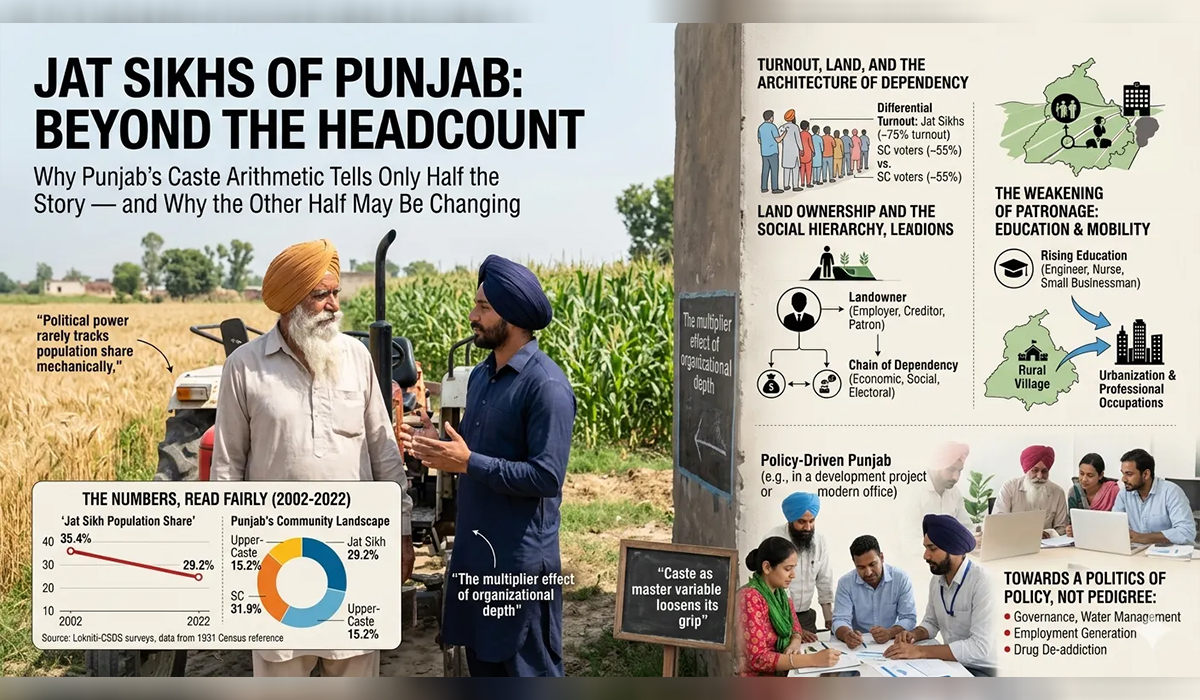
A recent data-journalism piece by IP Singh in the Times of India — “Why Jat Sikhs Dominate Punjab’s Political Space: It’s In The Numbers” — performs a useful public service. Drawing on Lokniti-CSDS surveys stretching from 2002 to 2022, it lays out, with welcome precision, the slow arithmetic erosion of the Jat Sikh population share in Punjab: from 35.4 per cent at the turn of the century to 29.2 per cent two decades later, against a backdrop of 1931 Census figures that once put the community at 37.7 per cent. It sets this against an SC population of 31.9 per cent — the highest proportion of any Indian state — fragmented across caste and denominational lines, and an upper-caste Hindu population of barely 15.2 per cent. The juxtaposition is the article’s real contribution: a politically dominant community that is numerically shrinking, governing alongside a numerically dominant community that remains politically dispersed.
This is sound, sober use of survey data in a domain — caste enumeration — where India has starved itself of hard numbers since 1931. The piece deserves credit for resisting the temptation to either sensationalise or moralise; it lets the table do the talking. Its weakness, if it has one, is the unstated assumption running beneath the numbers: that political power in a democracy tracks population share in any direct or mechanical way. It rarely does. And that gap between demographic weight and political weight is where the more interesting story begins.
Turnout, Land, and the Architecture of Dependency
Three forces other than headcount routinely decide who actually governs. The first is differential turnout. A community’s share of the population matters only as much as its share of the people who actually walk to the booth. Landowning, settled, organisationally embedded communities — and Jat Sikhs in rural Punjab are exactly this — have historically turned out at higher and more disciplined rates than scattered, often economically precarious, urban or semi-urban SC voters whose civic infrastructure of mobilisation is thinner. A 29 per cent population share that votes at 75 per cent turnout outweighs a 32 per cent population share that votes at 55 per cent, long before a single seat is counted.
The second, and more decisive, force is the structural influence of the dominant class — whether that dominance rests on land or on capital. In rural Punjab, land ownership is not merely an economic fact; it is a social architecture. The landowner is employer, creditor, panchayat patron, and often the final word on local dispute resolution, all at once. This produces a chain of dependency — economic, social, even electoral — that runs from landless and marginal-holding households upward to the dominant agrarian caste. A vote cast in a Punjab village is rarely cast in isolation; it is cast inside a web of obligation, patronage, and, not infrequently, quiet pressure. The same logic operates wherever capital substitutes for land — in the urban trading and contracting networks where Khatri, Arora, and Bania influence has historically been disproportionate to their numbers. Political dominance, in other words, is not just counted in heads; it is leveraged through the dependency of those who do not own the land or the capital but live and work within its orbit.
The third force, related to the second, is the multiplier effect of an organisationally and politically active class. A community that has, across generations, supplied a disproportionate share of legislators, ministers, panchayat heads, cooperative society chairpersons, and gurdwara committee office-bearers does not need a numerical majority to set the terms of public life — it only needs to occupy the nodes through which patronage, government schemes, and local dispute resolution actually flow. Political activism compounds; it is itself a resource, accumulated and inherited like land, and it is this accumulated activism — more than the bare population percentage in any Lokniti-CSDS table — that the original article’s numbers are really gesturing toward, even if its own framing stays at the level of headcount.
None of this is unique to Punjab or to Jat Sikhs. It is the general grammar of dominant-caste politics across India, whether in the form of Marathas in Maharashtra, Reddys and Kammas in Andhra and Telangana, or Vokkaligas and Lingayats in Karnataka. Numbers set the outer boundary of what is electorally possible; land, capital, and organisational embeddedness decide what happens inside that boundary.
Education, Mobility, and the Weakening of Patronage
Where, then, does this leave the future? Here a more hopeful trajectory is worth setting against the article’s largely backward-looking arithmetic. The very Lokniti-CSDS data series that documents the Jat Sikh population’s relative decline also points, indirectly, to forces that will reshape — and over time soften — the politics of caste arithmetic altogether: rising education, urbanisation, and inter-caste social mobility. As literacy and tertiary education expand across rural and semi-urban Punjab, as land fragmentation pushes successive generations of Jat Sikh and Dalit Sikh households alike into salaried, professional, and entrepreneurial occupations away from the immediate dependency structures of the village, the patronage chains that convert landownership into bloc votes will weaken. An engineer, a nurse, a small businessman, or a diaspora remittance-receiving household is harder to instruct on whom to vote for than a tenant farmer or a landless labourer is.
Catching Up With Scripture
This dynamic carries a particular resonance within Sikhism itself, whose foundational tenets explicitly reject caste hierarchy. The institution of the Guru ka Langar, the abolition of caste titles for the Khalsa, and the egalitarian vision articulated across the Guru Granth Sahib were never merely theological gestures; they were a social programme, one that Punjab’s politics has, for three centuries, only partially realised. A more educated, more mobile, more economically diversified Sikh society is, in a real sense, a society catching up with its own scripture — moving closer to the casteless ideal that the faith always asked of it, rather than away from some external modern imposition.
Towards a Politics of Policy, Not Pedigree
If this trajectory holds, Punjab’s electorate of the next generation may begin voting less along the lines of caste, religion, and language, and more along the lines of policy: governance delivery, water and power management, drug de-addiction outcomes, fiscal health, and employment generation. That would not eliminate identity from Punjab’s politics — no democracy fully does — but it would loosen its grip as the master variable. The community that currently translates land and organisational depth into outsized political reach, and the communities that currently lack the numbers to convert their numerical weight into commensurate power, would both find themselves competing on a more common ground: the ground of ideas, delivery, and policy preference.
The original article was right to insist that the numbers matter and that they are changing. But numbers are the floor of democratic politics, not its ceiling. What happens on the floor — who turns out, who depends on whom, and who has spent generations building the organisational muscle to convert presence into power — usually matters more than the census table. The genuinely optimistic possibility for Punjab is not that one caste’s numerical dominance will simply be replaced by another’s, but that growing education and economic diversification, read alongside Sikhism’s own egalitarian first principles, may over time make caste arithmetic itself a progressively less reliable predictor of who governs Punjab — and policy, finally, the more reliable one.



Leave a Comment