

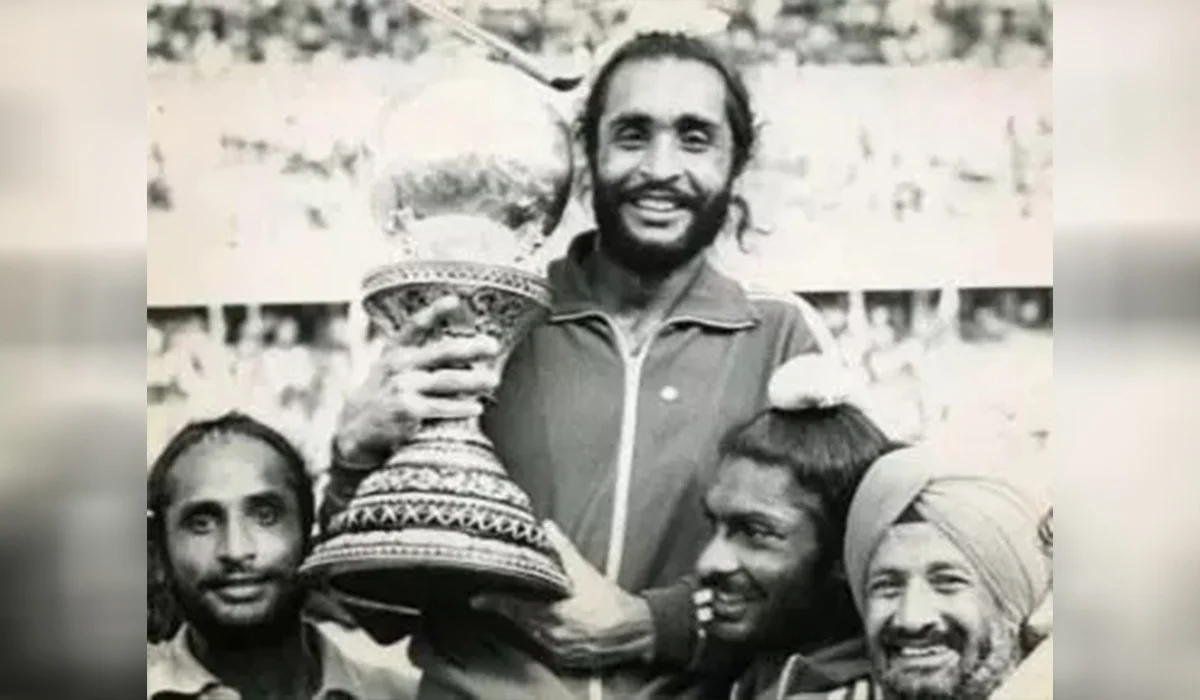

The moment one begins to speak of hockey Olympian Surjit Singh Randhawa, a long, unbroken line of memories stands before the eyes. After Prithipal Singh, Indian hockey found in him a full back as strong as the Great Wall of China. Just as fine a player, just as proud-spirited, and an alert guardian of players’ rights. He was the eldest son of Sardar Maghar Singh Randhawa and Sardarni Joginder Kaur of the small village of Dakhla, which lies on the road near the sugar mill outside Batala. After passing matriculation from Khalsa High School, Batala, Surjit became a student of the Sports School, Jalandhar, and later of Sports College. Guru Nanak Dev University had only just been established then. I remember that the boys from my villages who were interested in hockey looked upon Surjit as a great hope. From his classmates Baljit of Kale Nangal and Joginder of Shampura, I often heard stories of his growing fame. Though both of them were athletes and had come to study at Guru Nanak College, Kala Afghana, they often spoke of Surjit’s powerful sporting talent.
In 1971, I came to Ludhiana to study at GGN Khalsa College. The same year, or perhaps the following one, in the North Zone Inter-University competitions held at the sports grounds of Punjab Agricultural University, the final match was between Punjab University, Chandigarh and Guru Nanak Dev University, Amritsar. In that team were players like Surjit, Varinder, and Baldev. Their team lost to Punjab University, but that day, for the first time, I saw in Surjit’s eyes that redness which belongs to a born winner forced to taste defeat. These three players later became the pride of Indian hockey. All three were members of the victorious 1975 World Cup team. All three, together, once left the Indian hockey team camp in protest to defend the interests of players, and afterward I saw all three play for the Kila Raipur village hockey team at the Manjit Memorial Sports Fair in Dhamot, Ludhiana. The memorable evening spent with Surjit at the house of Professor Kesar Singh Gill of Dhamot still shines brightly in the caravan of memory.
Surjit, Baldev, and Varinder often played for the Kila Raipur hockey team. The real reason was Surjit’s friendship from Sports College days with my life partner Nirpajeet’s elder brother Jagwinder Grewal. Surjit spent many of his holidays there. Playing together, both of them joined Central Railway. They lived in the same room and sketched out the plans of their future together. When Surjit was selected for the Indian hockey team, Jagwinder and the rest of the family distributed sweets in the village. I also remember that when the Indian hockey team returned after winning the 1975 World Cup, the then Chief Minister Giani Zail Singh and Director Sports Balbir Singh Senior brought them to Ludhiana. On the same day, the same team was made to inaugurate the high bridge leading toward Miller Ganj. When this team later played a match against the Russian hockey team at the grounds of Punjab Agricultural University, Surjit introduced all of us to his fellow players Ashok Kumar, Govinda, and Baldev Singh. Surjit was a dear friend who played a key role in one of the most important decisions of my life. In my marriage, it was he who acted as matchmaker on behalf of the Kila Raipur family. In those days he worked with Indian Airlines. For the sake of playing, he had kept his headquarters in Ludhiana. There, at the Arya College sports ground, he practiced with players like Sukhbir Grewal, Gurdeep Singh Mangu, Baldev Singh, and others. Surjit’s contribution in preparing all of them for international competition was immense. Surjit’s life partner Chanchal Randhawa was appointed hockey coach at Government College for Women, Ludhiana. The mornings and evenings spent with Surjit at the house in the lane near the petrol pump at Bharat Nagar Chowk, in the house of Sardar Dalip Singh, still stand before me as treasured memory.
For as long as Surjit played for the Indian hockey team, he played with complete pride and self-respect. It was because of this excellence that Punjab Police directly recruited him as an Inspector and brought him back to Punjab. He left us all behind, departing from a house in the corner of Jalandhar Police Lines that was filled and decorated with medals and international sporting souvenirs. About fifteen days before he breathed his last, I met him along with my friend Darshan Singh Makkar, and he spoke of plans for a benefit match for the welfare of players. The first benefit match was to be held in Surjit’s own honor at Burlton Park, Jalandhar. Along with Surjit, Sports School coach Ram Pratap and basketball coach O.P. Panthe were working on the arrangements. A Pakistani team under Akhtar Rasul was to come. In the final stage of arrangements, Surjit died in a road accident near Vidhipur Chowk while returning from Amritsar. Panthe too died in the same accident, while Ram Pratap had to spend a long time in hospitals with injuries. The dream Surjit had envisioned remains unfulfilled to this day. Since then, not a single benefit match has been held on this soil for the welfare of any player. Even the souvenir for that benefit match had already been printed.
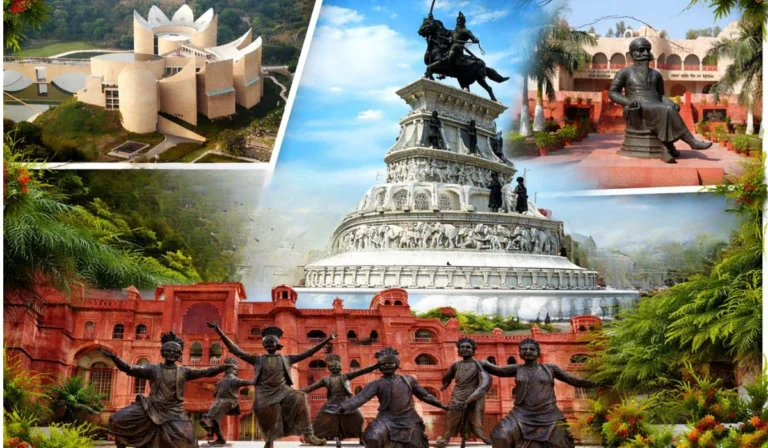
What, then, was it in Surjit that even today grand sports festivals are held in his memory? In Jalandhar, an international-level hockey tournament is organized in his name. Near Batala, in the village Kotla Shahia, players have formed the Surjit Sports Association and have begun construction of a sports complex. In Jarkhar, Ludhiana district, alongside Prithipal Singh, a statue of Surjit Singh has also been installed. As one enters Batala, Surjit’s life-size statue on the Hansli bridge reminds one of that heroic player. Sports writer Sarwan Singh repeatedly salutes Surjit’s manly game in one context after another.
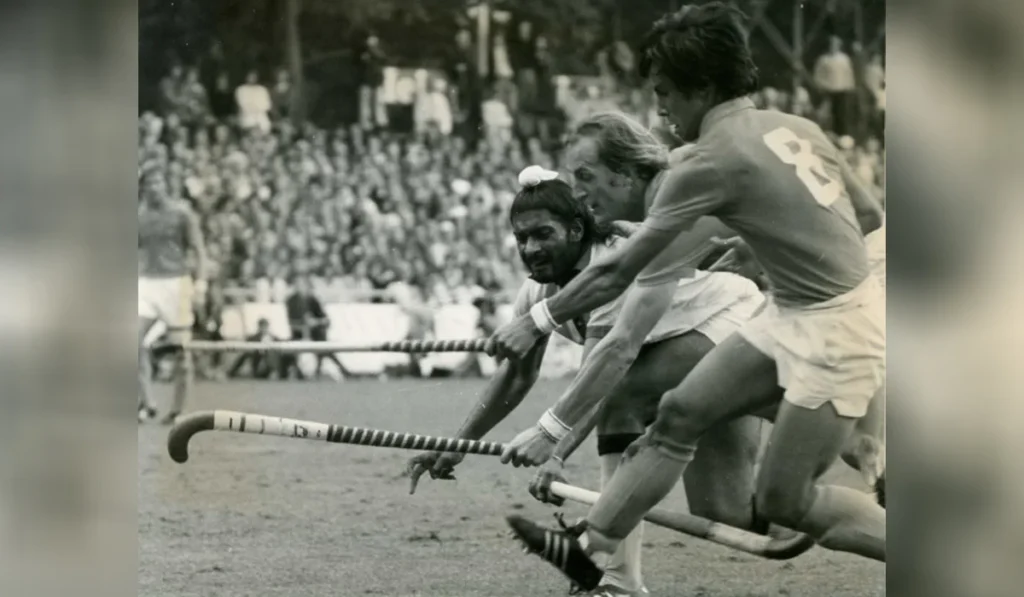
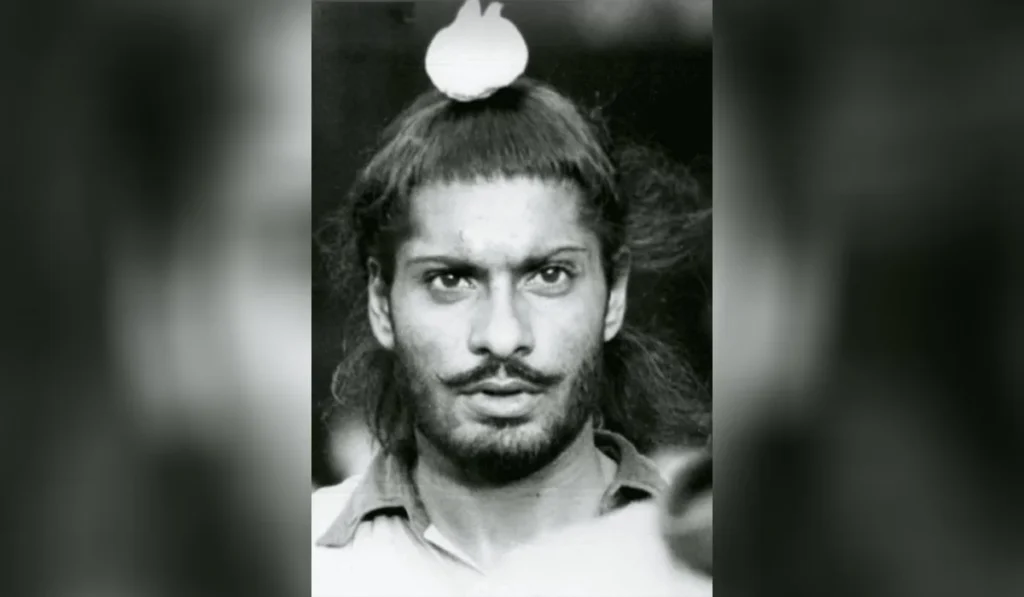
In his time, Surjit was the strongest full back in Indian hockey. Opposing team players, terrified of his hockey stick, considered it wiser to avoid him. His red eyes spread fear in the minds of rival players. Having grown up on the waters of Majha, Surjit did not hesitate to use a forceful style on the field, and Pakistani players felt this danger the most. Surjit was a complete man of style. His way of tying his hair and headcloth was unique. Children would copy his look. I remember my little nephew Navjeet, who began playing hockey after making Surjit his ideal, and tied his hair and cloth in the same way, leaving a few strands flowing in the air at the back, saying, “Look, I have become Surjit uncle now.” In those days Surjit often visited our home in Krishna Nagar, Ludhiana.
When the combined Indian Universities hockey team went on a tour of Australia, Sardar Bal Krishan Singh was their coach. To sharpen his playing skill, Surjit spent twice as much time on the field as the other players. Alone, with grave intensity, he would keep striking goals into the post, building the power of his hit. After Prithipal, he came to be known as the master of the short corner. Surjit was born on 8 October 1951. His village is now called not Dakhla, but Surjit Singh Wala. In the beginning he played center half, and later became a full back. He always regarded his coach Gurdeep Singh as his true mentor. At the age of twenty-two, Surjit was selected for the Indian hockey team. At that time he was a player for Central Railway, Mumbai. In a match held at Amsterdam, Holland, he entered the field for the first time for India, and within the first five or six minutes he had already scored two goals off short corners. The commentators instantly crowned him a world hero. Though the team lost in the final, Surjit’s supremacy was established.
In 1974, at the Asian Games held in Tehran, he played for India. There too, he was included in the All-Asia team, and that team played Europe to a draw. As a member of the Asian All-Star team, he toured Pakistan and India. In 1975, Punjab Chief Minister Giani Zail Singh took responsibility for training the Indian hockey team and arranged a camp at Punjab University, Chandigarh. Punjab’s Director of Sports, and three-time Olympic player Balbir Singh Senior, was appointed coach and manager of the team. No effort was spared in food or training. It was a golden phase for the refinement of Surjit’s game. Sports writer Sarwan Singh often mentions one inner weakness of Surjit: he was quite superstitious. Once, when he was not performing well on the field, sesame and jaggery were brought for him, after which he was perfectly fine. Another famous superstition was that he would never play wearing jersey number four. He considered it unlucky.
He was again selected for the 1976 Olympic Games. Around that time he fell in love with hockey player Chanchal Kohli, and the two were married. He shared a brotherly bond with Ajitpal Singh. It was the chemistry between the two that made short corners deadly: Ajitpal would stop the ball with his hand, and Surjit would take position and hammer the shot. At the Tehran Asian Games, Surjit became the highest goal scorer. By scoring three goals against Sri Lanka, he filled the front pages of newspapers across the world. During a tour of New Zealand, he scored seventeen goals.
It is my good fortune that, living in Ludhiana, I was able to closely know and cherish many moments from the lives of Prithipal Singh and Surjit Singh Randhawa in different periods. During the 1982 Asian Games in New Delhi, Prithipal Singh too was upset with the Indian Olympic Association, and so was Surjit. Prithipal’s contemporary Pakistani player Ghulam Rasul waited for him in New Delhi, but Prithipal did not go there. On returning to Pakistan, Ghulam Rasul met Prithipal at Punjab Agricultural University, Ludhiana. Surjit too was seen off by his fellow players only after they crossed Wagah. In both Surjit and Prithipal, I see a shared thread of emotional intensity and feeling, because of which they found it impossible to move with the mainstream of their times. They would not bow to anyone. Exactly like the hero of Professor Puran Singh’s poem. During preparations for the Buenos Aires World Cup, he, along with Baldev and Varinder, left the camp set up at NIS Patiala and returned home. There was uproar across the world. Players were worried what India would do now. One selector of the hockey team had made some crude remark against Punjab, which deeply offended Surjit. In protest, he said everything that a proud Punjabi was bound to say. Those trying to settle the issue brought Varinder and Baldev back into the team, but Surjit was not recalled. The team lost badly. I too had the chance to sit beside Surjit in Ludhiana and listen to the radio commentary of that humiliating defeat. Radio commentator Jasdev Singh repeatedly remembered Surjit, but Surjit, sitting in Ludhiana, merely ground his teeth in silence.
In the 1978 Bangkok Asian Games, Surjit returned to the Indian team. He played in the final against Pakistan. The radio said that in that match, on one side stood the entire Pakistani team, and on the other stood Surjit alone. Alone he held back the Pakistani side like a general of Majha. After Bangkok, he went to Perth in Australia for an international tournament. Owing to his excellent play, he was made captain of the Indian hockey team. Under his captaincy, India played three exhibition matches against Russia, winning two of them. One of those matches took place in Ludhiana. Under his leadership, the Indian team went to Moscow for the pre-Olympic tournament, where India finished second. In 1980, he was again made captain of the team going to Pakistan to play the Champions Trophy. For nearly a decade and a half, Surjit maintained his supremacy on the international field. He always kept the tips of his thin moustache standing stiff. Surjit’s daughter Cherry was born in Ludhiana. The respected mother of hockey Olympian Sukhbir Grewal, Sardarni Ranjodh Kaur, counted Surjit as her third son. Surjit honored that bond till his last breath. When a son, Hobby, was born in Surjit’s home, both of us went to Jalandhar to see him. It seemed Surjit himself had been born again in his house. The same eyes, the same features, the same face. In every joy and sorrow of our Kila Raipur family, Surjit was present, even in the biggest decisions.
That cursed morning of 1984 still sends a shiver down my spine, when Jagdish Chander Vaidya, Chief News Editor of Doordarshan, came to Punjab Agricultural University, Ludhiana and gave us the terrible news: Surjit was no more. I had never imagined, even in a dream, that he would leave us so soon. Remembering Surjit brings tears to my eyes and a deep ache I now feel alone, for my life partner Nirpajeet, who shared my sorrows, too bid me an eternal farewell in 1993. The songs sung at Surjit’s wedding, and the pictures of the decorated wedding reins, still leave me sorrowful. Surjit is gone, but the memories remain intact.
Leave a Comment