

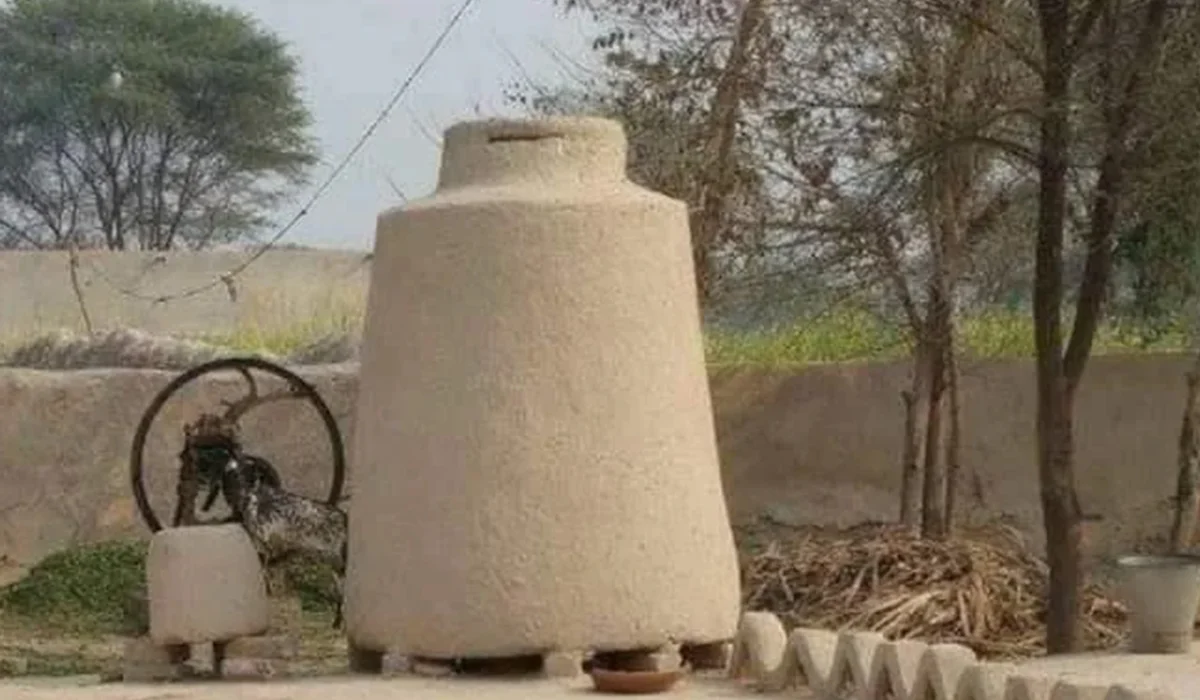

Punjab’s land and its people have always shared a deep, almost spiritual relationship with soil. In earlier times, rural life in Punjab existed close to nature. From the walls of homes to kitchen vessels, everything carried the artistic touch of clay. This art was not merely decoration. It reflected Punjabi women’s creativity, patience, and affection for family.
One of the finest examples of this tradition was the ਭੜੋਲਾ (Bharola).
In the days before iron drums and steel storage tanks became common, large clay-built bharole were used to preserve grains such as wheat, maize, and pulses. These structures were usually built inside the house or near the kitchen so the grain remained protected from moisture and pests.
A Bharola Was Never Built in a Day
Creating a bharola was a skilled and labour-intensive process. Punjabi women prepared a thick mixture using fine clay, straw, and sometimes cow dung. The straw strengthened the structure and prevented cracks after drying. The structure was built layer by layer. One layer was shaped and allowed to dry before another was added. This gradual process gave the bharola both durability and form. But its beauty was not only practical.
While the clay remained slightly wet, women decorated the surface with their fingertips, creating intricate patterns. Triangles, circles, and geometric forms appeared across its surface, becoming an early expression of Indian geometric folk art.
Why Were Birds Carved on Bharole?

Decorative carvings often included peacocks, doves, parrots, flowers, and vines. These motifs symbolised prosperity, abundance, and blessings. Once fully dry, the structure was coated with white clay, which highlighted the carved details and made the artwork stand out. Elders recall that clay art extended far beyond bharole.
Milk processing vessels, decorative hearths (chulhas), cool water pots (gharas), and curd-setting bowls (chattis) were all crafted from clay. Kitchens were regularly coated with white clay, becoming both clean and aesthetically pleasing.
Bharole Were Traditional… But Also Scientific
The bharola was not only cultural heritage. It had practical logic. Clay naturally regulates temperature and moisture, helping grain stay usable for long periods. These structures acted as passive storage systems long before modern preservation techniques existed. Culturally too, a filled bharola represented household prosperity. People believed that a home with full grain stores would never face scarcity.
A Heritage Slowly Disappearing

Today, the visual language of Punjab’s villages has changed. Mud homes have been replaced by concrete houses. Metal tanks and modern storage systems have pushed colourful clay bharole out of everyday life. Many young people may never have seen one. This tradition now survives mostly in old photographs, memories, and museums.
Returning to Our Roots
Clay art once occupied an important place in Punjabi life. It represented simplicity, sustainability, and closeness to nature. Even though lifestyles have changed, the warmth of hand-shaped clay and the intimacy of handmade carving cannot easily be replicated by machines. Perhaps bharole no longer need to return as grain storage. But they can return as memory, design, and identity.
Today, under the language of interior design and heritage revival, these forms can once again find space in Punjabi homes, reminding us that soil was never just a material here. It was culture shaped by hand.


Leave a Comment